The Story
Plant Bio
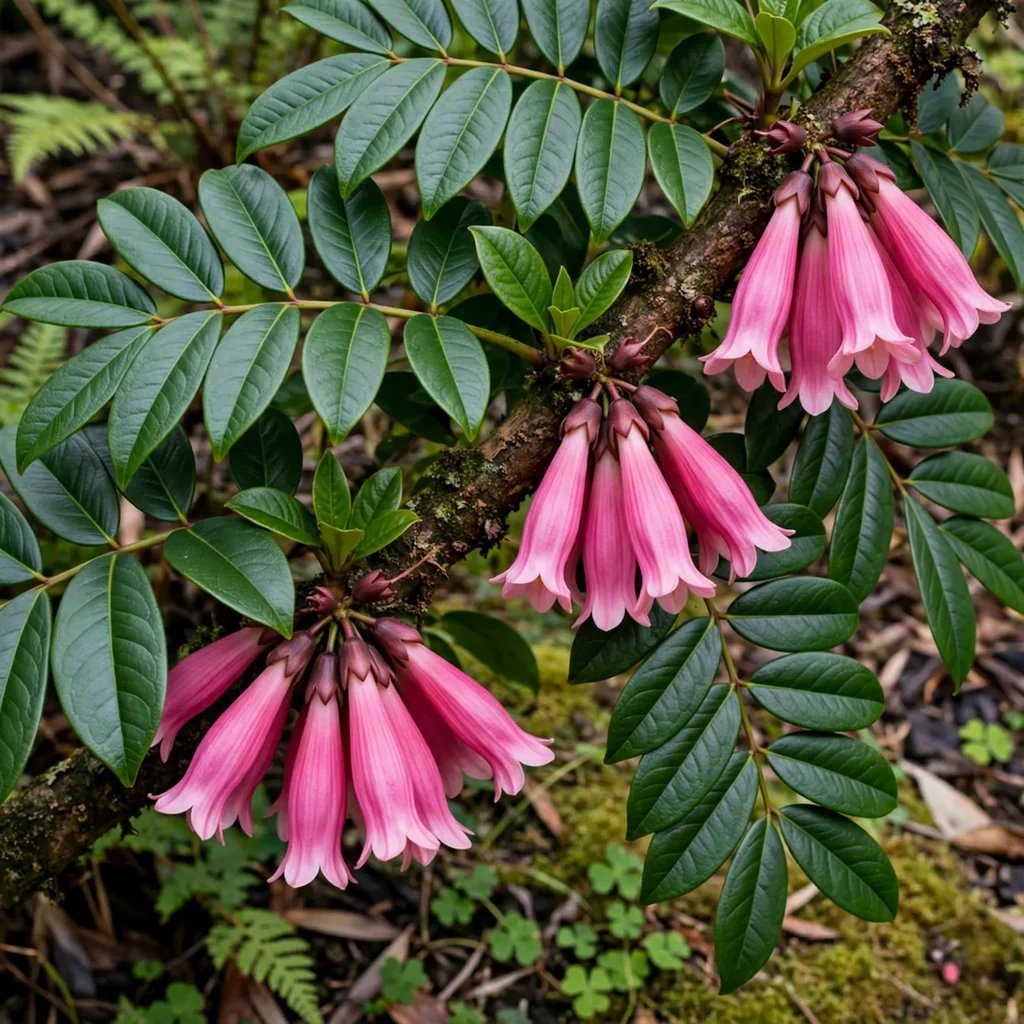
Tecomanthe hillii is a vigorous, woody, evergreen twining vine native to Queensland rainforests, climbing by wrapping around narrow supports and tree trunks. The large, dark green, glossy pinnate leaves provide a dense canopy, while the waxy, pink, bell-shaped flowers emerge in striking clusters directly from the older woody stems rather than new growth.
This species is notable for its cauliflorous flowering habit, where the pendant, trumpet-like blooms erupt directly from mature wood. It is highly sensitive to phosphorus, requiring specialized native plant fertilizers and excellent soil drainage to thrive.
Uses & Benefits:
Essentials
At a Glance
Plant Type
Vine
Height
240"
Width
196"
Light
Full Sun, Partial Sun
Zones
10
Water
Medium
Humidity
High
Lifespan
Perennial
Native To
Australia
Toxicity
Non-toxic
Bloom period
Late winter – Spring
In flower about 4 months of the year
Planting
How to Grow
- Select a planting site with rich, highly organic, well-draining soil that is low in lime.
- Provide a sturdy trellis, pillar, or support structure for the twining stems to climb.
- Maintain consistent soil moisture, ensuring the root system never sits in waterlogged conditions.
- Apply a slow-release, low-phosphorus fertilizer sparingly during the active spring growth phase.
Pro Tip
Never prune aggressively into the old, leafless woody framework, as this destroys the specialized nodes where future flower buds form.
Keep It Thriving
Care Guide
Do
- Prune lightly immediately after flowering to manage size and shape.
- Protect the vine from frost and cold winds, keeping it in a frost-free environment.
- Use a low-phosphorus fertilizer formulated for sensitive native plants.
Don't
- Do not cut back into old, bare wood, which permanently removes flowering nodes.
- Do not use standard high-phosphorus fertilizers, which cause severe toxicity.
- Do not allow the soil to dry out completely or become waterlogged.
Seasonal Care Calendar
| Task | Jan | Feb | Mar | Apr | May | Jun | Jul | Aug | Sep | Oct | Nov | Dec |
|---|---|---|---|---|---|---|---|---|---|---|---|---|
| Fertilize | ||||||||||||
| Pest Check | ||||||||||||
| Propagate | ||||||||||||
| Prune | ||||||||||||
| Winter Prep |
Watch Out For
Pests & Diseases
Common Pests
Common Diseases
In the Garden
Landscape Uses & Companions
Landscape Uses
Multiply
Propagation Methods
Good to Know
Common Questions
Fraser Island Creeper questions
What zones can Fraser Island Creeper grow in?
Fraser Island Creeper is hardy in USDA Zone 10. Inside that range it survives winter in the ground; outside it, grow it as an annual or a container plant you protect.
When does Fraser Island Creeper bloom?
Fraser Island Creeper typically blooms in late winter through spring. Exact timing shifts a week or two with your zone — Sow's bloom calendar maps it to your garden.
Does Fraser Island Creeper need full sun?
Fraser Island Creeper does best in full sun to part shade. In hot climates, afternoon shade keeps blooms fresher longer.
Keep exploring
Explore the genus
Hardy in your zone?
Grow Fraser Island Creeper with confidence
See it in a design of your actual yard, get zone-matched care reminders, and track it season by season in your garden journal.