The Story
Plant Bio
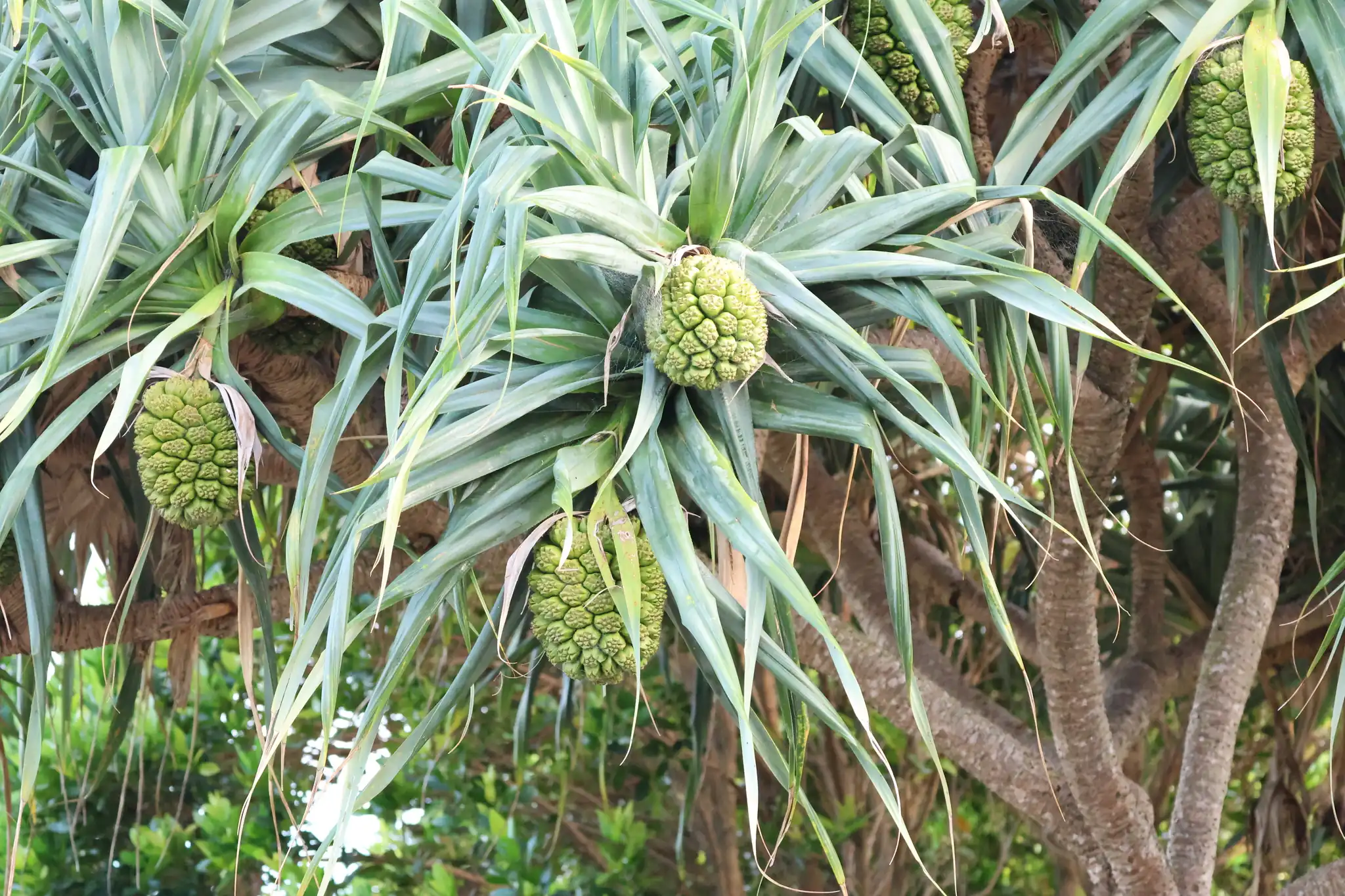
Pandanus tectorius, commonly known as the screw pine, is an erect, multi-branched tropical tree distinguished by its prominent, architectural aerial prop roots and ring-scarred grey trunk. Spirally arranged, sword-shaped leaves crowd the branch tips, creating a dense, palm-like evergreen canopy.
The species is dioecious, bearing fragrant male clusters with showy cream bracts or compact female heads that mature into large, pineapple-like orange-red fruits. Its rigid, light green foliage features sharp, spiny margins and midribs that require careful handling.
Uses & Benefits:
Essentials
At a Glance
Plant Type
Tree
Height
240"
Width
180"
Light
Full Sun, Partial Sun
Zones
10
Water
Low to moderate
Humidity
High
Lifespan
Long-lived
Native To
Southeast Asia, Australia, Pacific Islands
Toxicity
Skin irritant (spines)
Bloom period
Spring – Summer
In flower about 6 months of the year
Planting
How to Grow
- Select a planting site in full sun to partial shade with exceptionally well-drained, sandy or rocky soil.
- Dig a hole twice as wide as the root ball but no deeper, ensuring the plant sits at its original nursery depth.
- Backfill with native soil, press firmly to stabilize the prop roots, and water deeply to settle the ground.
- Apply a light layer of organic mulch around the base, keeping it clear of the trunk and prop roots to prevent rot.
Pro Tip
Never prune into old, leafless wood to expose the trunk; this species lacks latent buds on mature stems, and aggressive stripping of lower leaves causes permanent dieback.
Keep It Thriving
Care Guide
Do
- Plant in loose, sandy soil that drains rapidly.
- Wear thick leather gloves when pruning or handling the spiny foliage.
- Allow the lower leaves to drape naturally to protect the trunk.
Don't
- Never prune into bare, old wood, as the plant cannot regenerate from old stems.
- Do not overwater or plant in heavy clay soils that retain standing water.
- Avoid exposing the plant to freezing temperatures or frost.
Seasonal Care Calendar
| Task | Jan | Feb | Mar | Apr | May | Jun | Jul | Aug | Sep | Oct | Nov | Dec |
|---|---|---|---|---|---|---|---|---|---|---|---|---|
| Fertilize | ||||||||||||
| Pest Check | ||||||||||||
| Propagate | ||||||||||||
| Prune |
Watch Out For
Pests & Diseases
Common Pests
Common Diseases
In the Garden
Landscape Uses & Companions
Landscape Uses
Companion Plants
Multiply
Propagation Methods
Good to Know
Common Questions
Screw Pine questions
What zones can Screw Pine grow in?
Screw Pine is hardy in USDA Zone 10. Inside that range it survives winter in the ground; outside it, grow it as an annual or a container plant you protect.
When does Screw Pine bloom?
Screw Pine typically blooms in spring through summer. Exact timing shifts a week or two with your zone — Sow's bloom calendar maps it to your garden.
Does Screw Pine need full sun?
Screw Pine does best in full sun to part shade. In hot climates, afternoon shade keeps blooms fresher longer.
Is Screw Pine drought tolerant?
Yes — once established (usually after the first full season), Screw Pine handles dry spells with minimal watering. Water deeply its first year to build the root system that makes that possible.
Keep exploring
Explore the genus
Hardy in your zone?
Grow Screw Pine with confidence
See it in a design of your actual yard, get zone-matched care reminders, and track it season by season in your garden journal.