
The Story
Plant Bio
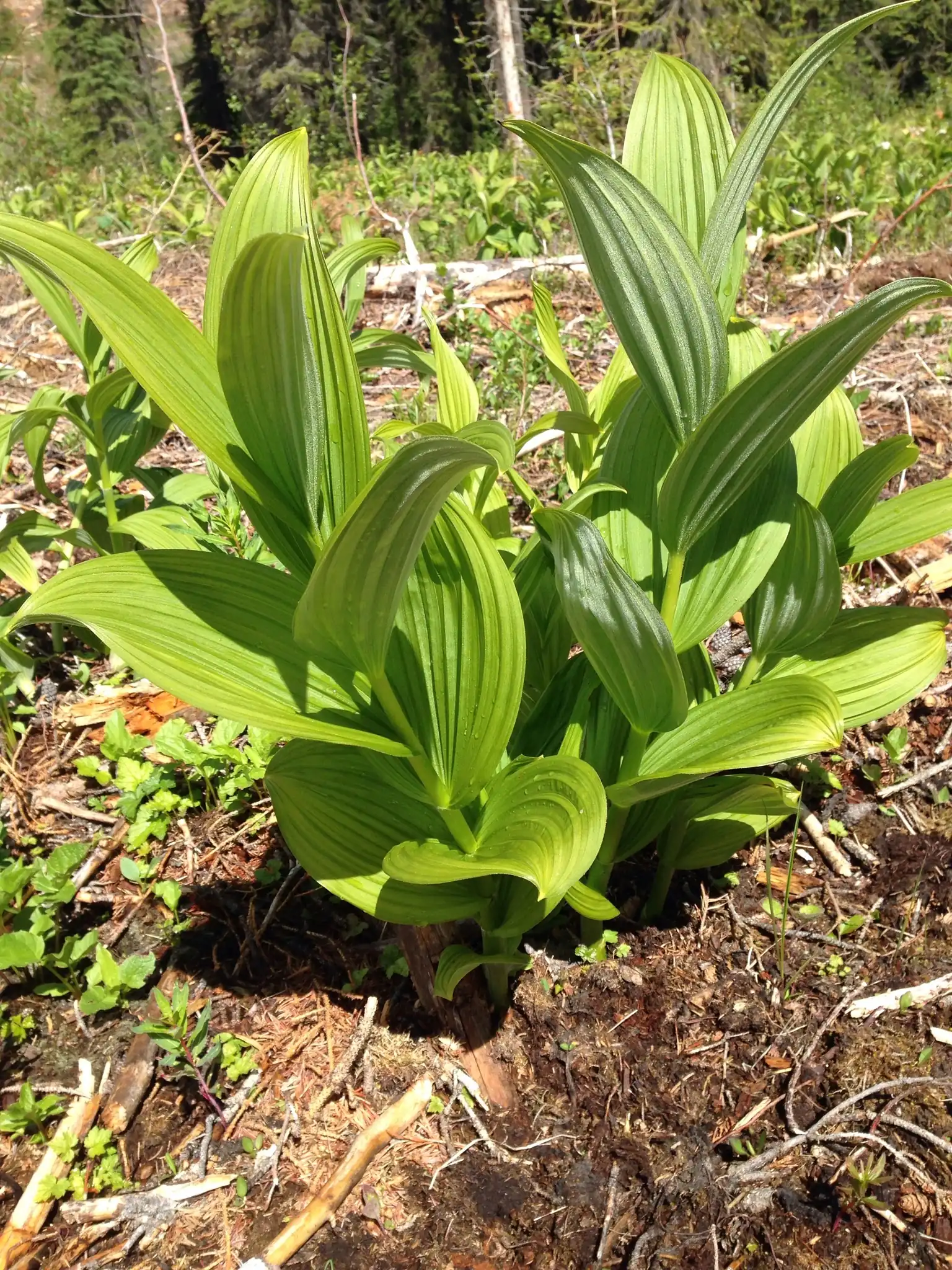
Veratrum viride, green false hellebore, is a stout herbaceous perennial native across Alaska, Canada and the northern United States, reaching two to six feet. Broad pleated leaves up to a foot long clasp a thick downy stem in a distinctive spiral, and branched panicles of small yellow-green star-shaped flowers open in late spring above the foliage.
It is one of the most poisonous plants on the continent: every part contains steroidal alkaloids that slow the heart and depress breathing, and serious poisonings happen most often in spring when the emerging shoots are mistaken for ramps or skunk cabbage. As a garden plant it is genuinely handsome in wet shade, but it belongs nowhere near foragers, children or livestock.
Uses & Benefits:
Essentials
At a Glance
Plant Type
Perennial
Height
48"
Width
18"
Light
Partial Sun, Shade
Zones
4, 5, 6, 7
Water
High
Humidity
High
Lifespan
Perennial
Native To
Alaska, Canada and the northern United States
Toxicity
Highly toxic if ingested
Planting
How to Grow
- Plant in spring in consistently wet, humus-rich soil.
- Choose dappled or partial shade.
- Site it well away from vegetable beds and foraging areas.
- Keep the soil wet; it grows naturally in seeps and stream margins.
- Wear gloves when handling; the sap is an irritant.
- Leave undisturbed — it is slow to establish and resents moving.
Pro Tip
Label it clearly and site it away from anywhere anyone forages — its spring shoots are the classic dangerous lookalike for ramps.
Keep It Thriving
Care Guide
Do
- Keep the soil consistently wet 💧
- Plant in dappled or partial shade 🌱
- Wear gloves when handling 🧤
- Label it clearly if anyone forages nearby ⚠️
Don't
- Let it dry out ❌
- Plant near vegetable beds or foraging ground ❌
- Let children, pets or livestock near it ❌
Seasonal Care Calendar
| Task | Jan | Feb | Mar | Apr | May | Jun | Jul | Aug | Sep | Oct | Nov | Dec |
|---|---|---|---|---|---|---|---|---|---|---|---|---|
| Prune |
Watch Out For
Pests & Diseases
Common Pests
Common Diseases
In the Garden
Landscape Uses & Companions
Landscape Uses
Multiply
Propagation Methods
Good to Know
Common Questions
American False Hellebore questions
What zones can American False Hellebore grow in?
American False Hellebore is hardy in USDA Zones 4–7. Inside that range it survives winter in the ground; outside it, grow it as an annual or a container plant you protect.
Is American False Hellebore deer resistant?
Yes — American False Hellebore is rated deer-resistant. Deer typically pass it over, though extreme hunger can override any plant's defenses.
When does American False Hellebore bloom?
American False Hellebore typically blooms in late spring through early summer. Exact timing shifts a week or two with your zone — Sow's bloom calendar maps it to your garden.
Does American False Hellebore need full sun?
American False Hellebore does best in part shade.
Keep exploring
Explore the genus
Hardy in your zone?
Grow American False Hellebore with confidence
See it in a design of your actual yard, get zone-matched care reminders, and track it season by season in your garden journal.