The Story
Plant Bio
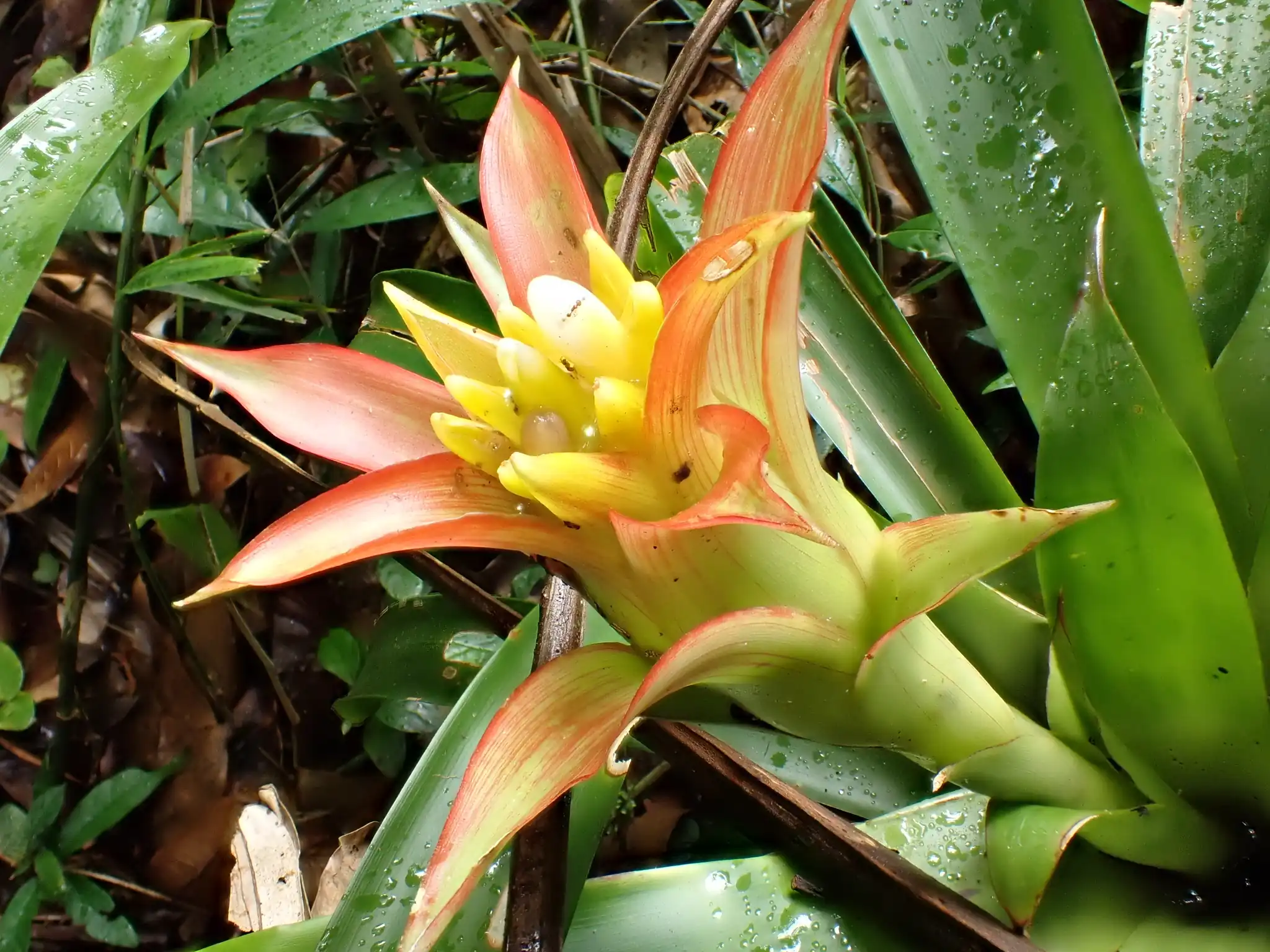
Guzmania lingulata is an evergreen, stemless epiphytic perennial native to the tropical rainforests of Central and South America. It forms a symmetrical, funnel-shaped basal rosette of glossy green leaves designed to collect water and organic debris in its central cup.
This species is distinguished by its long-lasting, star-like inflorescence of vibrant scarlet, orange, or yellow floral bracts rising from the center of the rosette. Nestled deep within these colorful bracts are small, inconspicuous white or yellow flowers that open sequentially over several weeks.
Uses & Benefits:
Essentials
At a Glance
Plant Type
Tropical
Height
24"
Width
24"
Light
Partial Sun, Shade
Zones
10
Water
Moderate
Humidity
High
Lifespan
Perennial
Native To
Central and South America
Toxicity
Non-toxic
Bloom period
Summer
In flower about 3 months of the year
Planting
How to Grow
- Select a small container with excellent drainage holes and fill it with a coarse, porous epiphytic medium such as orchid bark mixed with peat and perlite.
- Position the plant in a location that receives bright, indirect light or dappled shade, avoiding direct hot afternoon sun which burns the foliage.
- Fill the central rosette cup with rainwater or distilled water, keeping it topped up while allowing the potting medium to dry slightly between light waterings.
- Maintain high humidity levels around the plant by misting the leaves regularly or placing the pot on a tray filled with wet pebbles.
Pro Tip
Never allow the potting medium to remain soggy, as the roots of this epiphyte function primarily for anchorage and rot quickly in waterlogged soil.
Keep It Thriving
Care Guide
Do
- Flush the central water reservoir regularly to prevent stagnation.
- Use a highly porous, fast-draining potting mix designed for orchids or bromeliads.
- Keep the surrounding air humid by misting or using a humidifier.
Don't
- Do not use heavy garden soil or standard potting mix which suffocates the roots.
- Do not pour fertilizer directly into the central cup unless it is diluted to less than one-quarter strength.
- Do not expose the plant to freezing temperatures or cold drafts.
Seasonal Care Calendar
| Task | Jan | Feb | Mar | Apr | May | Jun | Jul | Aug | Sep | Oct | Nov | Dec |
|---|---|---|---|---|---|---|---|---|---|---|---|---|
| Fertilize | ||||||||||||
| Pest Check | ||||||||||||
| Propagate | ||||||||||||
| Winter Prep |
Watch Out For
Pests & Diseases
Common Pests
Common Diseases
In the Garden
Landscape Uses & Companions
Landscape Uses
Companion Plants
Multiply
Propagation Methods
Good to Know
Common Questions
Scarlet Star questions
What zones can Scarlet Star grow in?
Scarlet Star is hardy in USDA Zone 10. Inside that range it survives winter in the ground; outside it, grow it as an annual or a container plant you protect.
When does Scarlet Star bloom?
Scarlet Star typically blooms in summer through summer. Exact timing shifts a week or two with your zone — Sow's bloom calendar maps it to your garden.
Does Scarlet Star need full sun?
Scarlet Star does best in part shade.
Keep exploring
Explore the genus
Hardy in your zone?
Grow Scarlet Star with confidence
See it in a design of your actual yard, get zone-matched care reminders, and track it season by season in your garden journal.