The Story
Plant Bio
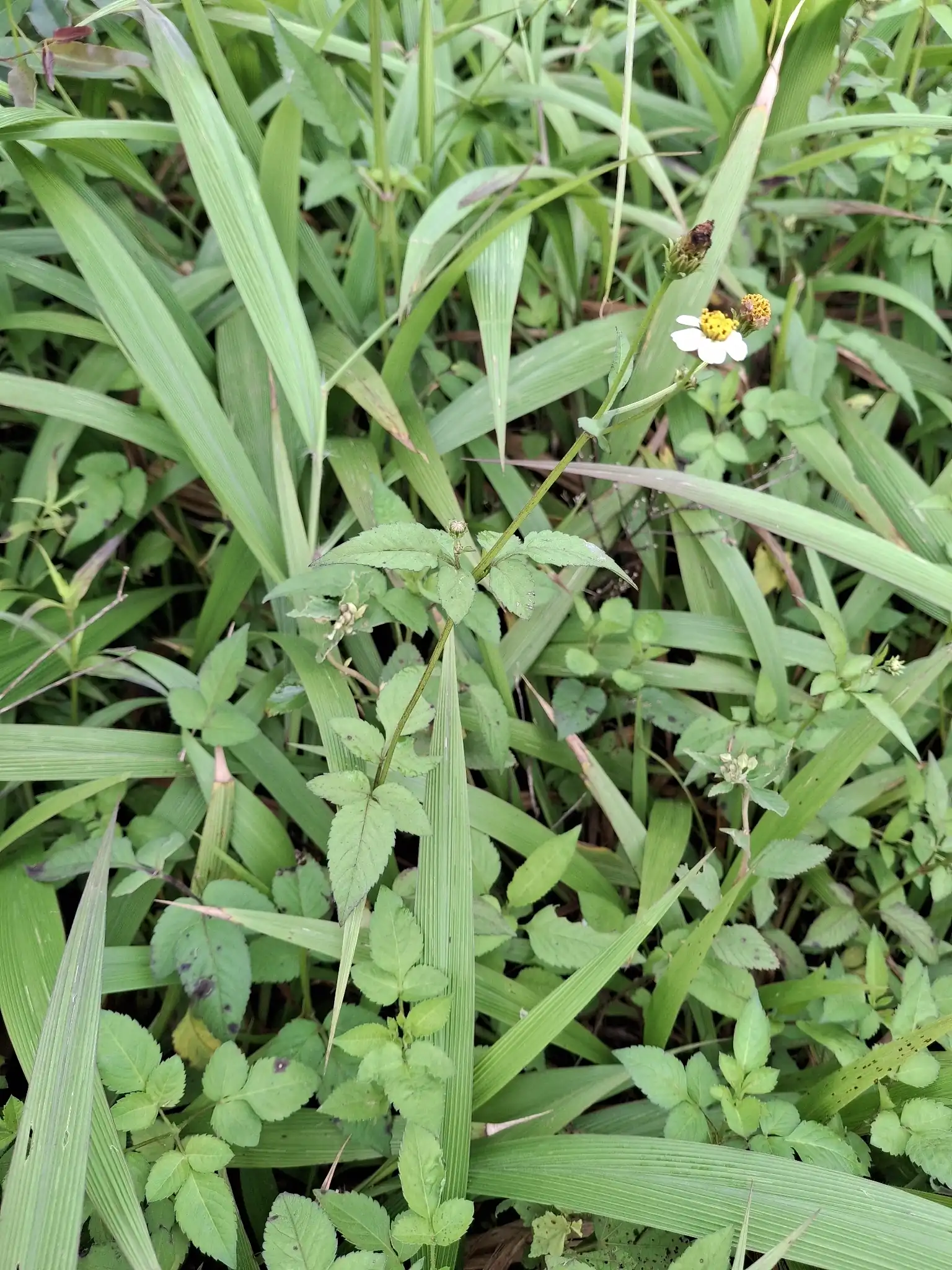
Bidens pilosa is an erect annual or short-lived perennial herb native to tropical and subtropical America, reaching heights of twelve to forty inches. The opposite leaves are primarily trifoliate or pinnate with toothed margins, supported by stems that range from smooth to densely hairy.
The plant produces small flower heads containing tubular yellow disk florets, which are either completely rayless or bordered by tiny, short-lived white rays. Each flower head matures into dozens of four-angled, barbed seeds that aggressively cling to passing animals and clothing.
Uses & Benefits:
Essentials
At a Glance
Plant Type
Annual
Height
40"
Width
24"
Light
Full Sun, Partial Sun
Zones
8, 9, 10
Water
Low to Moderate
Humidity
High
Lifespan
Annual or short-lived perennial
Native To
Tropical and Subtropical America
Toxicity
Non-toxic but causes mechanical irritation from barbed seeds
Bloom period
Summer – Fall
In flower about 6 months of the year
Planting
How to Grow
- Identify seedlings in spring by their opposite, toothed, trifoliate leaves and erect, square stems.
- Hand-pull young plants from moist soil before the taproot establishes deeply.
- Cut back mature stands to ground level before flower buds open to disrupt the seed cycle.
- Dispose of cleared plants securely in sealed bags rather than composting to prevent seed survival.
Pro Tip
Mow or hand-pull plants before the yellow flower heads fade to prevent the development of the barbed, self-dispersing seeds.
Keep It Thriving
Care Guide
Do
- Monitor disturbed soil and garden edges regularly for emerging seedlings.
- Wear thick gloves and protective clothing when clearing mature plants to avoid skin punctures from the barbed seeds.
- Bag and discard all flowering stems immediately after cutting.
Don't
- Do not allow flower heads to mature and set seed in cultivated garden beds.
- Do not add seed-bearing stems to home compost piles where temperatures fail to destroy the seeds.
- Do not apply supplemental fertilizer, which only triggers rapid, rank weed growth.
Seasonal Care Calendar
| Task | Jan | Feb | Mar | Apr | May | Jun | Jul | Aug | Sep | Oct | Nov | Dec |
|---|---|---|---|---|---|---|---|---|---|---|---|---|
| Pest Check | ||||||||||||
| Prune | ||||||||||||
| Spring Cleanup | ||||||||||||
| Winter Prep |
Watch Out For
Pests & Diseases
Common Pests
Common Diseases
In the Garden
Landscape Uses & Companions
Landscape Uses
Multiply
Propagation Methods
Good to Know
Common Questions
Hairy Beggar-Ticks questions
What zones can Hairy Beggar-Ticks grow in?
Hairy Beggar-Ticks is hardy in USDA Zones 8–10. Inside that range it survives winter in the ground; outside it, grow it as an annual or a container plant you protect.
Is Hairy Beggar-Ticks deer resistant?
Yes — Hairy Beggar-Ticks is rated deer-resistant. Deer typically pass it over, though extreme hunger can override any plant's defenses.
When does Hairy Beggar-Ticks bloom?
Hairy Beggar-Ticks typically blooms in summer through fall. Exact timing shifts a week or two with your zone — Sow's bloom calendar maps it to your garden.
Does Hairy Beggar-Ticks need full sun?
Hairy Beggar-Ticks does best in full sun to part shade. In hot climates, afternoon shade keeps blooms fresher longer.
Is Hairy Beggar-Ticks drought tolerant?
Yes — once established (usually after the first full season), Hairy Beggar-Ticks handles dry spells with minimal watering. Water deeply its first year to build the root system that makes that possible.
More Bidens to compare

Keep exploring
Explore the genus
Hardy in your zone?
Grow Hairy Beggar-Ticks with confidence
See it in a design of your actual yard, get zone-matched care reminders, and track it season by season in your garden journal.