The Story
Plant Bio
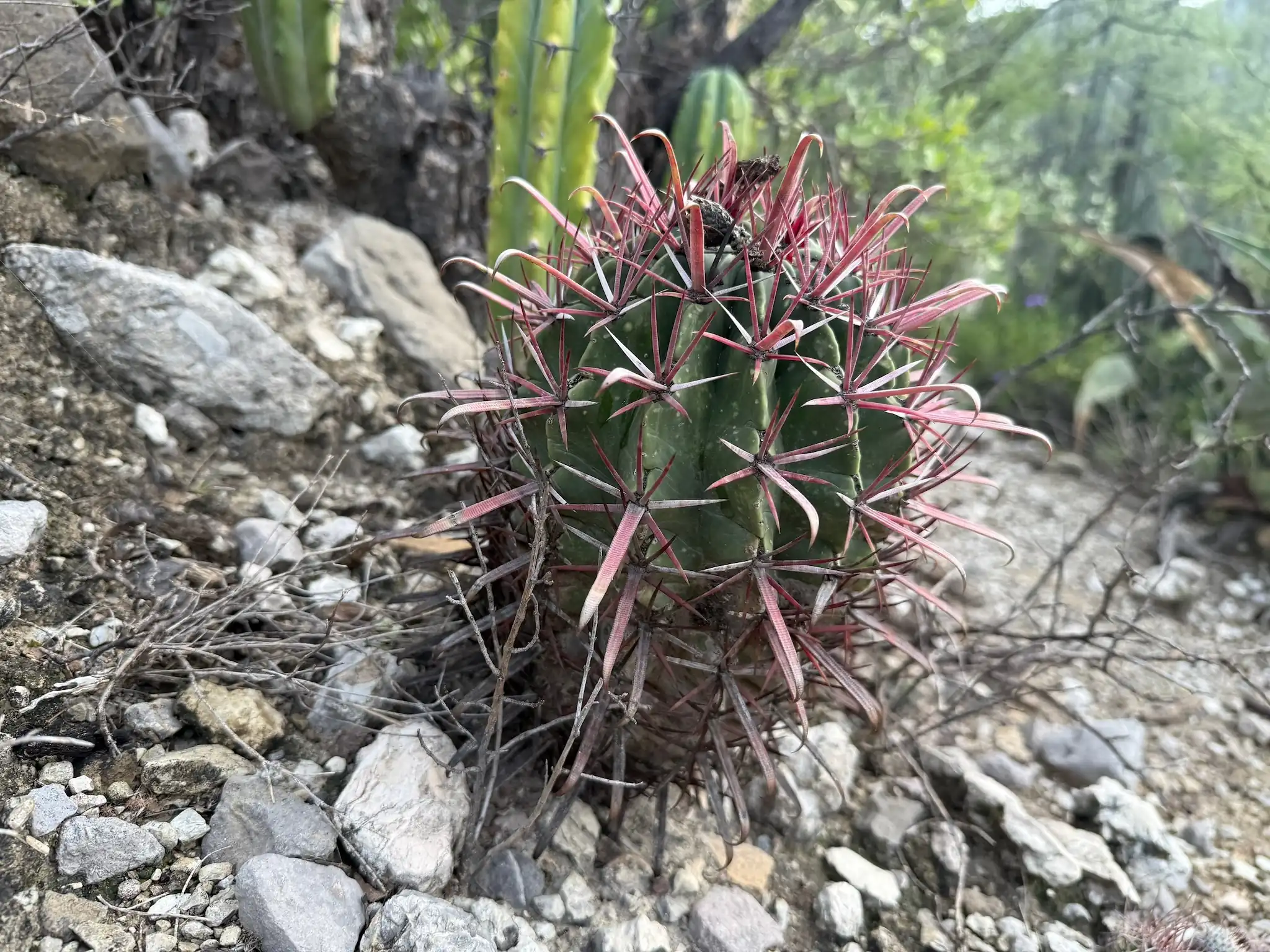
Ferocactus latispinus is a solitary, globose barrel cactus native to the desert highlands of Mexico, reaching twelve inches in height under typical cultivation. The bluish-green succulent body features fifteen to twenty-three prominent, sharp ribs armed with wide, flattened central spines that hook sharply downward.
New spines emerge in a vivid red or pinkish-red hue before maturing to gray, creating a striking contrast against the green stem. Funnel-shaped flowers in shades of rose, purple, or violet open at the flattened apex during late fall and early winter.
Uses & Benefits:
Essentials
At a Glance
Plant Type
Cactus Succulent
Height
12"
Width
16"
Light
Full Sun
Zones
9, 10
Water
Low
Humidity
Low
Lifespan
Perennial
Native To
Mexico
Toxicity
Non-toxic (spines present physical hazard)
Bloom period
Late fall – Early winter
In flower about 2 months of the year
Planting
How to Grow
- Select a container with multiple drainage holes and fill it with a mineral-based mix containing seventy to eighty percent coarse grit, pumice, or perlite.
- Position the cactus in a location receiving at least four to six hours of direct daily sunlight to maintain dense spine color and a compact shape.
- Water thoroughly during the spring and summer active growth phases, allowing the potting medium to dry out completely between applications.
- Withhold all water entirely during the cold winter dormancy period to prevent root rot when temperatures drop.
Pro Tip
Surround the root collar with pure mineral grit rather than organic mulch or compost; burying the stem base in organic material traps moisture and triggers fatal rot.
Keep It Thriving
Care Guide
Do
- Grow in a highly porous, fast-draining mineral substrate.
- Provide a minimum of four to six hours of direct daily sunlight.
- Keep the soil completely dry during winter dormancy.
- Ensure excellent air circulation to prevent fungal issues.
Don't
- Do not water during cold winter temperatures.
- Do not plant the stem collar below the soil line or surround it with organic mulch.
- Do not use heavy, moisture-retentive garden soils or standard potting mixes.
- Do not prune the plant except to remove dead or damaged tissue.
Seasonal Care Calendar
| Task | Jan | Feb | Mar | Apr | May | Jun | Jul | Aug | Sep | Oct | Nov | Dec |
|---|---|---|---|---|---|---|---|---|---|---|---|---|
| Fertilize | ||||||||||||
| Pest Check | ||||||||||||
| Propagate | ||||||||||||
| Winter Prep |
Watch Out For
Pests & Diseases
Common Pests
Common Diseases
In the Garden
Landscape Uses & Companions
Landscape Uses
Multiply
Propagation Methods
Good to Know
Common Questions
Devil's Tongue Barrel Cactus questions
What zones can Devil's Tongue Barrel Cactus grow in?
Devil's Tongue Barrel Cactus is hardy in USDA Zones 9–10. Inside that range it survives winter in the ground; outside it, grow it as an annual or a container plant you protect.
Is Devil's Tongue Barrel Cactus deer resistant?
Yes — Devil's Tongue Barrel Cactus is rated deer-resistant. Deer typically pass it over, though extreme hunger can override any plant's defenses.
When does Devil's Tongue Barrel Cactus bloom?
Devil's Tongue Barrel Cactus typically blooms in late fall through early winter. Exact timing shifts a week or two with your zone — Sow's bloom calendar maps it to your garden.
Does Devil's Tongue Barrel Cactus need full sun?
Devil's Tongue Barrel Cactus does best in full sun (6+ hours).
Is Devil's Tongue Barrel Cactus drought tolerant?
Yes — once established (usually after the first full season), Devil's Tongue Barrel Cactus handles dry spells with minimal watering. Water deeply its first year to build the root system that makes that possible.
Keep exploring
Explore the genus
Hardy in your zone?
Grow Devil's Tongue Barrel Cactus with confidence
See it in a design of your actual yard, get zone-matched care reminders, and track it season by season in your garden journal.