The Story
Plant Bio
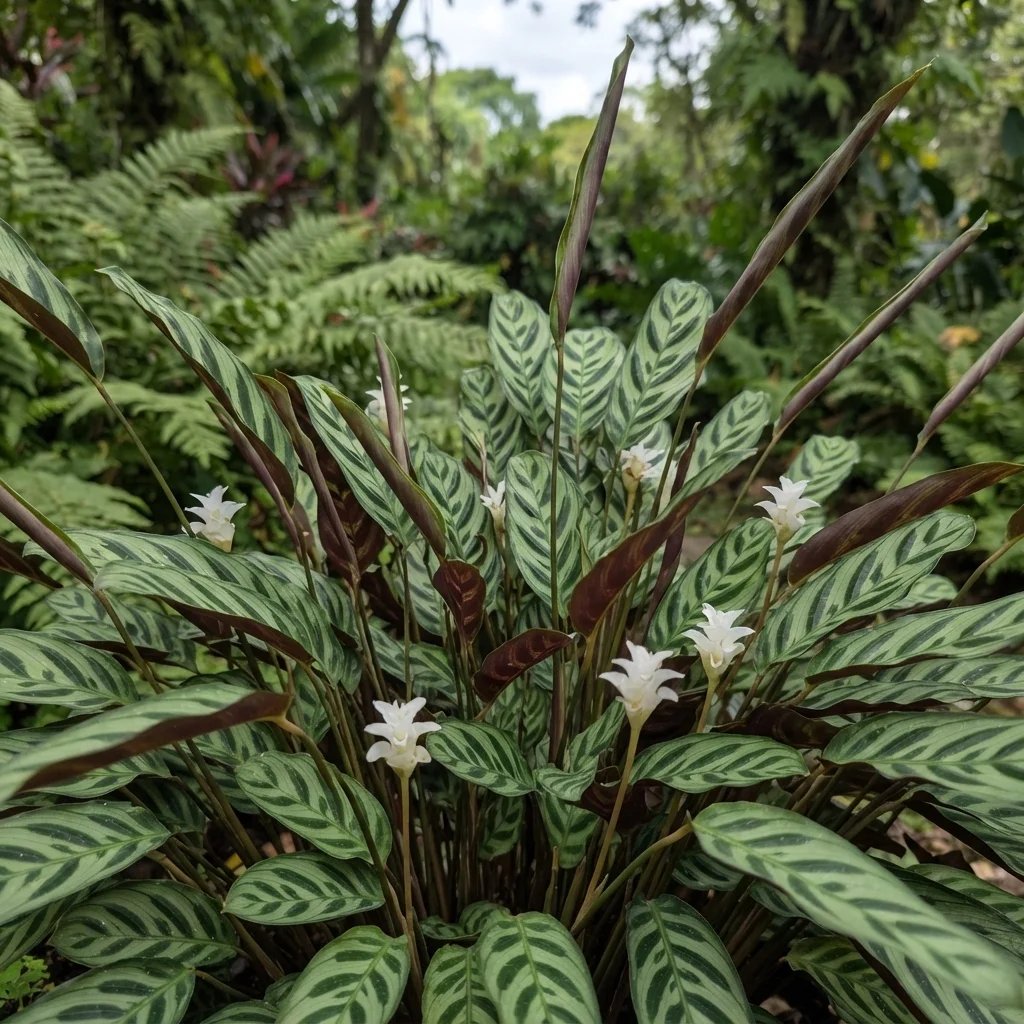
Goeppertia makoyana, widely known under its synonym Calathea makoyana, is an evergreen, clump-forming herbaceous perennial native to the tropical rainforests of eastern Brazil. The plant features a rhizomatous horizontal underground stem that produces upright, slender leaf stems bearing broad, paper-thin, oval leaves.
The glossy pale green leaves display translucent areas and dark green feathered stripes radiating from the central vein, mirrored by a deep purple-red pattern on the undersides. At night, the foliage exhibits nyctinasty, folding vertically upward before opening again the following morning.
Uses & Benefits:
Essentials
At a Glance
Plant Type
Tropical
Height
18"
Width
24"
Light
Shade
Water
High
Humidity
High (60%-80%)
Lifespan
Perennial
Native To
Brazil
Toxicity
Non-toxic
Bloom period
Summer
In flower about 3 months of the year
Planting
How to Grow
- Select a container with ample drainage holes and fill it with a highly porous, peat- or humus-rich potting mix.
- Position the plant in a location that receives bright, indirect light, ensuring complete protection from direct sun to prevent leaf scorch.
- Water thoroughly when the top inch of soil begins to dry, allowing excess water to drain completely from the pot.
- Maintain ambient relative humidity between 60% and 80% using a humidifier or a pebble tray filled with water.
Pro Tip
Irrigate exclusively with distilled, reverse-osmosis, or rainwater, as municipal tap water containing chlorine, fluoride, or dissolved salts triggers severe brown leaf-tip necrosis.
Keep It Thriving
Care Guide
Do
- Use distilled water, rainwater, or reverse-osmosis water to prevent chemical leaf burn.
- Keep the ambient temperature consistently above 61 degrees Fahrenheit to avoid chilling injury.
- Snip away dead or yellowing leaves at the very base of the stem using sterilized shears.
- Maintain high humidity levels to prevent the paper-thin leaves from drying out.
Don't
- Do not allow the pot to sit in standing water, which rapidly induces root rot.
- Do not expose the foliage to direct sunlight, which bleaches the leaf patterns and burns the margins.
- Do not use high-salt synthetic chemical fertilizers that cause leaf-tip burn.
- Do not cut into live, green stem tissue when removing old foliage.
Seasonal Care Calendar
| Task | Jan | Feb | Mar | Apr | May | Jun | Jul | Aug | Sep | Oct | Nov | Dec |
|---|---|---|---|---|---|---|---|---|---|---|---|---|
| Fertilize | ||||||||||||
| Pest Check | ||||||||||||
| Propagate | ||||||||||||
| Prune |
Watch Out For
Pests & Diseases
Common Pests
Common Diseases
In the Garden
Landscape Uses & Companions
Landscape Uses
Companion Plants
Multiply
Propagation Methods
Good to Know
Common Questions
Peacock Plant questions
When does Peacock Plant bloom?
Peacock Plant typically blooms in summer through summer. Exact timing shifts a week or two with your zone — Sow's bloom calendar maps it to your garden.
More Calathea to compare
Keep exploring
Explore the genus
Grow Peacock Plant with confidence
See it in a design of your actual yard, get zone-matched care reminders, and track it season by season in your garden journal.