The Story
Plant Bio
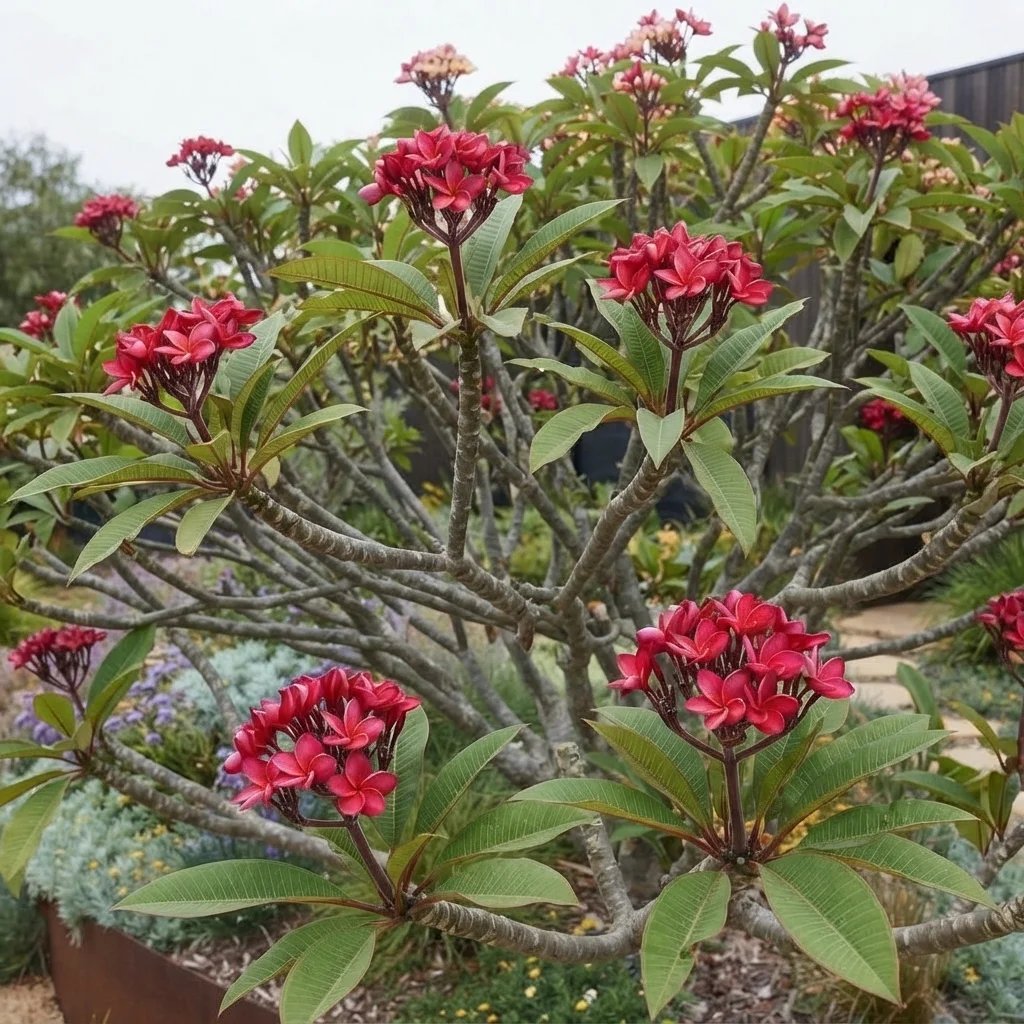
Plumeria rubra, the frangipani, is a deciduous tropical tree or large shrub with thick, succulent, blunt branches containing an abundant milky latex sap. The large, leathery, elliptic leaves cluster in dense whorls at the branch tips, providing a lush backdrop for terminal clusters of highly fragrant, five-petaled flowers.
While wild specimens produce pink to red blooms, cultivated selections expand the palette to include white, yellow, and multi-colored variations. The flowers emerge in late spring and continue in successive flushes through the fall, or year-round in entirely frost-free climates.
Uses & Benefits:
Essentials
At a Glance
Plant Type
Tropical
Height
300"
Width
240"
Light
Full Sun
Zones
10
Water
Low
Humidity
High
Native To
Mexico, Central America, Venezuela
Toxicity
Toxic if ingested; sap causes skin and eye irritation
Bloom period
Late spring – Fall
In flower about 7 months of the year
Planting
How to Grow
- Select a planting site that receives at least six hours of direct daily sunlight to ensure robust flowering.
- Prepare a rich, coarse, sandy or loamy soil mix that drains rapidly to prevent waterlogging around the root zone.
- Water deeply during the active spring and summer growing seasons, allowing the soil to dry out completely between waterings.
- Cease watering entirely in late fall as leaves begin to drop, allowing the plant to enter its dry winter dormancy.
Pro Tip
Withhold all water and fertilizer during the winter deciduous dormancy when the plant is leafless; applying water to dormant roots invariably causes fatal stem and root rot.
Keep It Thriving
Care Guide
Do
- Grow in containers in regions that experience frost so the plant can be moved indoors for winter protection.
- Allow stem cuttings to dry and callus for several days before planting them into a well-draining medium.
- Apply a balanced or high-phosphorus fertilizer during the active spring and summer growing season.
Don't
- Do not water the plant during its winter dormancy when it is devoid of leaves.
- Do not prune blindly into old, leafless wood that lacks visible live nodes.
- Do not allow the plant to sit in standing water or waterlogged, heavy soils.
Seasonal Care Calendar
| Task | Jan | Feb | Mar | Apr | May | Jun | Jul | Aug | Sep | Oct | Nov | Dec |
|---|---|---|---|---|---|---|---|---|---|---|---|---|
| Fertilize | ||||||||||||
| Pest Check | ||||||||||||
| Prune | ||||||||||||
| Winter Prep |
Watch Out For
Pests & Diseases
Common Pests
Common Diseases
In the Garden
Landscape Uses & Companions
Landscape Uses
Companion Plants
Multiply
Propagation Methods
Good to Know
Common Questions
Frangipani questions
What zones can Frangipani grow in?
Frangipani is hardy in USDA Zone 10. Inside that range it survives winter in the ground; outside it, grow it as an annual or a container plant you protect.
When does Frangipani bloom?
Frangipani typically blooms in late spring through fall. Exact timing shifts a week or two with your zone — Sow's bloom calendar maps it to your garden.
Does Frangipani need full sun?
Frangipani does best in full sun (6+ hours).
Is Frangipani drought tolerant?
Yes — once established (usually after the first full season), Frangipani handles dry spells with minimal watering. Water deeply its first year to build the root system that makes that possible.
More Plumeria to compare
Keep exploring
Explore the genus
Hardy in your zone?
Grow Frangipani with confidence
See it in a design of your actual yard, get zone-matched care reminders, and track it season by season in your garden journal.