The Story
Plant Bio
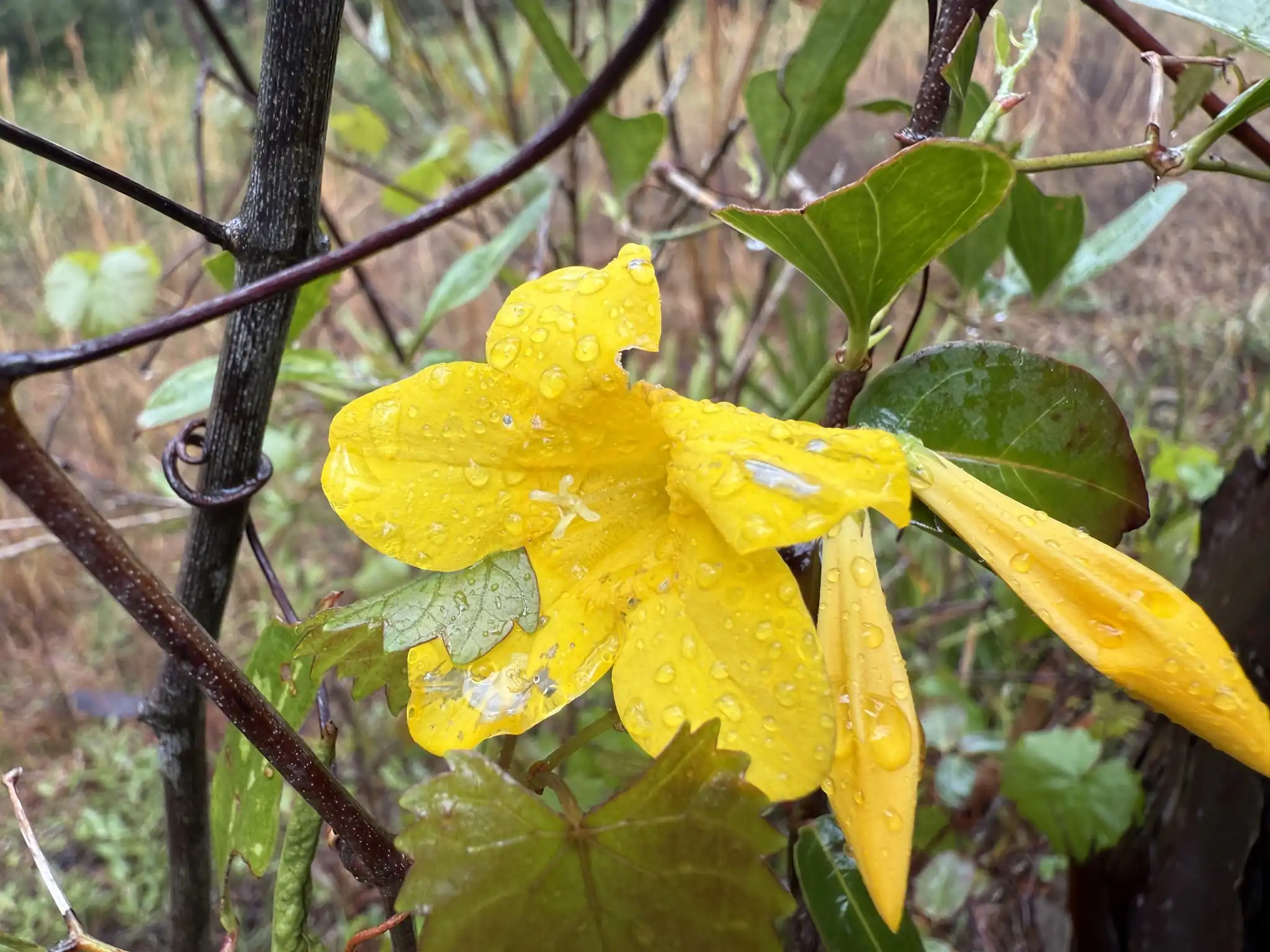
Gelsemium rankinii is a woody, evergreen to semi-evergreen twining vine native to wet habitats across the southeastern United States coastal plain. It produces glossy dark green, lanceolate leaves and bright, unscented, funnel-shaped yellow flowers measuring up to an inch and a half across.
Unlike its upland relative Gelsemium sempervirens, this species thrives in seasonally flooded bottomlands and acidic muck while putting on a heavy secondary bloom flush in fall alongside its spring display. Unsupported plants twist upon themselves to form a dense, mounding shrub shape three to four feet high.
Uses & Benefits:
Essentials
At a Glance
Plant Type
Vine
Height
236"
Width
71"
Light
Full Sun, Partial Sun
Zones
7, 8, 9
Water
High / Wet
Humidity
High
Lifespan
Perennial
Native To
Southeastern United States
Toxicity
High
Bloom period
Spring – Fall
In flower about 9 months of the year
Planting
How to Grow
- Select a planting site in full sun or light shade with rich, acidic soil that stays consistently moist.
- Work organic matter into the planting hole to enhance moisture retention.
- Provide a trellis, fence, or arbor for the stems to climb, or leave open space for mounding growth.
- Water regularly during dry periods to prevent the soil root zone from drying out.
Pro Tip
Prune stems immediately after the spring flowering flush finishes to control growth without cutting off upcoming fall flower buds.
Keep It Thriving
Care Guide
Do
- Keep soil consistently moist to wet.
- Plant in acidic soil with a pH below 6.0.
- Prune immediately after spring flowering.
Don't
- Do not allow the root zone to dry out completely.
- Do not shear deeply into old, leafless woody wood.
- Do not plant where livestock or pets might ingest plant parts.
Seasonal Care Calendar
| Task | Jan | Feb | Mar | Apr | May | Jun | Jul | Aug | Sep | Oct | Nov | Dec |
|---|---|---|---|---|---|---|---|---|---|---|---|---|
| Fertilize | ||||||||||||
| Mulch | ||||||||||||
| Pest Check | ||||||||||||
| Propagate | ||||||||||||
| Prune |
Watch Out For
Pests & Diseases
Common Pests
Common Diseases
In the Garden
Landscape Uses & Companions
Landscape Uses
Companion Plants
Multiply
Propagation Methods
Good to Know
Common Questions
Swamp Jasmine questions
What zones can Swamp Jasmine grow in?
Swamp Jasmine is hardy in USDA Zones 7–9. Inside that range it survives winter in the ground; outside it, grow it as an annual or a container plant you protect.
Is Swamp Jasmine deer resistant?
Yes — Swamp Jasmine is rated deer-resistant. Deer typically pass it over, though extreme hunger can override any plant's defenses.
When does Swamp Jasmine bloom?
Swamp Jasmine typically blooms in spring through fall. Exact timing shifts a week or two with your zone — Sow's bloom calendar maps it to your garden.
Does Swamp Jasmine need full sun?
Swamp Jasmine does best in full sun to part shade. In hot climates, afternoon shade keeps blooms fresher longer.
More Gelsemium to compare
Keep exploring
Explore the genus
Hardy in your zone?
Grow Swamp Jasmine with confidence
See it in a design of your actual yard, get zone-matched care reminders, and track it season by season in your garden journal.