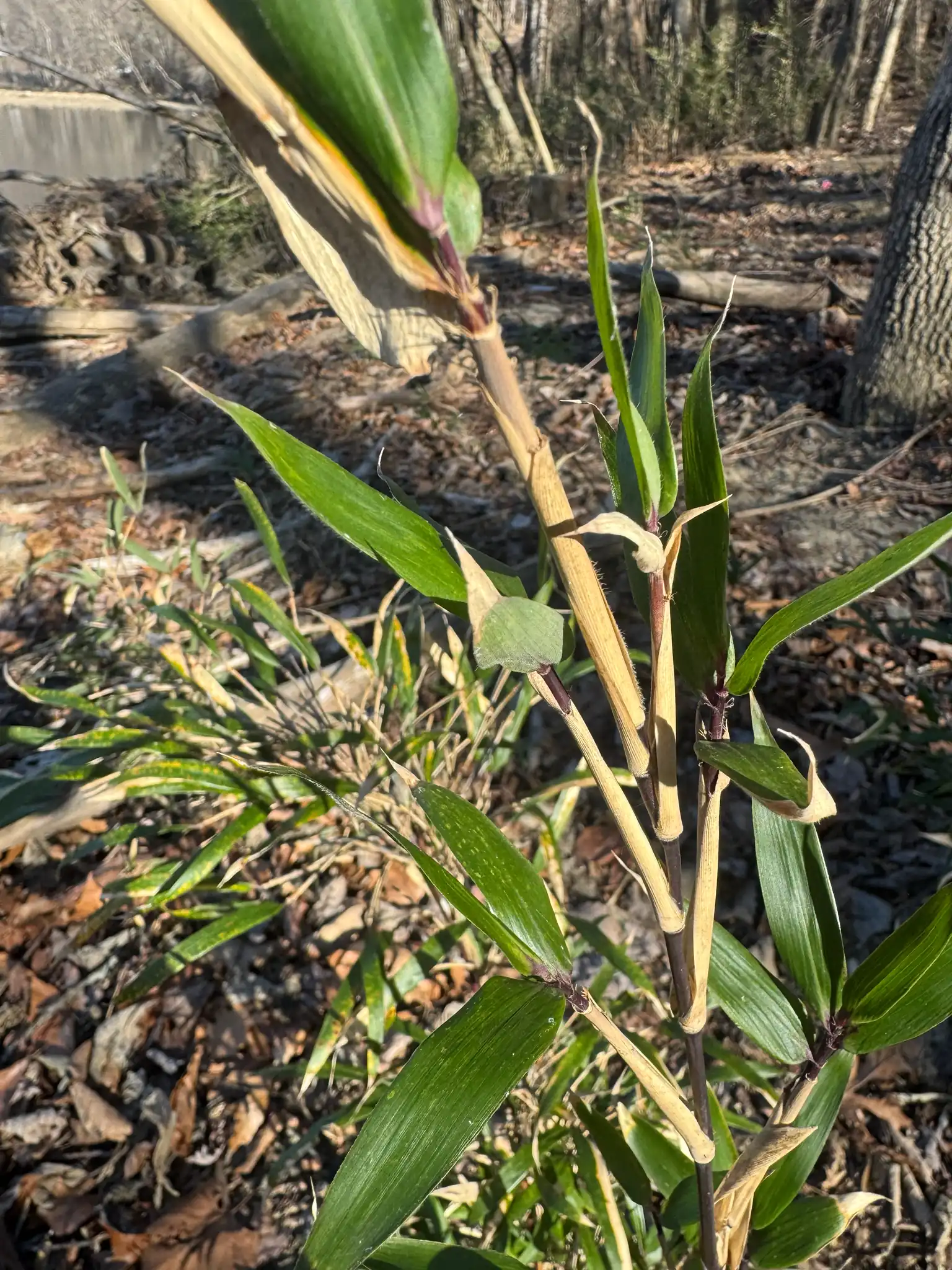
The Story
Plant Bio
Arundinaria gigantea, the only native bamboo of North America, is a rhizomatous woody grass that forms dense, evergreen thickets in moist alluvial soils. The upright, hollow culms bear coarse, lance-shaped leaves in fan-like clusters, maintaining a lush green presence throughout the year in southern climates.
This species spreads indefinitely via vigorous underground rhizomes to create impenetrable canebrakes that stabilize riparian zones. The purplish-green flowers are produced on lateral panicles only at irregular, multi-year intervals.
Uses & Benefits:
Essentials
At a Glance
Plant Type
Grass
Height
140"
Width
120"
Light
Full Sun, Partial Sun
Zones
5, 6, 7, 8, 9
Water
High
Humidity
High
Lifespan
Perennial
Native To
Southeastern and eastern United States
Toxicity
Non-toxic
Bloom period
Early spring
In flower about 1 month of the year
Planting
How to Grow
- Select a site with consistently moist, organic-rich soil in full sun to partial shade.
- Dig a planting hole twice the width of the rootball and set the plant at its original container depth.
- Water thoroughly after planting and apply a three-inch layer of organic mulch to retain soil moisture.
- Install a physical root barrier at least twenty-four inches deep if you need to contain the spreading rhizomes.
Pro Tip
Avoid shearing or cutting live green culms back to the ground annually, as hard pruning starves the rhizome system and severely weakens the colony.
Keep It Thriving
Care Guide
Do
- Keep the soil consistently moist, especially during hot summer months.
- Apply a thick organic mulch annually to supply slow-release nutrients and preserve moisture.
- Thin out dead or spent culms at the base to improve air circulation.
Don't
- Do not allow the soil to dry out completely, as this species has low drought tolerance.
- Do not cut back into old, leafless wood, which results in slow and patchy regrowth.
- Do not plant near delicate garden borders without a rhizome barrier.
Seasonal Care Calendar
| Task | Jan | Feb | Mar | Apr | May | Jun | Jul | Aug | Sep | Oct | Nov | Dec |
|---|---|---|---|---|---|---|---|---|---|---|---|---|
| Mulch | ||||||||||||
| Pest Check | ||||||||||||
| Propagate | ||||||||||||
| Prune |
Watch Out For
Pests & Diseases
Common Pests
Common Diseases
In the Garden
Landscape Uses & Companions
Landscape Uses
Multiply
Propagation Methods
Good to Know
Common Questions
Giant Cane questions
What zones can Giant Cane grow in?
Giant Cane is hardy in USDA Zones 5–9. Inside that range it survives winter in the ground; outside it, grow it as an annual or a container plant you protect.
Is Giant Cane deer resistant?
Not reliably. Deer may browse Giant Cane, especially tender spring growth — plan on repellents or fencing where pressure is high.
When does Giant Cane bloom?
Giant Cane typically blooms in early spring through early spring. Exact timing shifts a week or two with your zone — Sow's bloom calendar maps it to your garden.
Does Giant Cane need full sun?
Giant Cane does best in full sun to part shade. In hot climates, afternoon shade keeps blooms fresher longer.
Keep exploring
Explore the genus
Hardy in your zone?
Grow Giant Cane with confidence
See it in a design of your actual yard, get zone-matched care reminders, and track it season by season in your garden journal.