The Story
Plant Bio
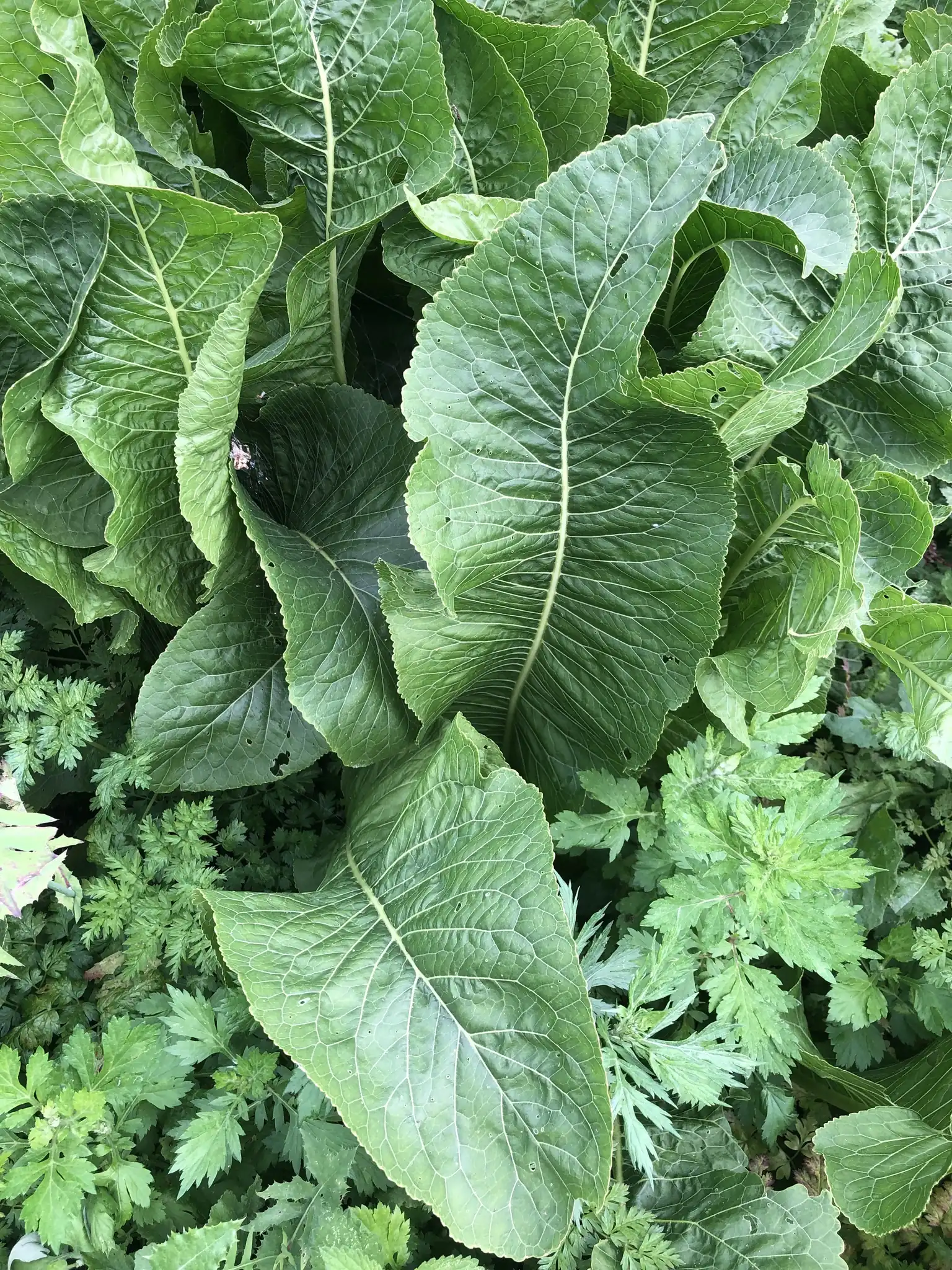
Armoracia rusticana, horseradish, is a vigorous spreading perennial from southern Ukraine and European Russia, two to five feet high in leaf. Coarse dark green basal leaves reach two feet long, small white four-petalled flowers open on tall stems in spring, and the crop is the thick pungent taproot below.
It is nearly impossible to remove once planted — every root fragment left in the soil regrows, so a single bed can supply a household indefinitely and will outlive most attempts to get rid of it. Plant it in a sunken container or a corner you are committed to. The heat only develops when the root is cut or grated, and fades within minutes unless vinegar is added.
Uses & Benefits:
Essentials
At a Glance
Plant Type
Fruit Vegetable
Height
42"
Width
39"
Light
Full Sun, Partial Sun
Zones
4, 5, 6, 7
Water
Moderate
Humidity
Moderate
Lifespan
Perennial
Native To
Southern Ukraine to European Russia
Toxicity
Root edible in small amounts; strong irritant
Bloom period
Late spring – Early summer
In flower about 2 months of the year
Planting
How to Grow
- Plant it in a contained bed or sunken container.
- Choose full sun and deep, freely drained soil.
- Water through dry spells for tender roots.
- Lift roots in autumn after the first frost.
- Leave a piece behind and it will regrow.
- Grate outdoors or in a well-ventilated room.
Pro Tip
The heat appears only when the root is cut and fades within minutes — add vinegar as soon as you grate it to lock it in.
Keep It Thriving
Care Guide
Do
- Contain it from the start 🚧
- Lift roots after the first frost 🥕
- Add vinegar straight after grating 🧪
- Grate it somewhere ventilated 🌬️
Don't
- Plant it loose in a border ❌
- Expect to remove it later ❌
- Grate it in a closed room ❌
Seasonal Care Calendar
| Task | Jan | Feb | Mar | Apr | May | Jun | Jul | Aug | Sep | Oct | Nov | Dec |
|---|---|---|---|---|---|---|---|---|---|---|---|---|
| Harvest | ||||||||||||
| Plant |
Watch Out For
Pests & Diseases
Common Pests
Common Diseases
In the Garden
Landscape Uses & Companions
Landscape Uses
Multiply
Propagation Methods
Good to Know
Common Questions
Horseradish questions
What zones can Horseradish grow in?
Horseradish is hardy in USDA Zones 4–7. Inside that range it survives winter in the ground; outside it, grow it as an annual or a container plant you protect.
Is Horseradish deer resistant?
Yes — Horseradish is rated deer-resistant. Deer typically pass it over, though extreme hunger can override any plant's defenses.
When does Horseradish bloom?
Horseradish typically blooms in late spring through early summer. Exact timing shifts a week or two with your zone — Sow's bloom calendar maps it to your garden.
Does Horseradish need full sun?
Horseradish does best in full sun to part shade. In hot climates, afternoon shade keeps blooms fresher longer.
Is Horseradish drought tolerant?
Yes — once established (usually after the first full season), Horseradish handles dry spells with minimal watering. Water deeply its first year to build the root system that makes that possible.
Keep exploring
Explore the genus
Hardy in your zone?
Grow Horseradish with confidence
See it in a design of your actual yard, get zone-matched care reminders, and track it season by season in your garden journal.