The Story
Plant Bio
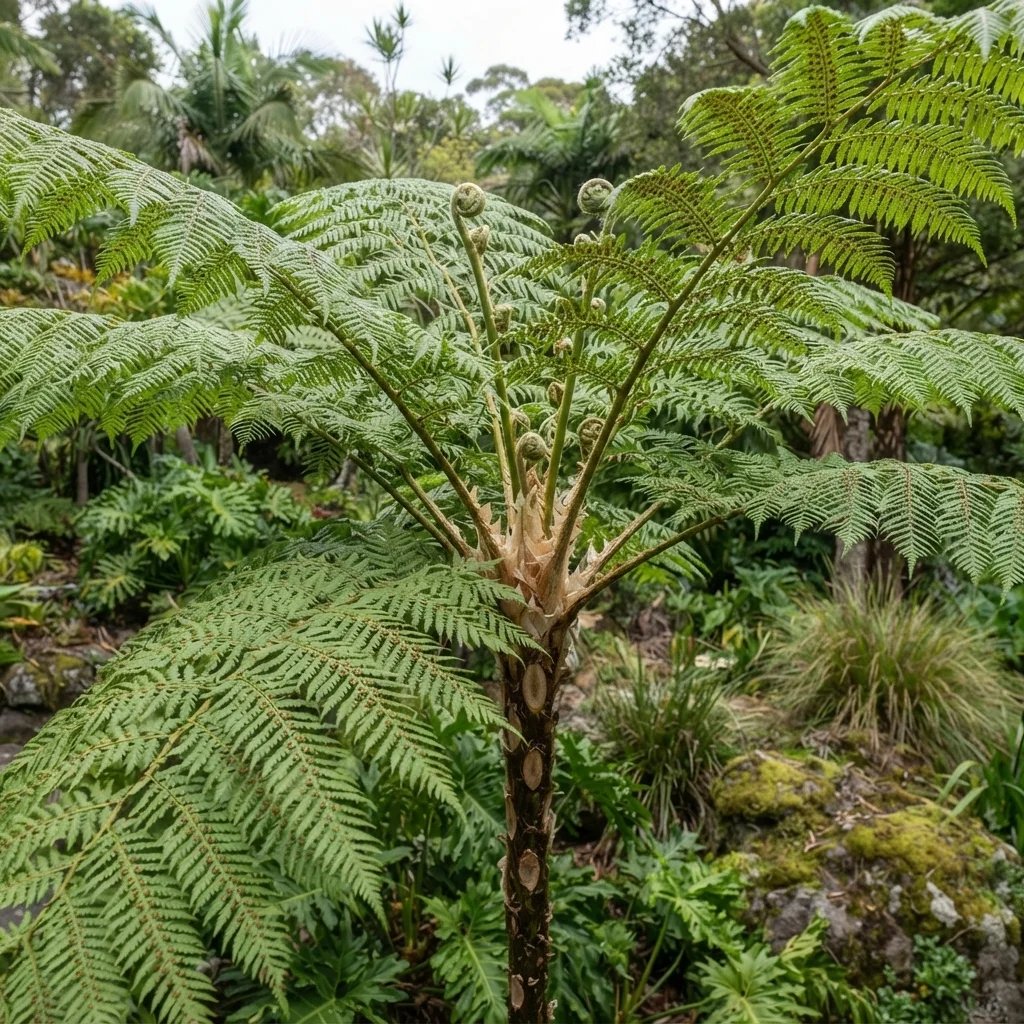
Cyathea cooperi, the Australian tree fern, is a fast-growing arborescent fern that develops a single, slender trunk topped by a sweeping crown of lacy fronds. This evergreen species thrives in sheltered, humid environments, providing a dramatic tropical structure in frost-free climates.
The trunk is distinguished by prominent oval scars, known as coin spots, left behind by fallen fronds. Young fiddleheads and leaf stems are densely clothed in characteristic pale and reddish-brown scales that offer tactile interest but can irritate sensitive skin.
Uses & Benefits:
Essentials
At a Glance
Plant Type
Fern
Height
300"
Width
140"
Light
Partial Sun, Shade
Zones
9, 10
Water
High
Humidity
High
Lifespan
Long-lived
Native To
Oceania (Australia)
Toxicity
Non-toxic (scales can cause skin irritation)
Marketplace
Where to Buy
Shipping costs Year-round shipping Free shipping
Planting
How to Grow
- Select a planting site in partial to full shade with protection from strong winds and harsh afternoon sun.
- Prepare a humus-rich, well-draining soil bed with a slightly acidic to neutral pH.
- Plant the root ball at soil level, backfilling with organic compost, and water deeply to settle the soil.
- Maintain consistent soil moisture through regular watering, ensuring the soil never dries out completely.
- Apply a thick layer of organic mulch around the base to retain moisture and protect the shallow root system.
Pro Tip
Water the trunk base and root mass directly rather than relying on foliage misting, as the fibrous trunk functions as an active root system that desiccates quickly in dry air.
Keep It Thriving
Care Guide
Do
- Keep the soil consistently moist but well-drained to prevent root rot.
- Water the fibrous trunk directly during hot or dry periods to maintain hydration.
- Apply a diluted, balanced organic fertilizer during the active spring and summer growing seasons.
- Provide shelter from strong winds that can tear the delicate, lacy fronds.
Don't
- Never cut or damage the single growing tip at the top of the trunk, as this kills the plant.
- Do not prune green, healthy fronds; remove only completely dead, brown fronds at the base.
- Avoid planting in heavy, compacted clay soils or areas prone to standing water.
- Do not use heavy chemical fertilizers, which can burn the sensitive root system.
Seasonal Care Calendar
| Task | Jan | Feb | Mar | Apr | May | Jun | Jul | Aug | Sep | Oct | Nov | Dec |
|---|---|---|---|---|---|---|---|---|---|---|---|---|
| Fertilize | ||||||||||||
| Mulch | ||||||||||||
| Pest Check | ||||||||||||
| Prune | ||||||||||||
| Winter Prep |
Watch Out For
Pests & Diseases
Common Pests
Common Diseases
In the Garden
Landscape Uses & Companions
Landscape Uses
Companion Plants
Multiply
Propagation Methods
Good to Know
Common Questions
Australian Tree Fern questions
What zones can Australian Tree Fern grow in?
Australian Tree Fern is hardy in USDA Zones 9–10. Inside that range it survives winter in the ground; outside it, grow it as an annual or a container plant you protect.
Is Australian Tree Fern deer resistant?
Yes — Australian Tree Fern is rated deer-resistant. Deer typically pass it over, though extreme hunger can override any plant's defenses.
Does Australian Tree Fern need full sun?
Australian Tree Fern does best in part shade.
Keep exploring
Explore the genus
Hardy in your zone?
Grow Australian Tree Fern with confidence
See it in a design of your actual yard, get zone-matched care reminders, and track it season by season in your garden journal.