The Story
Plant Bio
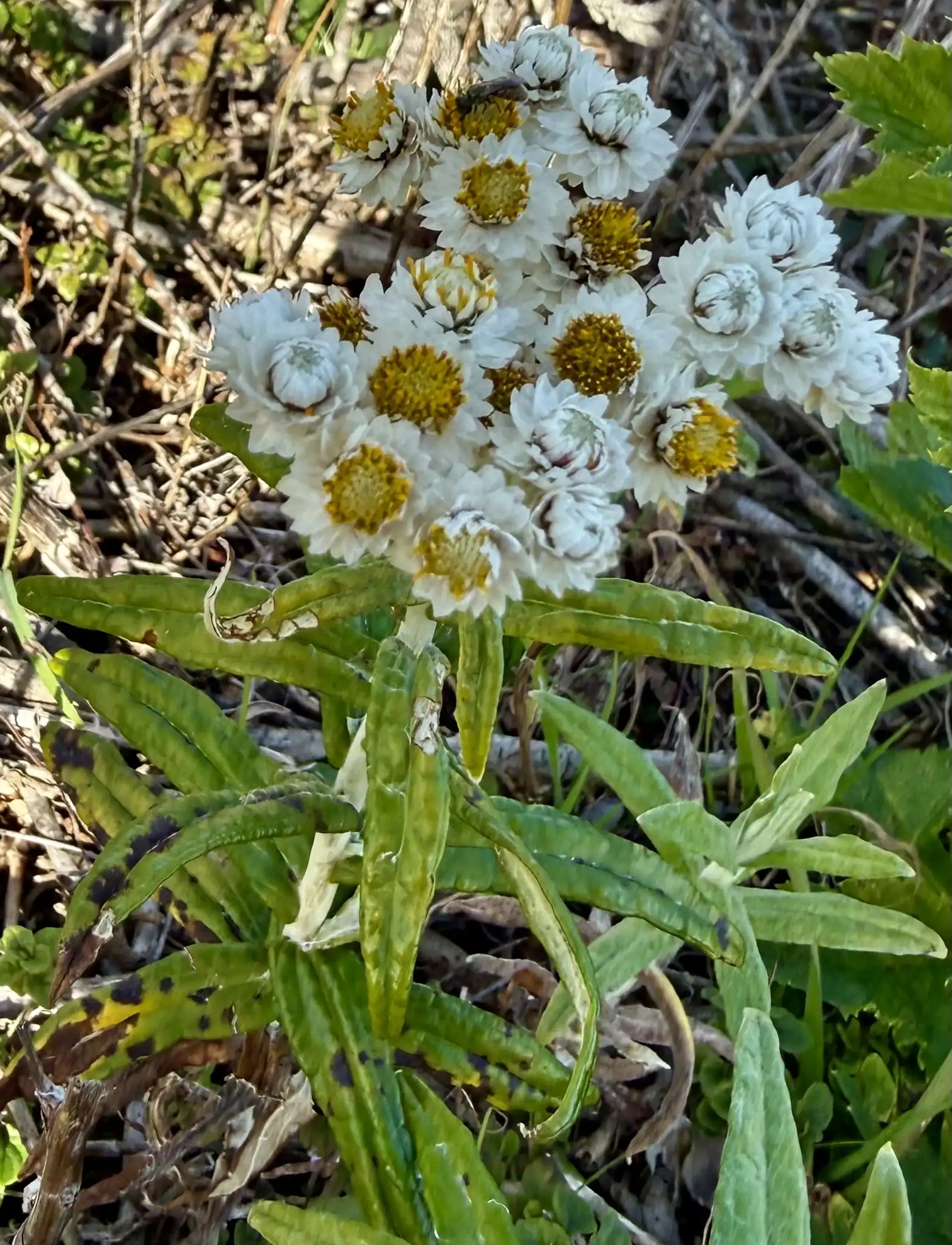
Anaphalis margaritacea, commonly known as pearly everlasting, is an upright perennial native across North America and Asia that reaches twelve to thirty-six inches in height. It produces narrow, lance-shaped leaves with silver, woolly undersides and terminal clusters of small flowerheads bounded by papery white bracts around yellow centers.
The species is distinguished by its papery involucre bracts that retain their shape and pearly white color long after drying on the stem. A dense coating of felt-like white hairs covers the lower leaves and stems, reflecting heat and conserving moisture in dry habitats.
Uses & Benefits:
Essentials
At a Glance
Plant Type
Perennial
Height
36"
Width
24"
Light
Full Sun, Partial Sun
Zones
4, 5, 6, 7, 8, 9
Water
Low
Humidity
Moderate
Lifespan
Perennial
Native To
North America, Asia
Toxicity
Non-toxic
Bloom period
Summer – Fall
In flower about 6 months of the year
Planting
How to Grow
- Choose a location receiving full sun to very light shade with light, sandy, or gravelly soil.
- Plant dormant bare-root plugs or container specimens at the same depth as their original soil line.
- Water lightly after planting to settle the roots, then reduce irrigation as plants establish.
- Cut spent flower stalks back to ground level in late winter before new basal leaves emerge.
Pro Tip
Plant in lean, gravelly, well-draining soil and avoid supplemental fertilizer; nitrogen-rich earth causes the stems to weaken, flop over, and rot.
Keep It Thriving
Care Guide
Do
- Plant in sharply draining sandy, gravelly, or poor soils.
- Expose plants to full sun to maintain upright, sturdy stem structure.
- Cut stems back to the ground in late winter or early spring.
Don't
- Do not add rich organic compost, heavy manures, or high-nitrogen fertilizers.
- Do not plant in heavy, waterlogged clay soils subject to standing water.
- Do not overwater established plants, as excessive moisture induces crown rot.
Seasonal Care Calendar
| Task | Jan | Feb | Mar | Apr | May | Jun | Jul | Aug | Sep | Oct | Nov | Dec |
|---|---|---|---|---|---|---|---|---|---|---|---|---|
| Divide | ||||||||||||
| Harvest | ||||||||||||
| Pest Check | ||||||||||||
| Prune |
Watch Out For
Pests & Diseases
Common Pests
Common Diseases
In the Garden
Landscape Uses & Companions
Landscape Uses
Multiply
Propagation Methods
Good to Know
Common Questions
Pearly Everlasting questions
What zones can Pearly Everlasting grow in?
Pearly Everlasting is hardy in USDA Zones 4–9. Inside that range it survives winter in the ground; outside it, grow it as an annual or a container plant you protect.
Is Pearly Everlasting deer resistant?
Yes — Pearly Everlasting is rated deer-resistant. Deer typically pass it over, though extreme hunger can override any plant's defenses.
When does Pearly Everlasting bloom?
Pearly Everlasting typically blooms in summer through fall. Exact timing shifts a week or two with your zone — Sow's bloom calendar maps it to your garden.
Does Pearly Everlasting need full sun?
Pearly Everlasting does best in full sun to part shade. In hot climates, afternoon shade keeps blooms fresher longer.
Is Pearly Everlasting drought tolerant?
Yes — once established (usually after the first full season), Pearly Everlasting handles dry spells with minimal watering. Water deeply its first year to build the root system that makes that possible.
More Anaphalis to compare
Keep exploring
Explore the genus
Grow Pearly Everlasting with confidence
See it in a design of your actual yard, get zone-matched care reminders, and track it season by season in your garden journal.