The Story
Plant Bio
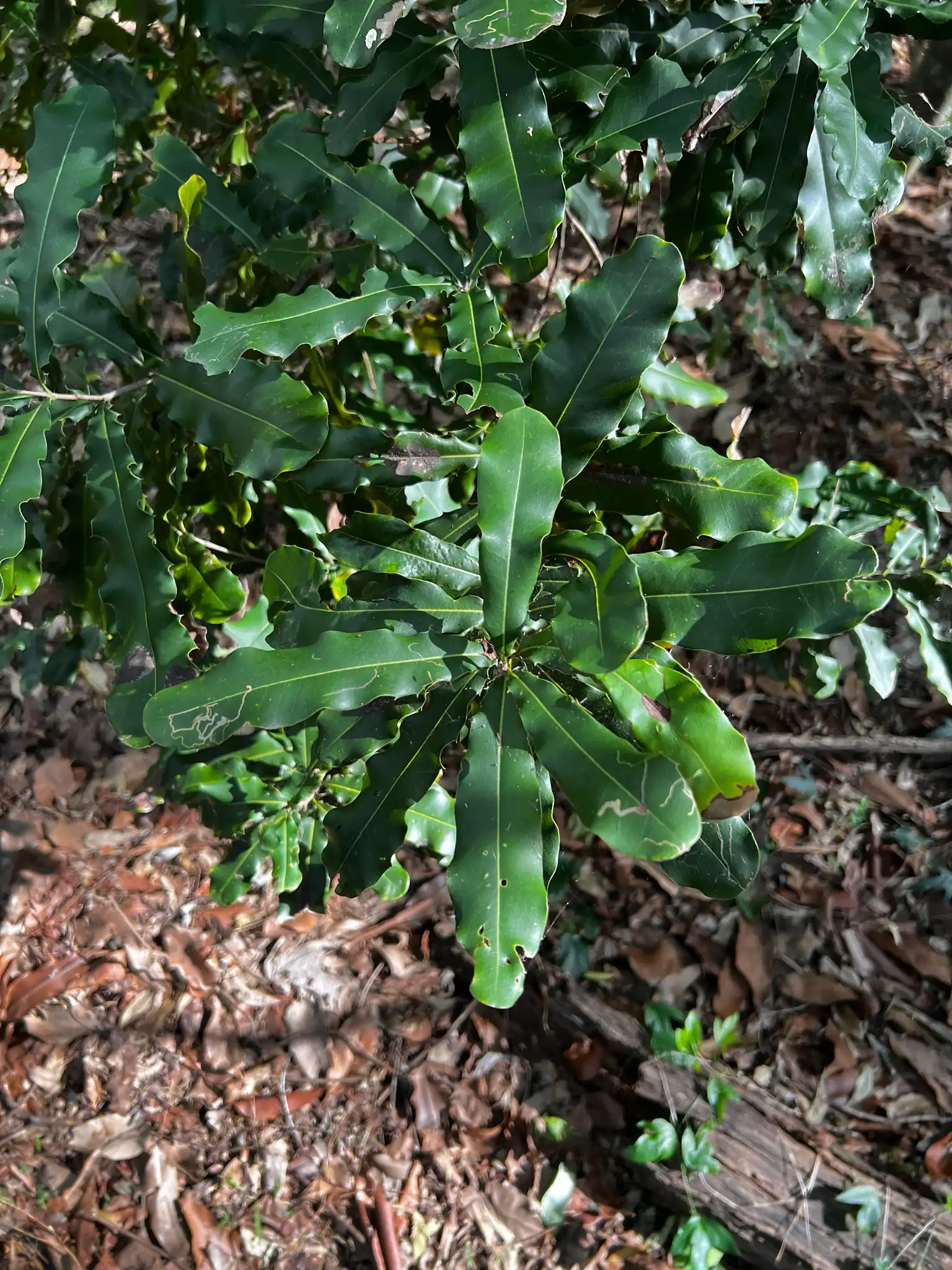
Macadamia integrifolia is a large, spreading evergreen tree native to the subtropical rainforest margins of eastern Australia, valued globally for its edible nuts. It develops a dense, rounded canopy of glossy, leathery leaves arranged in whorls, with new growth emerging in bronze and reddish-pink tones.
This species is distinguished by its smooth-shelled nuts and mature leaves with entirely smooth margins, unlike the spiny-edged foliage of some relatives. In winter and spring, it produces long, pendulous racemes of cream-colored flowers that emit a subtle fragrance and attract insect pollinators.
Uses & Benefits:
Essentials
At a Glance
Plant Type
Tree
Height
709"
Width
591"
Light
Full Sun, Partial Sun
Zones
9, 10
Water
Moderate
Humidity
High
Lifespan
Long-lived
Native To
Australia
Toxicity
Toxic to Dogs
Bloom period
Winter – Spring
In flower about 6 months of the year
Planting
How to Grow
- Select a planting site in full sun to partial shade with deep, exceptionally well-drained sandy loam or loamy soil.
- Dig a hole twice as wide as the root ball and plant at the same depth as the nursery container, avoiding any root disturbance.
- Water deeply and regularly during the establishment phase and throughout the nut-production season, ensuring the soil never waterlogs.
- Apply a thick layer of organic mulch around the base to retain moisture, keeping it several inches away from the trunk.
Pro Tip
Apply only low-phosphorus, native-formulated fertilizers, as standard garden blends cause severe leaf burn and root damage due to the plant's highly sensitive proteoid root system.
Keep It Thriving
Care Guide
Do
- Water regularly during dry spells to support consistent nut development.
- Protect young trees from even light frosts using frost cloth or temporary shelters.
- Use specialized low-phosphorus fertilizers formulated for native or Proteaceae species.
- Prune young trees early to establish a strong, single-leader structural framework.
Don't
- Do not use standard phosphorus-rich fertilizers, which cause rapid root decline.
- Do not allow the soil to become waterlogged, as poor drainage triggers root rot.
- Do not prune heavily into old, leafless wood, which fails to regenerate.
- Do not let dogs access fallen nuts, as the kernels are highly toxic to them.
Seasonal Care Calendar
| Task | Jan | Feb | Mar | Apr | May | Jun | Jul | Aug | Sep | Oct | Nov | Dec |
|---|---|---|---|---|---|---|---|---|---|---|---|---|
| Fertilize | ||||||||||||
| Harvest | ||||||||||||
| Pest Check | ||||||||||||
| Prune |
Watch Out For
Pests & Diseases
Common Pests
Common Diseases
In the Garden
Landscape Uses & Companions
Landscape Uses
Companion Plants
Multiply
Propagation Methods
Good to Know
Common Questions
Macadamia Nut questions
What zones can Macadamia Nut grow in?
Macadamia Nut is hardy in USDA Zones 9–10. Inside that range it survives winter in the ground; outside it, grow it as an annual or a container plant you protect.
Is Macadamia Nut deer resistant?
Not reliably. Deer may browse Macadamia Nut, especially tender spring growth — plan on repellents or fencing where pressure is high.
When does Macadamia Nut bloom?
Macadamia Nut typically blooms in winter through spring. Exact timing shifts a week or two with your zone — Sow's bloom calendar maps it to your garden.
Does Macadamia Nut need full sun?
Macadamia Nut does best in full sun to part shade. In hot climates, afternoon shade keeps blooms fresher longer.
Is Macadamia Nut drought tolerant?
Yes — once established (usually after the first full season), Macadamia Nut handles dry spells with minimal watering. Water deeply its first year to build the root system that makes that possible.
Keep exploring
Explore the genus
Hardy in your zone?
Grow Macadamia Nut with confidence
See it in a design of your actual yard, get zone-matched care reminders, and track it season by season in your garden journal.