The Story
Plant Bio
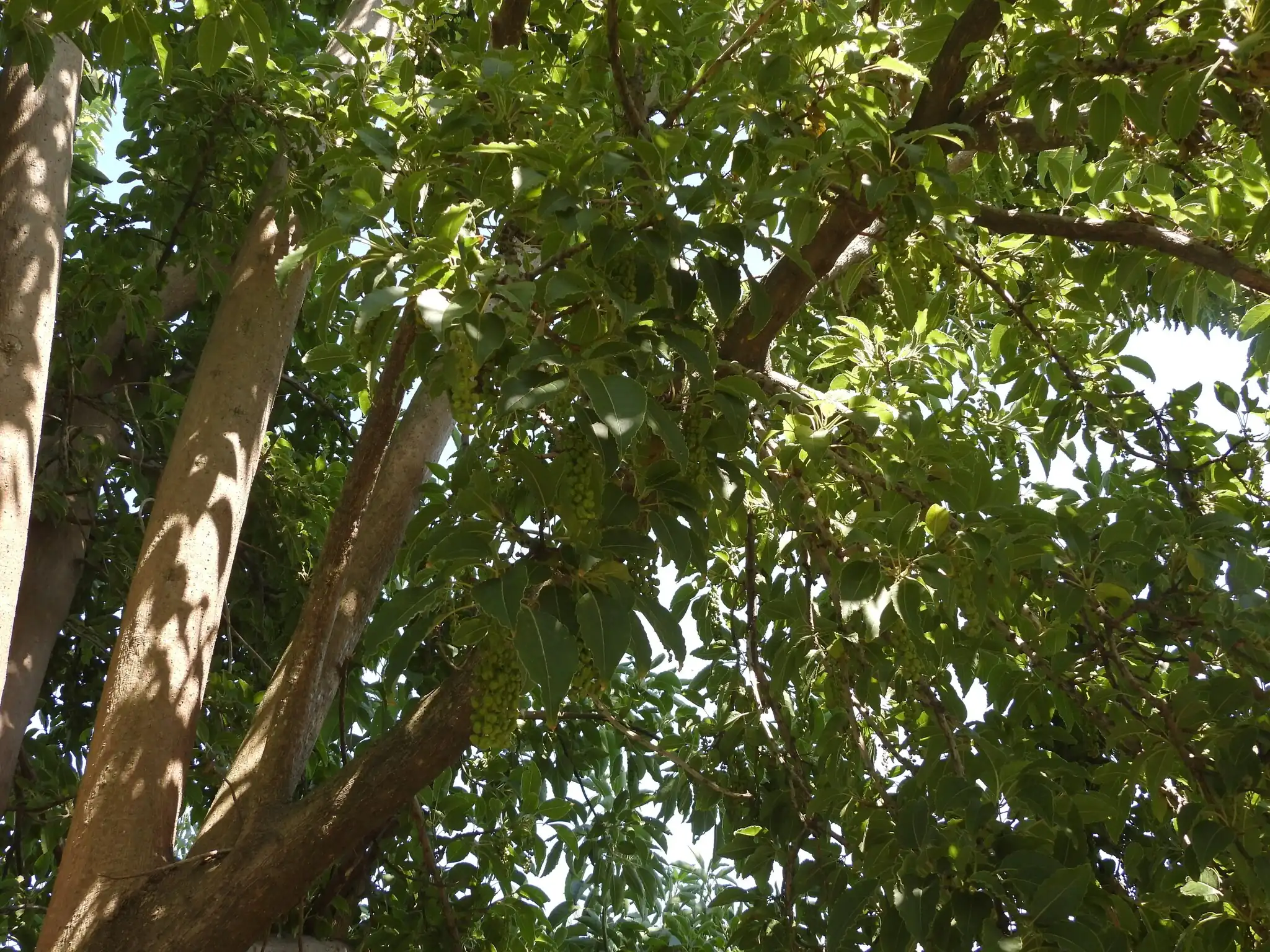
Phytolacca dioica, commonly known as the ombú, is a massive evergreen tree native to the South American pampas, characterized by a rapid growth rate and a dense, rounded canopy. The species is dioecious, producing small, greenish-white flowers on drooping racemes up to eight inches long during spring and summer.
Despite its immense tree-like proportions, this species is botanically a giant herbaceous perennial with anomalous secondary growth that lacks true annual rings. The trunk base develops into a massive, swollen, water-storing pedestal with aggressive, visible surface roots that easily disrupt nearby pavement and structures.
Uses & Benefits:
Essentials
At a Glance
Plant Type
Tree
Height
709"
Width
591"
Light
Full Sun, Partial Sun
Zones
9, 10
Water
Low
Humidity
Moderate
Lifespan
Long-lived
Native To
South America
Toxicity
Toxic if Ingested
Bloom period
Spring – Summer
In flower about 6 months of the year
Planting
How to Grow
- Select a planting site in full sun with ample clearance for aggressive, wide-spreading surface roots.
- Dig a hole twice the width of the root ball but no deeper, ensuring the swollen trunk base sits slightly above the surrounding soil level.
- Backfill with native soil, pressing firmly to eliminate air pockets, and water thoroughly to settle the roots.
- Irrigate moderately during the first growing season to establish the root system, then reduce watering significantly once the succulent trunk begins to swell.
Pro Tip
Avoid overwatering established specimens, as the succulent trunk tissues store ample water and are highly susceptible to fatal root rot in waterlogged soils.
Keep It Thriving
Care Guide
Do
- Provide wide clearance from sidewalks, foundations, and underground pipes to accommodate the invasive surface roots.
- Prune lightly during winter dormancy only when structural clearance is absolutely necessary.
- Ensure the soil drains rapidly to prevent moisture accumulation around the trunk base.
Don't
- Do not prune hard into old, leafless woody stems, as latent buds fail to push reliably from old wood.
- Do not overwater or plant in low-lying areas where water pools.
- Do not apply heavy fertilizer, as this species thrives in poor soils and excess nutrients cause weak, floppy growth.
Seasonal Care Calendar
| Task | Jan | Feb | Mar | Apr | May | Jun | Jul | Aug | Sep | Oct | Nov | Dec |
|---|---|---|---|---|---|---|---|---|---|---|---|---|
| Fertilize | ||||||||||||
| Pest Check | ||||||||||||
| Propagate | ||||||||||||
| Prune | ||||||||||||
| Winter Prep |
Watch Out For
Pests & Diseases
Common Pests
Common Diseases
In the Garden
Landscape Uses & Companions
Landscape Uses
Companion Plants
Multiply
Propagation Methods
Good to Know
Common Questions
Ombú questions
What zones can Ombú grow in?
Ombú is hardy in USDA Zones 9–10. Inside that range it survives winter in the ground; outside it, grow it as an annual or a container plant you protect.
When does Ombú bloom?
Ombú typically blooms in spring through summer. Exact timing shifts a week or two with your zone — Sow's bloom calendar maps it to your garden.
Does Ombú need full sun?
Ombú does best in full sun to part shade. In hot climates, afternoon shade keeps blooms fresher longer.
Is Ombú drought tolerant?
Yes — once established (usually after the first full season), Ombú handles dry spells with minimal watering. Water deeply its first year to build the root system that makes that possible.
More Phytolacca to compare
Keep exploring
Explore the genus
Hardy in your zone?
Grow Ombú with confidence
See it in a design of your actual yard, get zone-matched care reminders, and track it season by season in your garden journal.