
The Story
Plant Bio
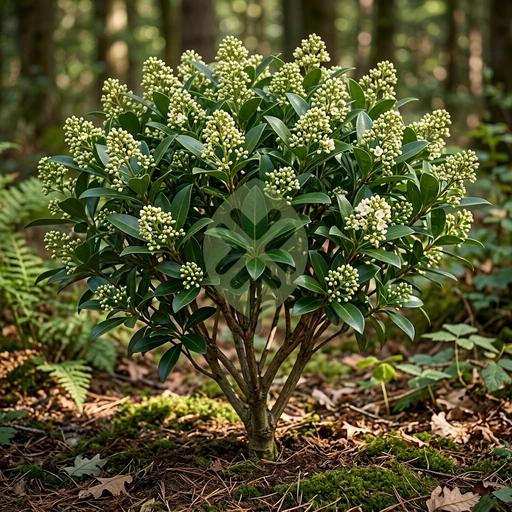
Skimmia japonica, the Japanese skimmia, is a slow-growing, broadleaf evergreen shrub native to the forested regions of Asia. It forms a dense, rounded dome of leathery, glossy dark green leaves that release a spicy aroma when crushed.
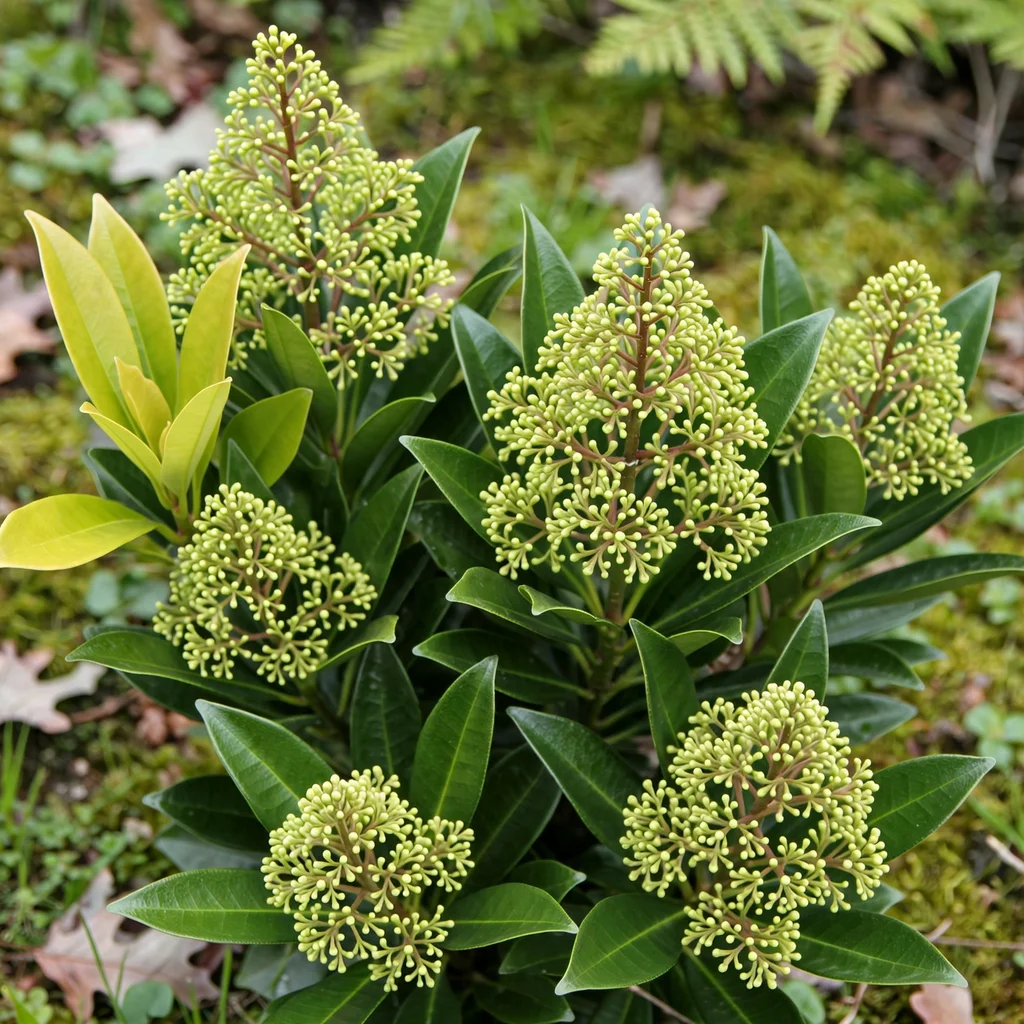
'Rubella' is a distinct male clone selected for its prominent, deep red flower buds that persist throughout fall and winter before opening into fragrant, creamy-white spring blooms. Because this selection is strictly male, it does not produce berries, but it serves as an exceptional pollinator for female cultivars.
Uses & Benefits:
Essentials
At a Glance
Plant Type
Shrub
Height
36"
Width
39"
Light
Partial Sun, Shade
Zones
6, 7, 8
Water
Consistent moisture
Humidity
Moderate to high
Lifespan
Long-lived
Native To
Asia (Japan, China, Taiwan, Korea, Kuril Islands)
Toxicity
Toxic if ingested
Bloom period
Spring
In flower about 3 months of the year
Planting
How to Grow
- Select a planting site in partial to full shade with moist, organically rich, acidic soil.
- Dig a hole twice the width of the root ball and backfill with compost to ensure excellent drainage.
- Set the plant at the same depth as it was in the container, avoiding burying the crown.
- Water thoroughly and apply an organic mulch to retain consistent soil moisture.
Pro Tip
Plant in acidic, humus-rich soil in partial to full shade; full sun bleaches the evergreen foliage, while alkaline soils trigger severe iron chlorosis.
Keep It Thriving
Care Guide
Do
- Do plant in dappled or afternoon shade to prevent leaf scorch.
- Do mulch annually with compost or ericaceous matter to maintain soil acidity.
- Do ensure sharp drainage to prevent root rot.
Don't
- Don't plant in high-pH alkaline or chalky soils.
- Don't prune hard into old, leafless wood as it will not resprout.
- Don't allow the soil to dry out completely.
Seasonal Care Calendar
| Task | Jan | Feb | Mar | Apr | May | Jun | Jul | Aug | Sep | Oct | Nov | Dec |
|---|---|---|---|---|---|---|---|---|---|---|---|---|
| Fertilize | ||||||||||||
| Mulch | ||||||||||||
| Pest Check | ||||||||||||
| Prune |
Watch Out For
Pests & Diseases
Common Pests
Common Diseases
In the Garden
Landscape Uses & Companions
Landscape Uses
Companion Plants
Multiply
Propagation Methods
Good to Know
Common Questions
Japanese Skimmia questions
What zones can Japanese Skimmia grow in?
Japanese Skimmia is hardy in USDA Zones 6–8. Inside that range it survives winter in the ground; outside it, grow it as an annual or a container plant you protect.
Is Japanese Skimmia deer resistant?
Not reliably. Deer may browse Japanese Skimmia, especially tender spring growth — plan on repellents or fencing where pressure is high.
When does Japanese Skimmia bloom?
Japanese Skimmia typically blooms in spring through spring. Exact timing shifts a week or two with your zone — Sow's bloom calendar maps it to your garden.
Does Japanese Skimmia need full sun?
Japanese Skimmia does best in part shade.
More Skimmia to compare
Keep exploring
Explore the genus
Hardy in your zone?
Grow Japanese Skimmia with confidence
See it in a design of your actual yard, get zone-matched care reminders, and track it season by season in your garden journal.