The Story
Plant Bio
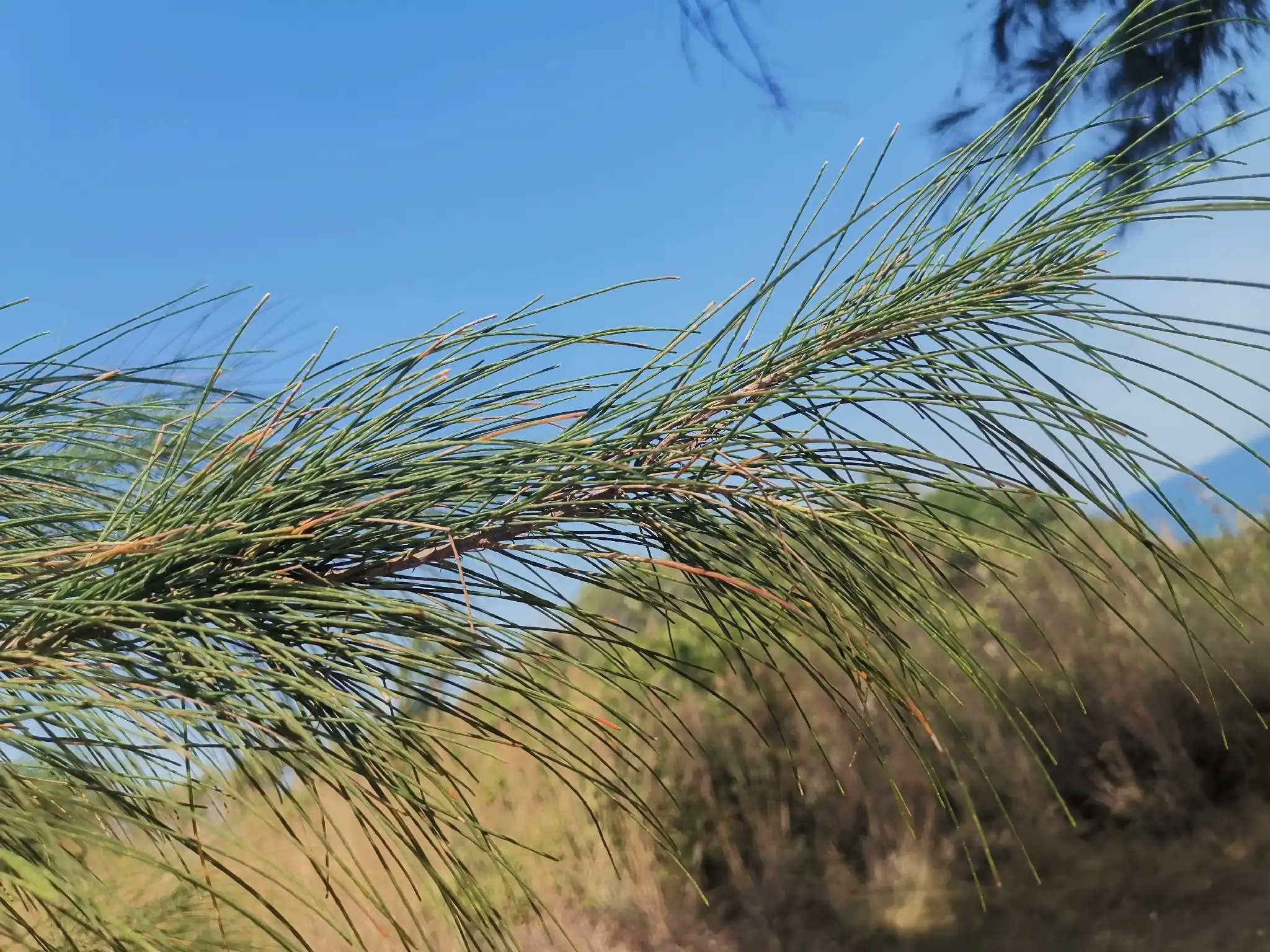
Casuarina equisetifolia is a fast-growing, upright evergreen tree distinguished by its slender, drooping, jointed green branchlets that mimic pine needles. Native to coastal regions of Asia, Australia, and the Pacific, it develops an open, pyramidal crown and thrives in harsh, salt-laden maritime environments.
The species features tiny, scale-like leaves arranged in whorls at the nodes of its photosynthetic branchlets rather than true foliage. It possesses nitrogen-fixing root nodules containing Frankia bacteria, allowing it to colonize and stabilize barren, nutrient-poor sandy dunes.
Uses & Benefits:
Essentials
At a Glance
Plant Type
Tree
Height
1181"
Width
590"
Light
Full Sun
Zones
9, 10
Water
Low
Humidity
High
Lifespan
Long
Native To
Asia, Oceania, Australia
Toxicity
Non-toxic
Bloom period
Spring – Summer
In flower about 6 months of the year
Planting
How to Grow
- Select a planting site in full sun with exceptionally well-drained sandy or calcareous soil.
- Dig a hole twice the width of the root ball and set the plant at the same depth as its nursery container.
- Water deeply to settle the soil around the roots, then withhold supplemental watering once the root system is established.
- Allow fallen branchlets to accumulate naturally to suppress weeds, or clear them if understory growth is desired.
Pro Tip
Avoid pruning back into old, leafless brown wood, as the tree lacks dormant buds on mature stems and will not regenerate.
Keep It Thriving
Care Guide
Do
- Plant in loose, sandy, or gravelly soils that drain rapidly.
- Allow the soil to dry out completely between waterings once established.
- Prune exclusively to remove dead, damaged, or hazardous low-hanging limbs.
Don't
- Do not apply nitrogen-rich fertilizers, as the root nodules fix their own nitrogen.
- Do not shear or cut back into bare, woody branches.
- Do not plant near sensitive native coastal ecosystems where it can become invasive.
Seasonal Care Calendar
| Task | Jan | Feb | Mar | Apr | May | Jun | Jul | Aug | Sep | Oct | Nov | Dec |
|---|---|---|---|---|---|---|---|---|---|---|---|---|
| Pest Check | ||||||||||||
| Propagate | ||||||||||||
| Prune | ||||||||||||
| Winter Prep |
Watch Out For
Pests & Diseases
Common Pests
Common Diseases
In the Garden
Landscape Uses & Companions
Landscape Uses
Multiply
Propagation Methods
Good to Know
Common Questions
Horsetail Tree questions
What zones can Horsetail Tree grow in?
Horsetail Tree is hardy in USDA Zones 9–10. Inside that range it survives winter in the ground; outside it, grow it as an annual or a container plant you protect.
When does Horsetail Tree bloom?
Horsetail Tree typically blooms in spring through summer. Exact timing shifts a week or two with your zone — Sow's bloom calendar maps it to your garden.
Does Horsetail Tree need full sun?
Horsetail Tree does best in full sun (6+ hours).
Is Horsetail Tree drought tolerant?
Yes — once established (usually after the first full season), Horsetail Tree handles dry spells with minimal watering. Water deeply its first year to build the root system that makes that possible.
More Casuarina to compare
Keep exploring
Explore the genus
Hardy in your zone?
Grow Horsetail Tree with confidence
See it in a design of your actual yard, get zone-matched care reminders, and track it season by season in your garden journal.