The Story
Plant Bio
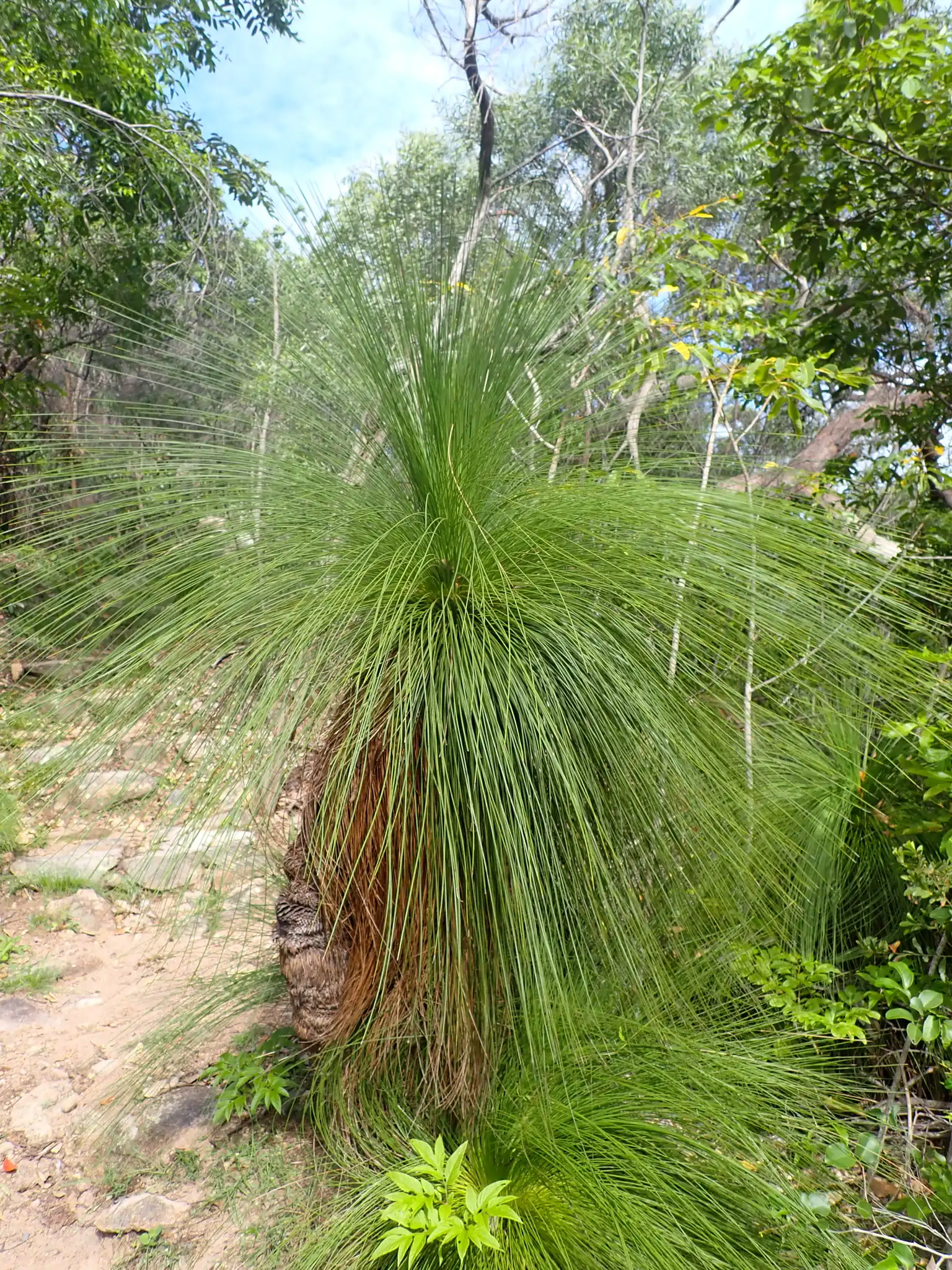
Xanthorrhoea johnsonii is a slow-growing, trunk-forming Australian monocot topped by a dense, spherical crown of narrow, grass-like leaves. Over decades, the accumulation of old leaf bases bound by natural resin builds a thick, fire-resistant trunk that can eventually reach fifteen feet in height.
The rigid, needle-like foliage is distinctively diamond-shaped in cross-section and remains deep green throughout the year. Mature specimens produce a single, massive flower spike up to six feet tall, densely packed with cream-colored blossoms that emerge from a dark brown scape.
Uses & Benefits:
Essentials
At a Glance
Plant Type
Perennial
Height
197"
Width
79"
Light
Full Sun
Zones
9, 10
Water
Low
Humidity
Low to High
Lifespan
Long-lived
Native To
Eastern Australia
Toxicity
Non-toxic
Bloom period
Spring – Autumn
In flower about 9 months of the year
Planting
How to Grow
- Select a planting site in full sun with sandy, gravelly, or highly porous soil that mimics a rocky slope.
- Excavate a hole twice as wide as the root ball but exactly the same depth to prevent the trunk base from sinking.
- Gently slide the plant from its container without shaking or breaking the soil column to protect the fragile roots.
- Backfill with native soil mixed with coarse sand, press down lightly to stabilize, and water once deeply to settle.
Pro Tip
Never disturb the highly sensitive root system during planting, and ensure the soil drains rapidly; standing water triggers fatal Phytophthora root rot within days.
Keep It Thriving
Care Guide
Do
- Grow in a container if local winter temperatures regularly drop below twenty-five degrees Fahrenheit.
- Allow the soil to dry out completely between waterings once the plant is established.
- Use a specialized low-phosphorus fertilizer extremely sparingly if growing in a pot.
Don't
- Do not prune the lower skirt of dead leaves unless fire safety regulations strictly require it.
- Do not plant in heavy clay soils or low-lying areas where water accumulates.
- Do not cut into the woody trunk or prune into old, leafless wood.
Seasonal Care Calendar
| Task | Jan | Feb | Mar | Apr | May | Jun | Jul | Aug | Sep | Oct | Nov | Dec |
|---|---|---|---|---|---|---|---|---|---|---|---|---|
| Fertilize | ||||||||||||
| Pest Check | ||||||||||||
| Spring Cleanup | ||||||||||||
| Winter Prep |
Watch Out For
Pests & Diseases
Common Pests
Common Diseases
In the Garden
Landscape Uses & Companions
Landscape Uses
Companion Plants
Multiply
Propagation Methods
Good to Know
Common Questions
Forest Grass Tree questions
What zones can Forest Grass Tree grow in?
Forest Grass Tree is hardy in USDA Zones 9–10. Inside that range it survives winter in the ground; outside it, grow it as an annual or a container plant you protect.
Is Forest Grass Tree deer resistant?
Yes — Forest Grass Tree is rated deer-resistant. Deer typically pass it over, though extreme hunger can override any plant's defenses.
When does Forest Grass Tree bloom?
Forest Grass Tree typically blooms in spring through autumn. Exact timing shifts a week or two with your zone — Sow's bloom calendar maps it to your garden.
Does Forest Grass Tree need full sun?
Forest Grass Tree does best in full sun (6+ hours).
Is Forest Grass Tree drought tolerant?
Yes — once established (usually after the first full season), Forest Grass Tree handles dry spells with minimal watering. Water deeply its first year to build the root system that makes that possible.
More Xanthorrhoea to compare
Keep exploring
Explore the genus
Hardy in your zone?
Grow Forest Grass Tree with confidence
See it in a design of your actual yard, get zone-matched care reminders, and track it season by season in your garden journal.