The Story
Plant Bio
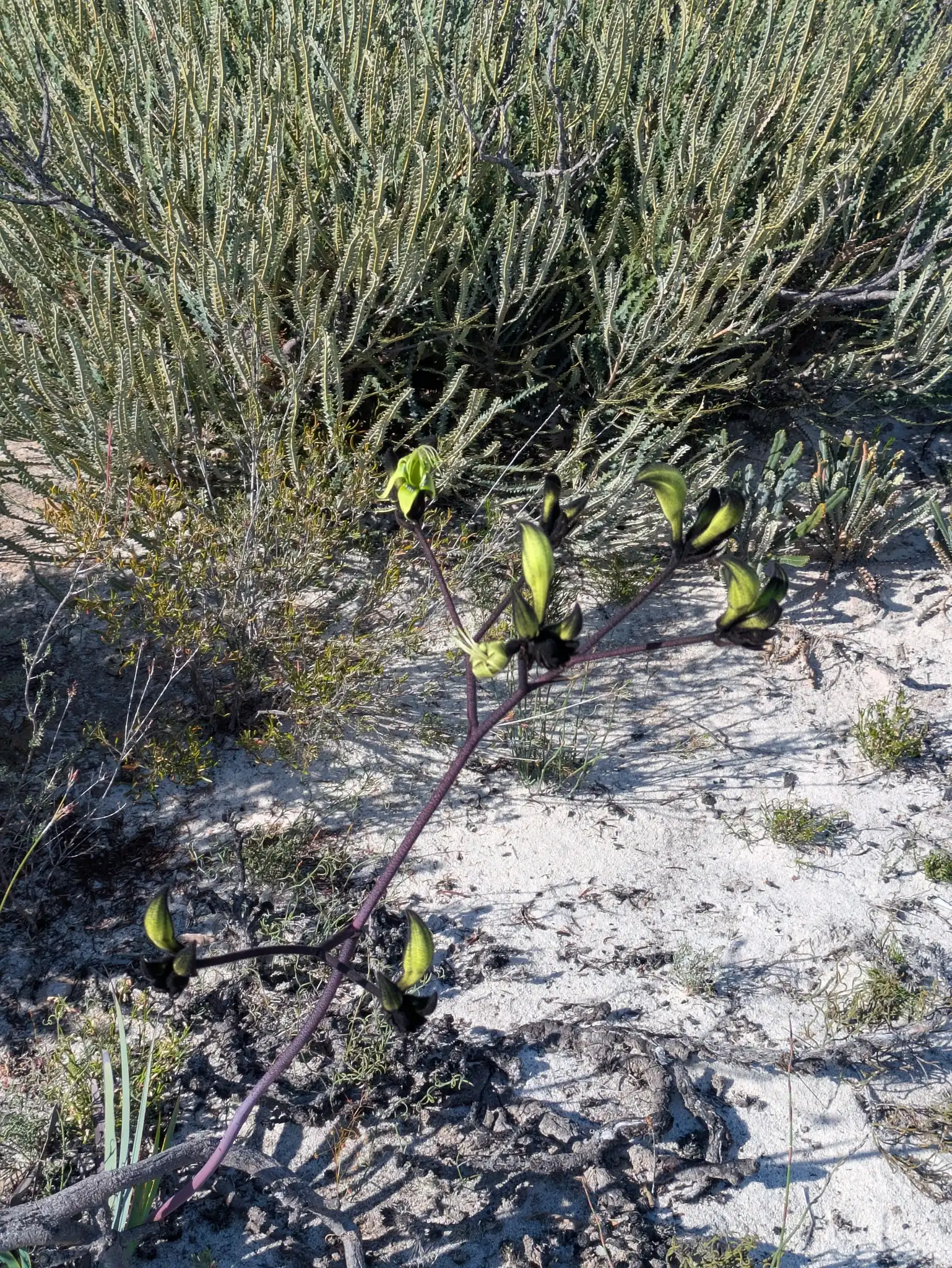
Macropidia fuliginosa, the black kangaroo paw, is a rhizomatous Australian perennial forming upright fans of narrow, hairless, blue-green foliage. Tall woolly stems rise above the leaves in spring and summer, bearing tubular lime-green flowers encrusted in dense, velvety black hairs.
Unlike true Anigozanthos species, Macropidia produces distinctive ink-black floral hairs that contrast sharply against bright green petals. The plant relies on low-phosphorus soils and underlying soil moisture to sustain its dramatic flowering display.
Uses & Benefits:
Essentials
At a Glance
Plant Type
Perennial
Height
71"
Width
39"
Light
Full Sun
Zones
9, 10
Water
Moderate
Humidity
Low
Lifespan
Short-lived perennial
Native To
Australia (Western Australia)
Toxicity
Non-toxic (skin irritant)
Bloom period
Spring – Summer
In flower about 6 months of the year
Planting
How to Grow
- Plant in full sun in gritty, sharply draining sand or sandy loam amended for maximum aeration.
- Water regularly during dry spells in spring and summer, allowing the top layer to dry slightly while maintaining deep root moisture.
- Apply a slow-release native plant fertilizer strictly formulated low in phosphorus during active spring growth.
- Cut spent floral scapes down to the base fan of leaves after blooming completes, avoiding crown damage.
Pro Tip
Never allow soil to dry out completely during active summer growth, as wild roots tap persistent subsurface moisture and succumb quickly to absolute drought.
Keep It Thriving
Care Guide
Do
- Provide sharp, free-draining sandy soil in full sun.
- Use low-phosphorus fertilizers formulated for sensitive native species.
- Cut flower scapes back to ground level after bloom.
Don't
- Do not use standard multi-purpose fertilizers containing high phosphorus.
- Do not overhead water or allow wet foliage in humid conditions.
- Do not shear into old crown tissue when removing old scapes.
Seasonal Care Calendar
| Task | Jan | Feb | Mar | Apr | May | Jun | Jul | Aug | Sep | Oct | Nov | Dec |
|---|---|---|---|---|---|---|---|---|---|---|---|---|
| Fertilize | ||||||||||||
| Pest Check | ||||||||||||
| Prune | ||||||||||||
| Winter Prep |
Watch Out For
Pests & Diseases
Common Pests
Common Diseases
In the Garden
Landscape Uses & Companions
Landscape Uses
Companion Plants
Multiply
Propagation Methods
Good to Know
Common Questions
Black Kangaroo Paw questions
What zones can Black Kangaroo Paw grow in?
Black Kangaroo Paw is hardy in USDA Zones 9–10: in that range it survives winter in the ground. Colder than Zone 9, grow it in a container you can move to shelter for the winter, or as an annual.
Is Black Kangaroo Paw deer resistant?
Not reliably. Deer may browse Black Kangaroo Paw, especially tender spring growth — plan on repellents or fencing where pressure is high.
When does Black Kangaroo Paw bloom?
Black Kangaroo Paw typically blooms from spring to summer. Exact timing shifts a week or two with your zone — Sow's bloom calendar maps it to your garden.
Does Black Kangaroo Paw need full sun?
Black Kangaroo Paw does best in full sun (6+ hours).
Is Black Kangaroo Paw drought tolerant?
Yes — once established (usually after the first full season), Black Kangaroo Paw handles dry spells with minimal watering. Water deeply its first year to build the root system that makes that possible.
Keep exploring
Explore the genus
Hardy in your zone?
Grow Black Kangaroo Paw with confidence
See it in a design of your actual yard, get zone-matched care reminders, and track it season by season in your garden journal.