The Story
Plant Bio
Dorstenia bahiensis is a creeping rhizomatous perennial from the understory of humid forests in eastern Brazil, reaching six to twelve inches tall with fleshy erect to prostrate stems that exude yellow milky latex when broken. The alternate leaves are glossy deep green, oblong-ovate eight to ten inches long, finely toothed with an acute tip and cordate base, held erect on grooved petioles two to eight inches long.
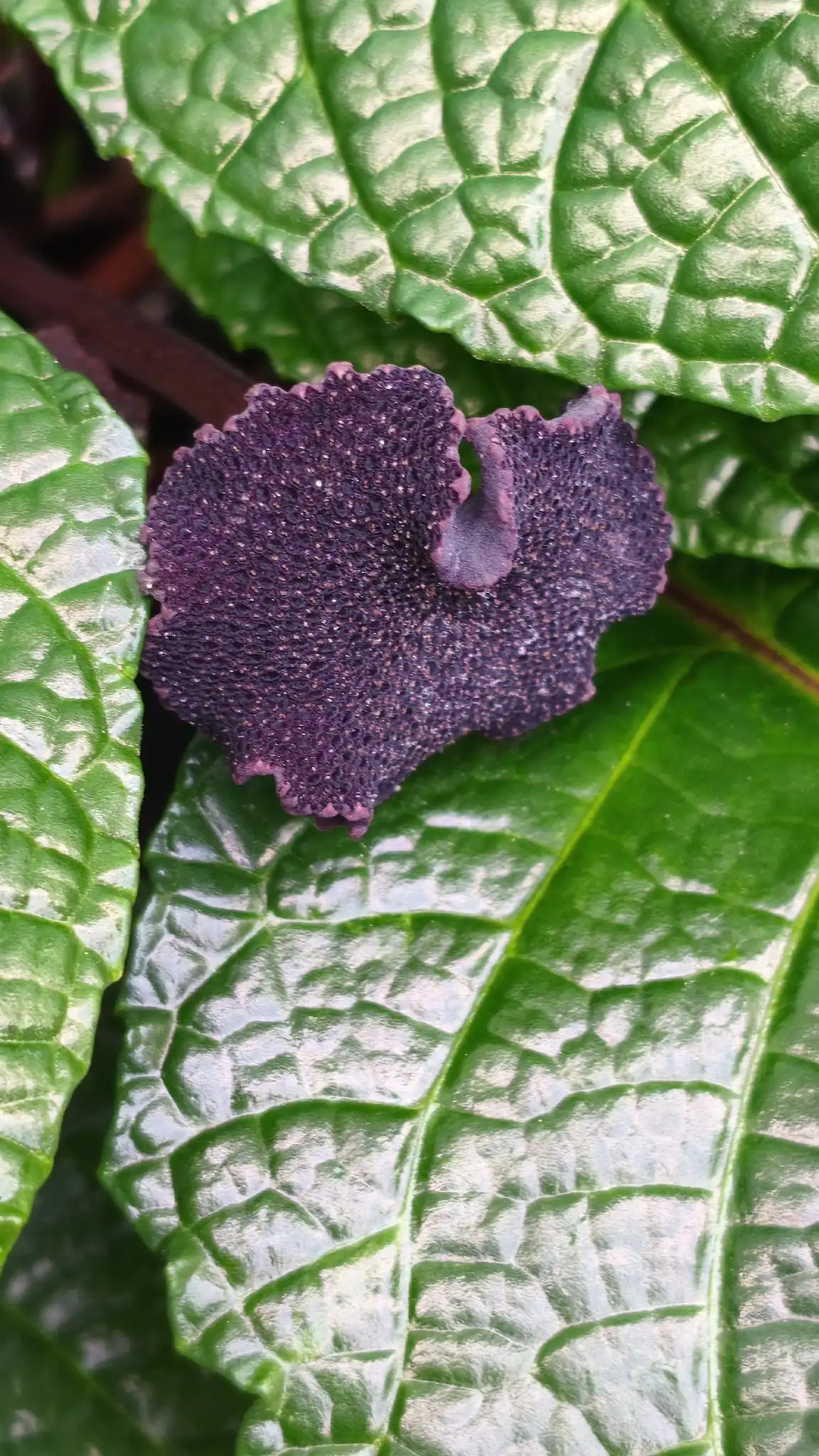
It makes no showy petals; the inflorescence is a flat orbicular receptacle one to four centimeters across, dark purple-brown above and green beneath with a wavy toothed margin, bearing tiny male and female flowers across its face on a bare stalk two to six inches tall. Ripe drupes dehisce explosively and throw white two-millimeter seeds meters from the pot, so one plant self-sows through nearby containers and is often mislabelled in trade.
Uses & Benefits:
Essentials
At a Glance
Plant Type
Tropical
Height
12"
Width
12"
Light
Partial Sun, Shade
Zones
9, 10
Water
Medium
Humidity
High
Lifespan
Perennial
Native To
Eastern Brazil
Toxicity
Milky latex - skin and ingestion risk unknown
Bloom period
Year round
In flower about 12 months of the year
Planting
How to Grow
- Grow outdoors only in zones 9-11 in semi-shade to full shade; elsewhere keep it as an indoor or greenhouse pot plant.
- Pot in a draining porous organic-rich mix and water to keep it evenly moist but never waterlogged.
- Hold temperatures above 59F for continuous growth, protect from any frost, and provide high humidity away from dry heat vents.
- Feed lightly with balanced fertilizer during active growth and leave the rhizome clump undisturbed.
- Harvest ejected seed daily and surface-sow fresh, or divide congested rhizomes to increase stock.
Pro Tip
Sow seed the day it is shot; viability is short and fresh seed surface-sown on moist porous mix at 75 to 82F germinates in 10 to 20 days.
Keep It Thriving
Care Guide
Do
- Keep the mix constantly moist with free drainage.
- Provide bright indirect light or deep shade and high humidity.
- Sow fresh seed immediately and isolate seeding pots to contain self-sowing.
Don't
- Do not let the root ball dry out; plants drop leaves when dry.
- Do not waterlog the pot or leave it standing in water.
- Do not expose to frost or to prolonged temperatures below 59F.
Seasonal Care Calendar
| Task | Jan | Feb | Mar | Apr | May | Jun | Jul | Aug | Sep | Oct | Nov | Dec |
|---|---|---|---|---|---|---|---|---|---|---|---|---|
| Fertilize | ||||||||||||
| Pest Check | ||||||||||||
| Propagate | ||||||||||||
| Winter Prep |
Watch Out For
Pests & Diseases
Common Pests
Common Diseases
In the Garden
Landscape Uses & Companions
Landscape Uses
Companion Plants
Multiply
Propagation Methods
Good to Know
Common Questions
Mattress Button Plant questions
What zones can Mattress Button Plant grow in?
Mattress Button Plant is hardy in USDA Zones 9–10: in that range it survives winter in the ground. Colder than Zone 9, grow it in a container you can move to shelter for the winter, or as an annual.
When does Mattress Button Plant bloom?
Mattress Button Plant typically blooms year-round. Exact timing shifts a week or two with your zone — Sow's bloom calendar maps it to your garden.
Does Mattress Button Plant need full sun?
Mattress Button Plant does best in part shade.
Keep exploring
Explore the genus
Hardy in your zone?
Grow Mattress Button Plant with confidence
See it in a design of your actual yard, get zone-matched care reminders, and track it season by season in your garden journal.