The Story
Plant Bio
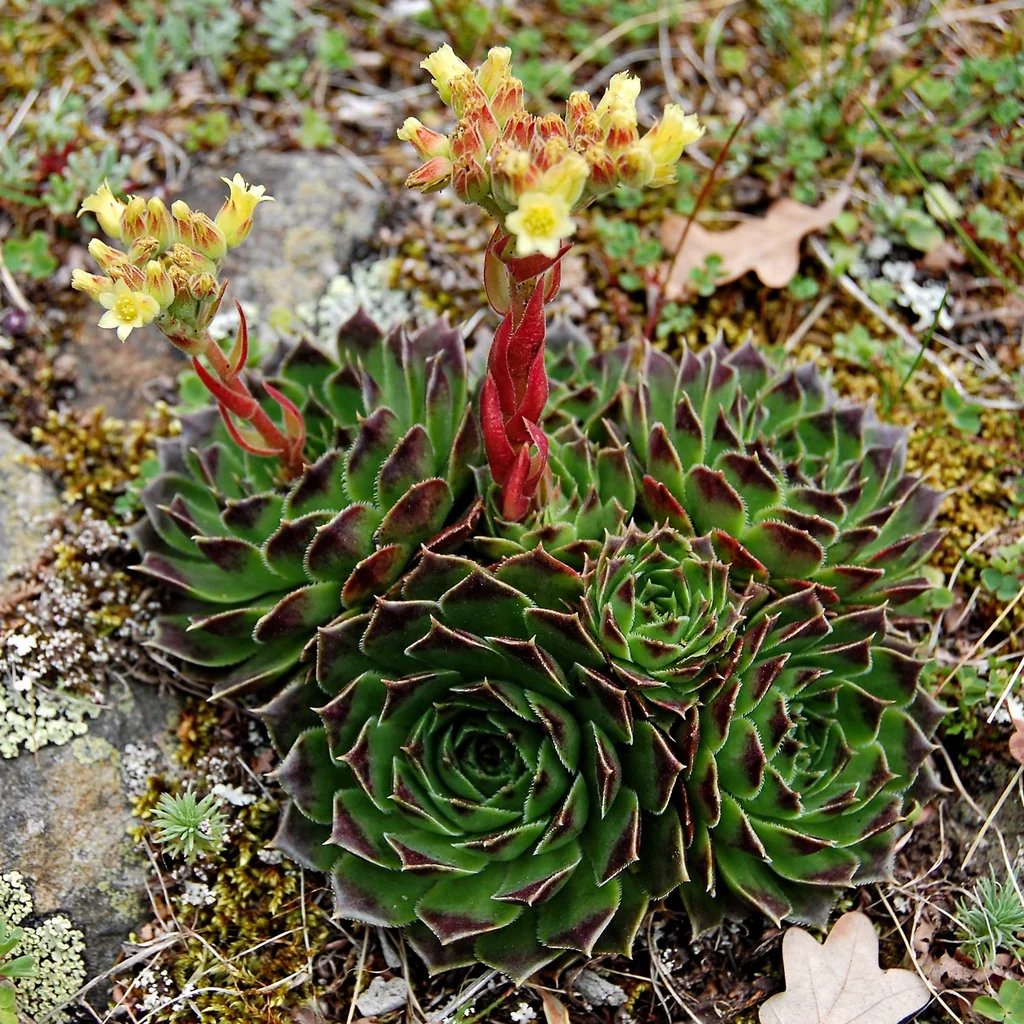
Sempervivum heuffelii, sold as Jovibarba heuffelii, is a clump-forming evergreen succulent from Balkan rock outcrops and cliffs, making tight rosettes 3 to 6 inches tall by 8 inches wide with thick dark green leaves tipped burgundy under stress. Each mature rosette sends up a stout leafy stalk 8 to 14 inches tall carrying up to 40 pale yellow bell-shaped six-petalled flowers in summer.
Unlike common hen-and-chicks it produces no stolons, splitting new sessile offsets from between the leaves that can only be increased by cutting the crown apart. Each rosette is monocarpic and dies after it flowers, and in cultivation winter wet at the crown kills more plants than cold.
Uses & Benefits:
Essentials
At a Glance
Plant Type
Cactus Succulent
Height
6"
Width
8"
Light
Full Sun
Zones
4, 5, 6, 7, 8, 9, 10
Water
Low
Humidity
Low, dry winter crown
Lifespan
Perennial, monocarpic rosettes
Native To
Balkan Peninsula to Romania
Toxicity
Mildly toxic if ingested
Bloom period
Summer
In flower about 3 months of the year
Planting
How to Grow
- Plant in full sun in very gritty, lean, fast-draining soil in a rockery, trough, or pot with a drainage hole.
- Set the crown at soil level and top-dress with gravel to keep leaves off wet soil.
- Water deeply only when completely dry from spring through summer, then keep almost dry in fall and winter.
- Shelter pots from heavy winter rain under an eave while leaving them out in the cold.
- Remove the spent rosette after flowering and leave the attached offsets to fill in.
Pro Tip
Keep the crown dry in winter and water only when the soil is completely dry; cold is not the limit, standing water is.
Keep It Thriving
Care Guide
Do
- Plant in full sun with excellent drainage
- Water only when soil is completely dry
- Top-dress with grit to keep crown dry
Don't
- Do not plant in rich moisture-holding soil
- Do not overhead water or leave crown wet in winter
- Do not try to root single leaves like other succulents
Seasonal Care Calendar
| Task | Jan | Feb | Mar | Apr | May | Jun | Jul | Aug | Sep | Oct | Nov | Dec |
|---|---|---|---|---|---|---|---|---|---|---|---|---|
| Deadhead | ||||||||||||
| Divide | ||||||||||||
| Pest Check | ||||||||||||
| Plant | ||||||||||||
| Winter Prep |
Watch Out For
Pests & Diseases
Common Pests
Common Diseases
In the Garden
Landscape Uses & Companions
Landscape Uses
Companion Plants
Multiply
Propagation Methods
Good to Know
Common Questions
Job's Beard questions
What zones can Job's Beard grow in?
Job's Beard is hardy in USDA Zones 4–10: in that range it survives winter in the ground.
Is Job's Beard deer resistant?
Not reliably. Deer may browse Job's Beard, especially tender spring growth — plan on repellents or fencing where pressure is high.
When does Job's Beard bloom?
Job's Beard typically blooms in summer. Exact timing shifts a week or two with your zone — Sow's bloom calendar maps it to your garden.
Does Job's Beard need full sun?
Job's Beard does best in full sun (6+ hours).
Is Job's Beard drought tolerant?
Yes — once established (usually after the first full season), Job's Beard handles dry spells with minimal watering. Water deeply its first year to build the root system that makes that possible.
Keep exploring
Explore the genus
Grow Job's Beard with confidence
See it in a design of your actual yard, get zone-matched care reminders, and track it season by season in your garden journal.