The Story
Plant Bio
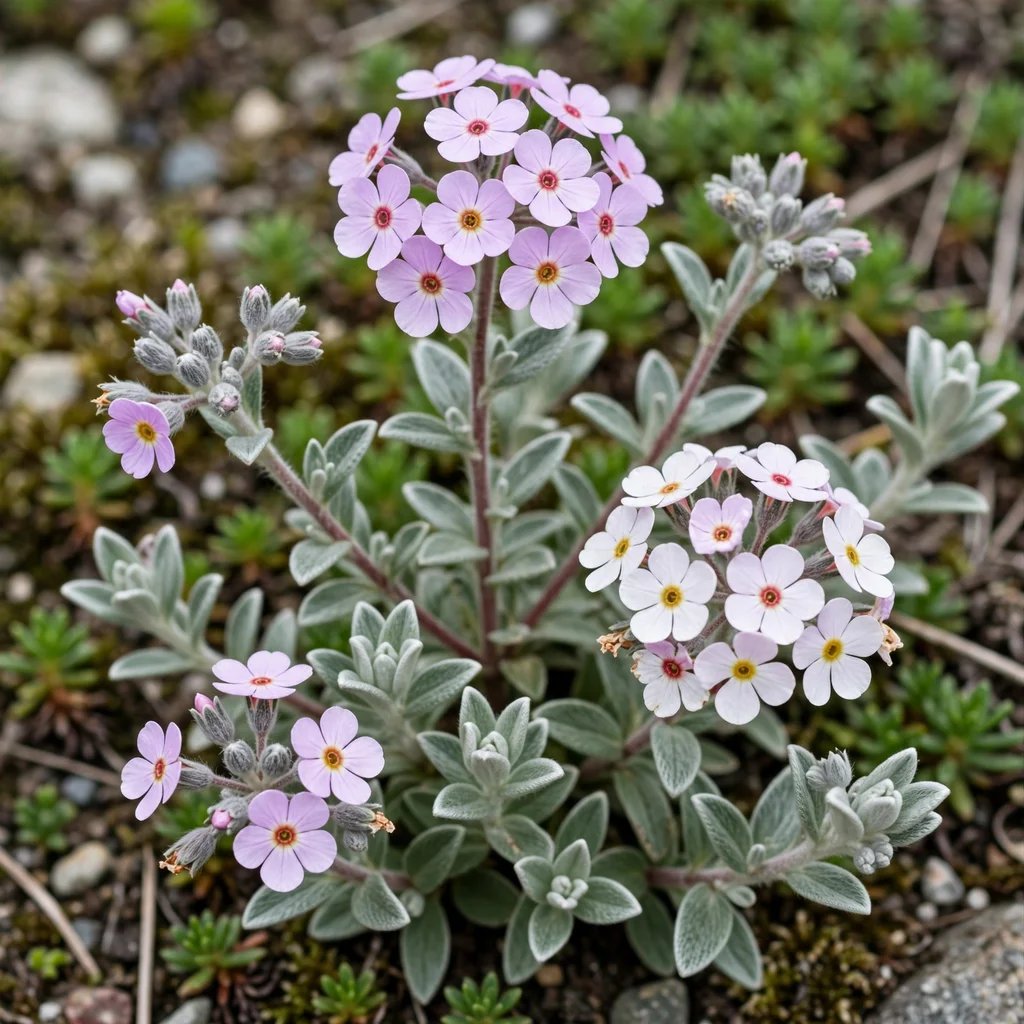
Androsace lanuginosa is an evergreen mat-forming perennial from Himalayan scree, rooting along trailing stems to form loose silvery mats. The leaves are small ovate to elliptic, densely covered in silky gray hairs that shed water and reflect sun.
Unlike cushion androsaces, it grows as a loose cascade rather than a tight dome, with stems that spill over rock and root where they touch. In summer it carries umbels of salverform lilac-pink flowers with a red to yellow eye on short upright stalks above the foliage.
Uses & Benefits:
Essentials
At a Glance
Plant Type
Perennial
Height
4"
Width
24"
Light
Full Sun, Partial Sun
Zones
4, 5, 6, 7, 8, 9
Water
Low to moderate
Humidity
Low
Lifespan
Perennial
Native To
Western Himalaya
Toxicity
Non-toxic
Bloom period
Summer – Late summer
In flower about 3 months of the year
Marketplace
Where to Buy
Shipping costs Year-round shipping Free shipping
Planting
How to Grow
- Set plants into a rock crevice, wall top, or trough filled with equal parts loam, coarse sand, and fine gravel.
- Place in full sun with light afternoon shade in hot-summer areas; set the crown slightly proud of the soil line.
- Water at the base to keep the scree lightly moist in growth, letting it dry between waterings and keeping rosettes dry.
- Top-dress with grit and pull out dead rosettes promptly to keep air moving through the mat.
- Shelter from winter rain under an eave or cold-frame glass while leaving it exposed to cold.
Pro Tip
Plant it on edge in a vertical crevice or gritty scree so water runs straight off the crown; cold does not kill it, standing winter wet does.
Keep It Thriving
Care Guide
Do
- Plant high in gritty, fast-draining scree with the crown clear of soil.
- Water from below and allow the mix to dry between waterings.
- Remove spent flowers and dead rosettes to prevent fungus.
Don't
- Do not overhead water or let rosettes sit wet overnight.
- Do not cut back into old bare stems or feed with rich fertilizer.
- Do not plant in clay or low ground that holds winter wet.
Seasonal Care Calendar
| Task | Jan | Feb | Mar | Apr | May | Jun | Jul | Aug | Sep | Oct | Nov | Dec |
|---|---|---|---|---|---|---|---|---|---|---|---|---|
| Pest Check | ||||||||||||
| Plant | ||||||||||||
| Propagate | ||||||||||||
| Spring Cleanup | ||||||||||||
| Winter Prep |
Watch Out For
Pests & Diseases
Common Pests
Common Diseases
In the Garden
Landscape Uses & Companions
Landscape Uses
Multiply
Propagation Methods
Good to Know
Common Questions
Woolly Rock Jasmine questions
What zones can Woolly Rock Jasmine grow in?
Woolly Rock Jasmine is hardy in USDA Zones 4–9: in that range it survives winter in the ground. Warmer than Zone 9, winter isn't the problem: it prefers colder winters, and summer heat can shorten its life.
When does Woolly Rock Jasmine bloom?
Woolly Rock Jasmine typically blooms in summer. Exact timing shifts a week or two with your zone — Sow's bloom calendar maps it to your garden.
Does Woolly Rock Jasmine need full sun?
Woolly Rock Jasmine does best in full sun to part shade. In hot climates, afternoon shade keeps blooms fresher longer.
Is Woolly Rock Jasmine drought tolerant?
Yes — once established (usually after the first full season), Woolly Rock Jasmine handles dry spells with minimal watering. Water deeply its first year to build the root system that makes that possible.
Keep exploring
Explore the genus
Grow Woolly Rock Jasmine with confidence
See it in a design of your actual yard, get zone-matched care reminders, and track it season by season in your garden journal.