The Story
Plant Bio
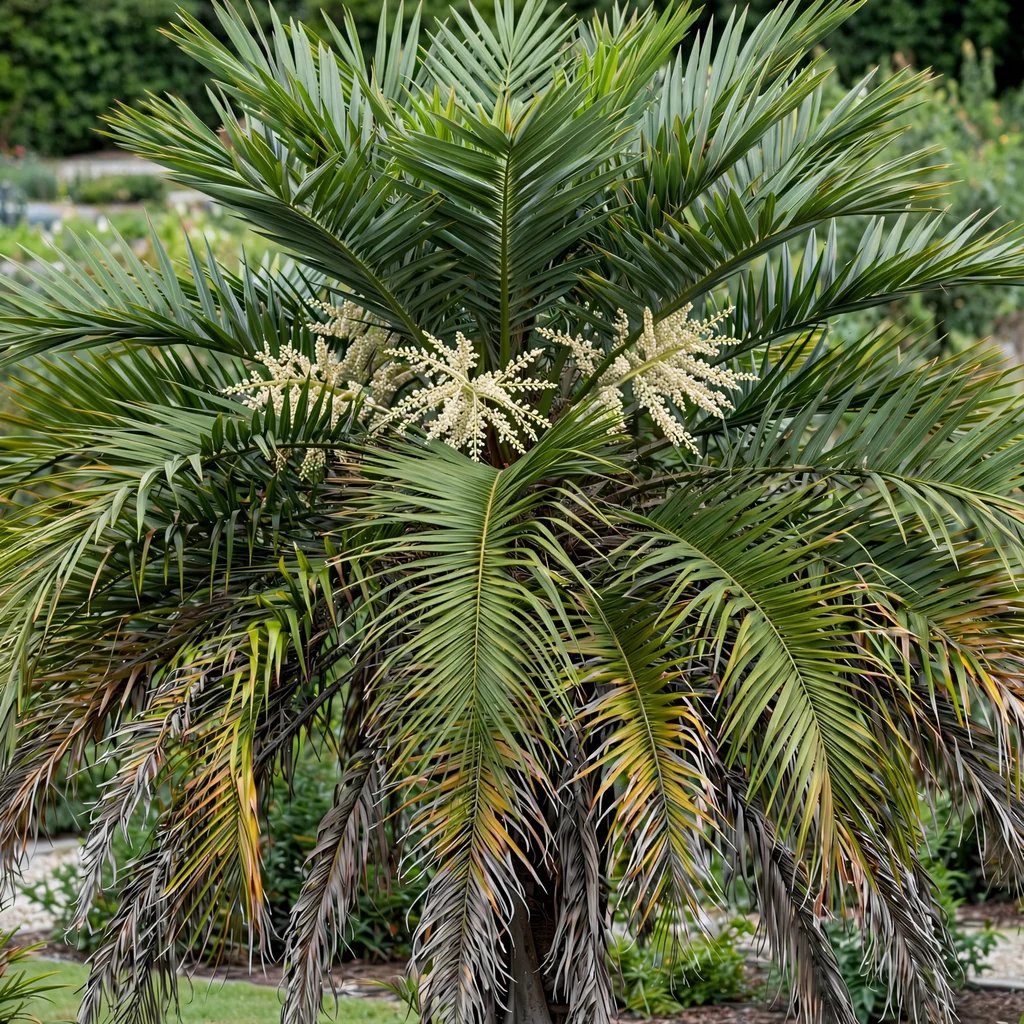
x Butyagrus nabonnandii is a single-trunked feather palm from subtropical South America, occurring wild in southern Brazil to Uruguay where the parent ranges overlap. It builds an upright trunk topped by a crown of arching pinnate fronds, reaching 20 to 30 feet tall with a 15 to 20 foot canopy.
It is the F1 cross of Butia odorata by Syagrus romanzoffiana, joining pindo cold hardiness to 14F with the faster, more upright crown of the queen palm. It blooms in branched creamy white panicles in mid summer followed by abundant showy orange drupes that are almost always sterile, so it does not self-sow.
Uses & Benefits:
Essentials
At a Glance
Plant Type
Tree
Height
300"
Width
210"
Light
Full Sun, Partial Sun
Zones
8, 9, 10
Water
Moderate
Humidity
Tolerant
Lifespan
Long-lived palm
Native To
Southern Brazil to Uruguay
Toxicity
Unknown
Bloom period
Mid summer – Late summer
In flower about 2 months of the year
Planting
How to Grow
- Set in full sun with room for a 15 to 20 foot canopy, tolerating light shade but fruiting and crowning best in sun.
- Plant at grade in well-drained sandy or loamy soil, working in no more than loose backfill to avoid a wet sump around the rootball.
- Water deeply after planting and through the first summer, then reduce to moderate irrigation once established.
- Mulch 2 to 3 inches wide of the trunk, keeping mulch off the trunk to keep the base dry in winter.
- Leave green fronds intact and prune only fully brown fronds cut close to the trunk.
Pro Tip
Remove only fully brown dead fronds and never cut green fronds or the crown; keep winter drainage sharp to prevent trunk rot.
Keep It Thriving
Care Guide
Do
- Plant in well-drained soil that dries between waterings in winter
- Irrigate during establishment and drought to maintain crown growth
- Monitor the crown and trunk base for scale and decay
Don't
- Do not cut green fronds or into the crown
- Do not plant in soil that stays saturated in winter
- Do not expect viable seed; do not sow fallen drupes for increase
Seasonal Care Calendar
| Task | Jan | Feb | Mar | Apr | May | Jun | Jul | Aug | Sep | Oct | Nov | Dec |
|---|---|---|---|---|---|---|---|---|---|---|---|---|
| Pest Check | ||||||||||||
| Plant | ||||||||||||
| Prune | ||||||||||||
| Winter Prep |
Watch Out For
Pests & Diseases
Common Pests
Common Diseases
In the Garden
Landscape Uses & Companions
Landscape Uses
Companion Plants
Multiply
Propagation Methods
Good to Know
Common Questions
Mule Palm questions
What zones can Mule Palm grow in?
Mule Palm is hardy in USDA Zones 8–10: in that range it survives winter in the ground. Colder than Zone 8, winters are too cold for it to survive outdoors.
When does Mule Palm bloom?
Mule Palm typically blooms in mid- to late summer. Exact timing shifts a week or two with your zone — Sow's bloom calendar maps it to your garden.
Does Mule Palm need full sun?
Mule Palm does best in full sun to part shade. In hot climates, afternoon shade keeps blooms fresher longer.
Is Mule Palm drought tolerant?
Yes — once established (usually after the first full season), Mule Palm handles dry spells with minimal watering. Water deeply its first year to build the root system that makes that possible.
Keep exploring
Explore the genus
Hardy in your zone?
Grow Mule Palm with confidence
See it in a design of your actual yard, get zone-matched care reminders, and track it season by season in your garden journal.