The Story
Plant Bio
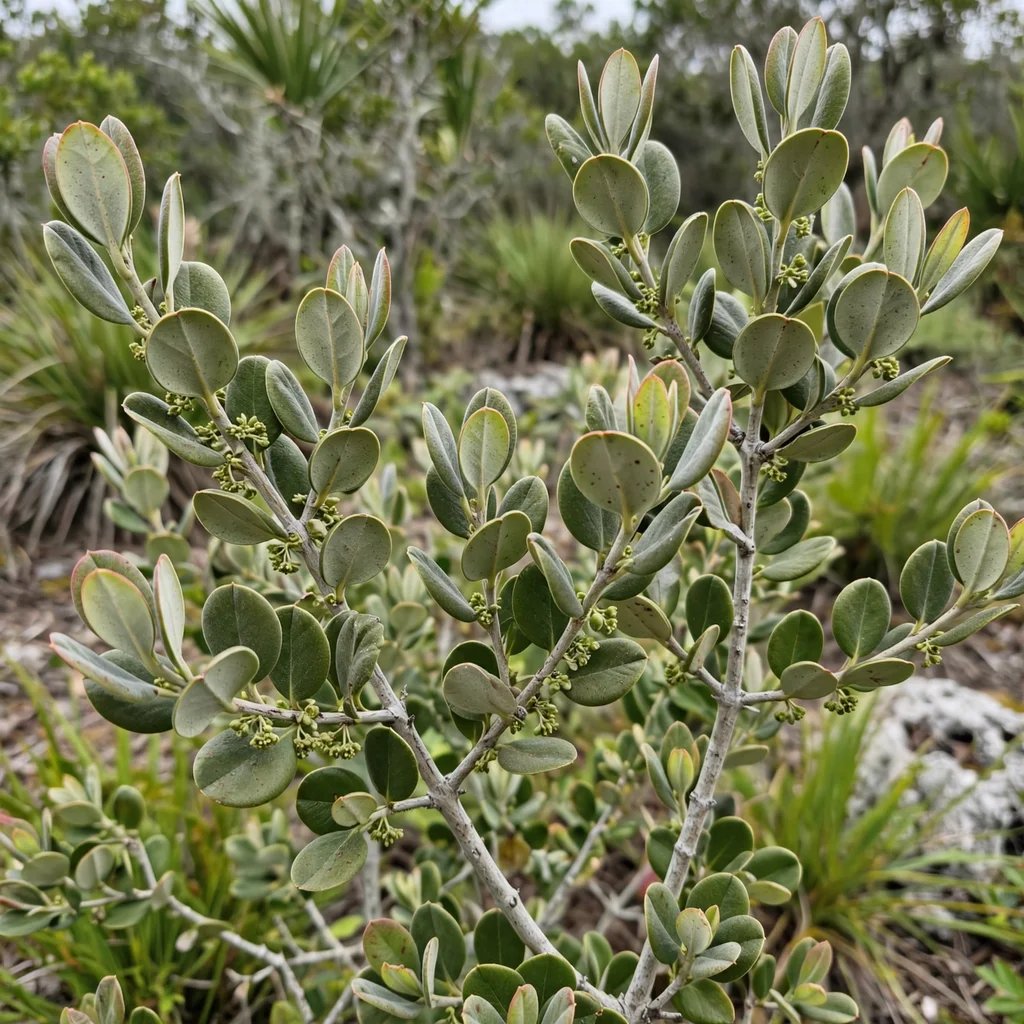
Heterosavia bahamensis, the Bahama maidenbush, is an evergreen shrub of Florida Keys limestone hammocks reaching six to ten feet in gardens, with a rounded multi-stemmed crown and pale gray bark. Leaves are alternate, oval-spatulate and dark green under two inches long, folding upward along the stem, with bright red new growth on thin reddish twigs.
Flowers are tiny green to greenish-white five-petaled blooms, the males borne six to twenty-five to a cluster with females usually solitary, followed by brown three-parted capsules under half an inch. It closely resembles cocoplum in leaf and red flush, differing in its folded smaller leaves and inconspicuous flowers; older labels still list it as Savia bahamensis in the Phyllanthaceae.
Uses & Benefits:
Essentials
At a Glance
Plant Type
Shrub
Height
120"
Width
120"
Light
Full Sun, Partial Sun
Zones
10
Water
Low to moderate once established
Humidity
Tolerant of humid subtropical air
Lifespan
Long-lived shrub
Native To
South Florida Keys to Caribbean
Toxicity
Unknown - no toxicity reported
Bloom period
Spring – Summer
In flower about 6 months of the year
Planting
How to Grow
- Plant container stock in spring or fall in zones 10B-11 in full sun to part sun.
- Dig a hole no deeper than the root ball and twice as wide in sand, loam, clay or lime rock that drains freely.
- Set the crown level with the grade, backfill, firm gently and water in thoroughly.
- Mulch 2 to 3 inches with bark, keeping mulch off the stems, and space plants 36 to 60 inches for a hedge.
- Water regularly until rooted, then reduce to occasional deep watering; established plants tolerate drought.
Pro Tip
Site in full sun on well-drained calcareous soil and tip-prune lightly to keep the crown dense; cutting hard back into leafless wood refills slowly.
Keep It Thriving
Care Guide
Do
- Plant in well-drained coastal upland soil neutral to slightly alkaline.
- Provide full sun for densest growth and red new foliage.
- Source nursery-grown, Florida-listed stock and leave wild thickets undisturbed.
Don't
- Do not plant north of zone 10B where frost damages it.
- Do not plant in sites with standing water or saltwater flooding.
- Do not shear hard into old bare stems to force regrowth.
Seasonal Care Calendar
| Task | Jan | Feb | Mar | Apr | May | Jun | Jul | Aug | Sep | Oct | Nov | Dec |
|---|---|---|---|---|---|---|---|---|---|---|---|---|
| Mulch | ||||||||||||
| Pest Check | ||||||||||||
| Plant | ||||||||||||
| Prune |
Watch Out For
Pests & Diseases
Common Pests
Common Diseases
In the Garden
Landscape Uses & Companions
Landscape Uses
Multiply
Propagation Methods
Good to Know
Common Questions
Bahama Maidenbush questions
What zones can Bahama Maidenbush grow in?
Bahama Maidenbush is hardy in USDA Zone 10: in that range it survives winter in the ground. Colder than Zone 10, grow it in a container you can move to shelter for the winter.
When does Bahama Maidenbush bloom?
Bahama Maidenbush typically blooms from spring to summer. Exact timing shifts a week or two with your zone — Sow's bloom calendar maps it to your garden.
Does Bahama Maidenbush need full sun?
Bahama Maidenbush does best in full sun to part shade. In hot climates, afternoon shade keeps blooms fresher longer.
Is Bahama Maidenbush drought tolerant?
Yes — once established (usually after the first full season), Bahama Maidenbush handles dry spells with minimal watering. Water deeply its first year to build the root system that makes that possible.
Keep exploring
Explore the genus
Hardy in your zone?
Grow Bahama Maidenbush with confidence
See it in a design of your actual yard, get zone-matched care reminders, and track it season by season in your garden journal.