The Story
Plant Bio
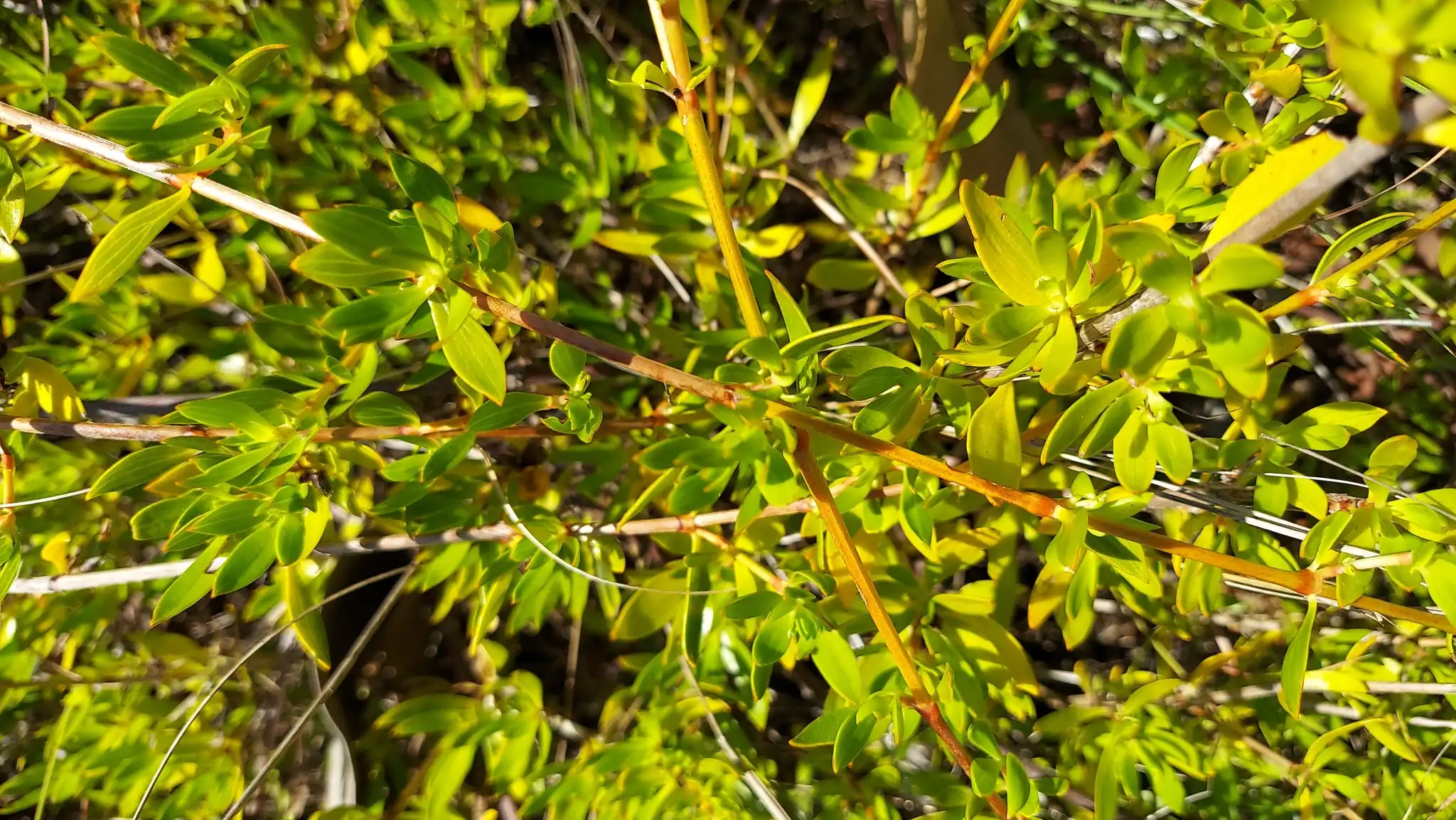
Ernodea littoralis, a member of the Rubiaceae, is a prostrate evergreen groundcover reaching one to three feet tall with long, curving, multi-stemmed branches that root where they touch sand. The small, light-green, succulent leaves are opposite, simple and glossy with entire margins, carried on bright red stems in a fine-textured, moderately dense mat.
It flowers year round with small, tubular, white to pinkish-white blooms borne singly or in clusters, followed by round, fleshy golden-yellow berries under a half inch across. Unlike inland groundcovers, it binds sterile coastal sand, tolerates salt spray and prolonged drought, and thins and rots with shade or over-irrigation.
Uses & Benefits:
Essentials
At a Glance
Plant Type
Groundcover
Height
36"
Width
60"
Light
Full Sun
Zones
10
Water
Low
Humidity
Unknown
Lifespan
Perennial
Native To
South Florida, Caribbean, Central America to Colombia
Toxicity
Unknown
Bloom period
Year round
In flower about 12 months of the year
Planting
How to Grow
- Choose an open site in full sun with well-drained sand; do not plant in low ground that holds water.
- Space plants 36 to 60 inches apart to form a spreading mat and allow airflow between crowns.
- Set the root ball level with the sand surface and water in once to settle contact.
- Withhold further irrigation except to establish; mature plants survive dry spells with little to no water.
Pro Tip
Give it full sun, sterile well-drained sand and almost no supplemental water once rooted; shade and irrigation thin the mat and rot the roots.
Keep It Thriving
Care Guide
Do
- Plant in full sun in sand or sandy clay with sharp drainage.
- Allow stems to layer and root to knit dunes and beach ridges.
- Keep irrigation minimal once established.
Don't
- Do not overwater or install irrigation that keeps the root zone wet.
- Do not plant in shade or under dense canopy; the mat thins and weakens.
- Do not enrich with heavy compost or fertilizer that holds moisture.
Seasonal Care Calendar
| Task | Jan | Feb | Mar | Apr | May | Jun | Jul | Aug | Sep | Oct | Nov | Dec |
|---|---|---|---|---|---|---|---|---|---|---|---|---|
| Pest Check | ||||||||||||
| Plant | ||||||||||||
| Propagate | ||||||||||||
| Prune |
Watch Out For
Pests & Diseases
Common Pests
Common Diseases
In the Garden
Landscape Uses & Companions
Landscape Uses
Multiply
Propagation Methods
Good to Know
Common Questions
Golden Creeper questions
What zones can Golden Creeper grow in?
Golden Creeper is hardy in USDA Zone 10: in that range it survives winter in the ground. Colder than Zone 10, grow it in a container you can move to shelter for the winter, or as an annual.
When does Golden Creeper bloom?
Golden Creeper typically blooms year-round. Exact timing shifts a week or two with your zone — Sow's bloom calendar maps it to your garden.
Does Golden Creeper need full sun?
Golden Creeper does best in full sun (6+ hours).
Is Golden Creeper drought tolerant?
Yes — once established (usually after the first full season), Golden Creeper handles dry spells with minimal watering. Water deeply its first year to build the root system that makes that possible.
Keep exploring
Explore the genus
Hardy in your zone?
Grow Golden Creeper with confidence
See it in a design of your actual yard, get zone-matched care reminders, and track it season by season in your garden journal.