The Story
Plant Bio
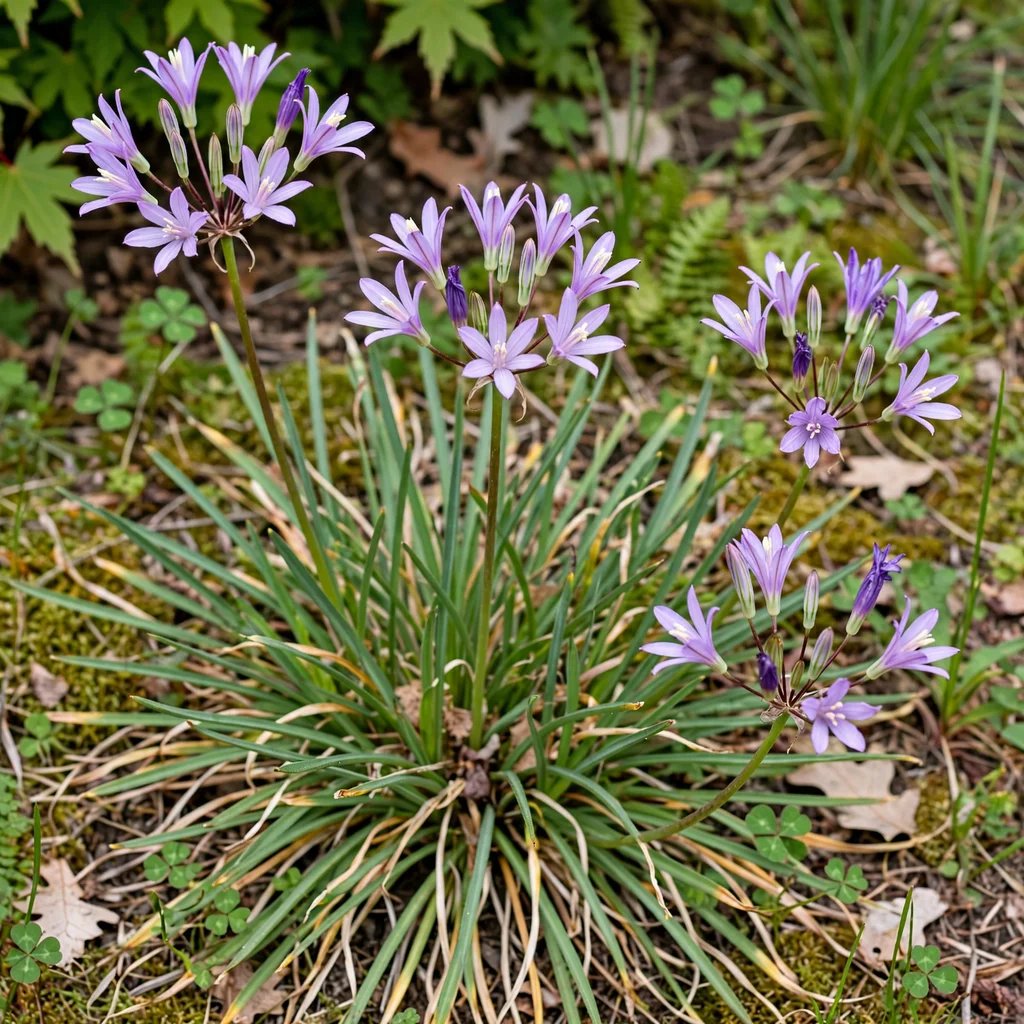
Brodiaea californica is a cormous perennial from northern California to southwestern Oregon that grows one to two feet tall from narrow grass-like basal leaves. The foliage yellows and withers as stout leafless stalks rise in late spring, each topped by an open umbel of star-shaped lavender to purple flowers about one to one and a half inches across.
It is set apart by large flower heads held well above the fading leaves on robust stalks, with bloom continuing for three to four weeks into summer. The corms enter full dormancy with summer dryness and resume root growth with fall rain, so dry soil in summer keeps the corms sound.
Uses & Benefits:
Essentials
At a Glance
Plant Type
Bulb Corm Tuber
Height
24"
Width
12"
Light
Full Sun, Partial Sun
Zones
6, 7, 8, 9
Water
Low
Humidity
Unknown
Lifespan
Perennial
Native To
California, Oregon
Toxicity
Non-toxic
Bloom period
Late spring – Summer
In flower about 4 months of the year
Planting
How to Grow
- Plant corms in fall 4 inches deep and 3 to 4 inches apart in sharply drained sandy or loamy soil in full sun to partial sun.
- Water through spring growth while leaves are green and flowers are developing.
- Stop watering as foliage yellows and leave the yellowing leaves until fully withered to recharge the corm.
- Mark the dormant spot and keep soil dry through summer to prevent rot.
- Divide crowded clumps in late summer while dormant and replant immediately at the same depth.
Pro Tip
Keep dormant corms completely dry in summer; watering after the foliage yellows rots the corm.
Keep It Thriving
Care Guide
Do
- Provide full sun to partial sun and excellent drainage.
- Allow foliage to wither fully before removing.
- Keep dormant corms dry in summer.
Don't
- Do not water during summer dormancy.
- Do not plant in heavy wet soil that stays soggy.
- Do not cut green foliage after bloom.
Seasonal Care Calendar
| Task | Jan | Feb | Mar | Apr | May | Jun | Jul | Aug | Sep | Oct | Nov | Dec |
|---|---|---|---|---|---|---|---|---|---|---|---|---|
| Deadhead | ||||||||||||
| Pest Check | ||||||||||||
| Plant | ||||||||||||
| Propagate | ||||||||||||
| Spring Cleanup |
Watch Out For
Pests & Diseases
Common Pests
Common Diseases
In the Garden
Landscape Uses & Companions
Landscape Uses
Multiply
Propagation Methods
Good to Know
Common Questions
California Brodiaea questions
What zones can California Brodiaea grow in?
California Brodiaea is hardy in USDA Zones 6–9: in that range it survives winter in the ground. Colder than Zone 6, grow it in a container you can move to shelter for the winter, or as an annual. Warmer than Zone 9, winter isn't the problem: it prefers colder winters, and summer heat can shorten its life.
When does California Brodiaea bloom?
California Brodiaea typically blooms from late spring to late summer. Exact timing shifts a week or two with your zone — Sow's bloom calendar maps it to your garden.
Does California Brodiaea need full sun?
California Brodiaea does best in full sun to part shade. In hot climates, afternoon shade keeps blooms fresher longer.
Is California Brodiaea drought tolerant?
Yes — once established (usually after the first full season), California Brodiaea handles dry spells with minimal watering. Water deeply its first year to build the root system that makes that possible.
Keep exploring
Explore the genus
Hardy in your zone?
Grow California Brodiaea with confidence
See it in a design of your actual yard, get zone-matched care reminders, and track it season by season in your garden journal.