The Story
Plant Bio
Casasia clusiifolia is an evergreen large shrub to small multi-trunked tree from coastal South Florida and the Caribbean, forming a dense rounded crown 8 to 20 feet tall and 8 to 15 feet wide. The thick glossy obovate leaves reach 4 to 8 inches long, cluster at the branch tips, and hold year-round on sand, tolerating salt spray, wind, and drought.
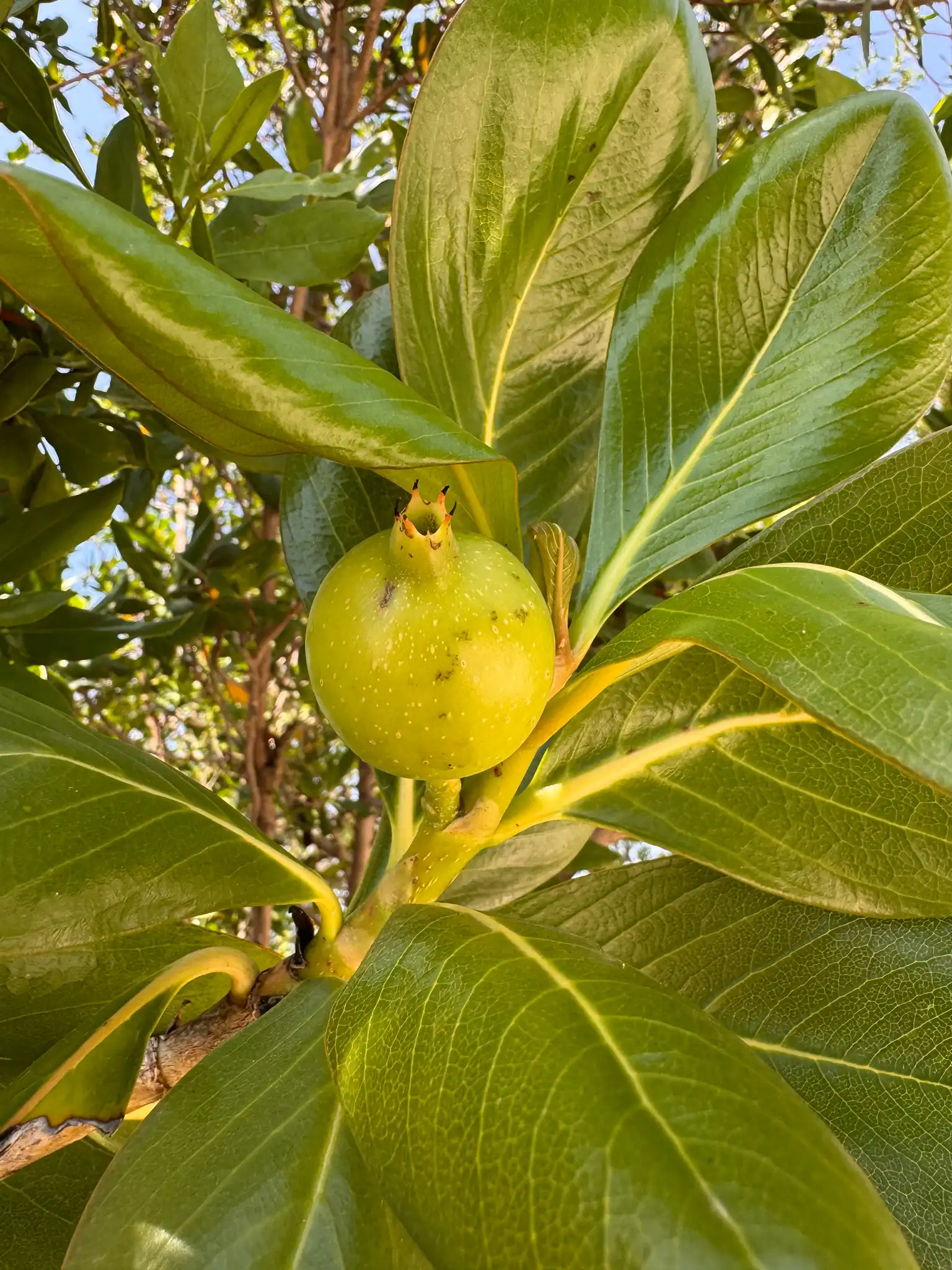
Plants are dioecious, bearing fragrant white flowers tipped pink in axillary clusters in spring, with male and female flowers on separate plants. The so-called seven-year apple takes about 12 months to ripen and persists on the plant as wrinkled fruit turning green to yellow to black, with seedy black pulp whose seeds cause vomiting and whose juice stains skin black.
Uses & Benefits:
Essentials
At a Glance
Plant Type
Shrub
Height
240"
Width
180"
Light
Full Sun, Partial Sun
Zones
10
Water
Low
Humidity
Unknown
Lifespan
Long-lived
Native To
South Florida, Bahamas, Bermuda, Cuba, Turks and Caicos
Toxicity
Seeds emetic, unripe fruit inedible
Bloom period
Spring – Summer
In flower about 6 months of the year
Planting
How to Grow
- Plant year-round in zones 10B-11B in full sun to part shade.
- Set into well-drained sand or loam, acidic to alkaline; it tolerates dry sandy soil once established.
- Space 3 to 5 feet for a hedge on 4 to 5 foot centers, wider for a specimen tree.
- Water to establish, then water sparingly; prune after the spring bloom to contain size or remove lower limbs to train a multi-trunk form.
Pro Tip
Plant a male within sight of females if you want fruit; without both sexes flowers never set, and allow room for a 15-foot spread unless you plan to prune it as a small multi-trunk tree.
Keep It Thriving
Care Guide
Do
- Do plant in a coastal, frost-free site with sharp drainage.
- Do plant male and female plants together if fruit is wanted.
- Do prune lightly after bloom to keep the dense rounded form.
Don't
- Do not plant outdoors below zone 10B; it has low frost tolerance.
- Do not eat unripe fruit or chew seeds; seeds cause vomiting and pulp stains skin.
- Do not expect roots to be a problem; they are usually not an issue near walks.
Seasonal Care Calendar
| Task | Jan | Feb | Mar | Apr | May | Jun | Jul | Aug | Sep | Oct | Nov | Dec |
|---|---|---|---|---|---|---|---|---|---|---|---|---|
| Mulch | ||||||||||||
| Pest Check | ||||||||||||
| Plant | ||||||||||||
| Prune |
Watch Out For
Pests & Diseases
Common Pests
Common Diseases
In the Garden
Landscape Uses & Companions
Landscape Uses
Multiply
Propagation Methods
Good to Know
Common Questions
Seven Year Apple questions
What zones can Seven Year Apple grow in?
Seven Year Apple is hardy in USDA Zone 10: in that range it survives winter in the ground. Colder than Zone 10, grow it in a container you can move to shelter for the winter.
When does Seven Year Apple bloom?
Seven Year Apple typically blooms from spring to summer. Exact timing shifts a week or two with your zone — Sow's bloom calendar maps it to your garden.
Does Seven Year Apple need full sun?
Seven Year Apple does best in full sun to part shade. In hot climates, afternoon shade keeps blooms fresher longer.
Is Seven Year Apple drought tolerant?
Yes — once established (usually after the first full season), Seven Year Apple handles dry spells with minimal watering. Water deeply its first year to build the root system that makes that possible.
Keep exploring
Explore the genus
Hardy in your zone?
Grow Seven Year Apple with confidence
See it in a design of your actual yard, get zone-matched care reminders, and track it season by season in your garden journal.