The Story
Plant Bio
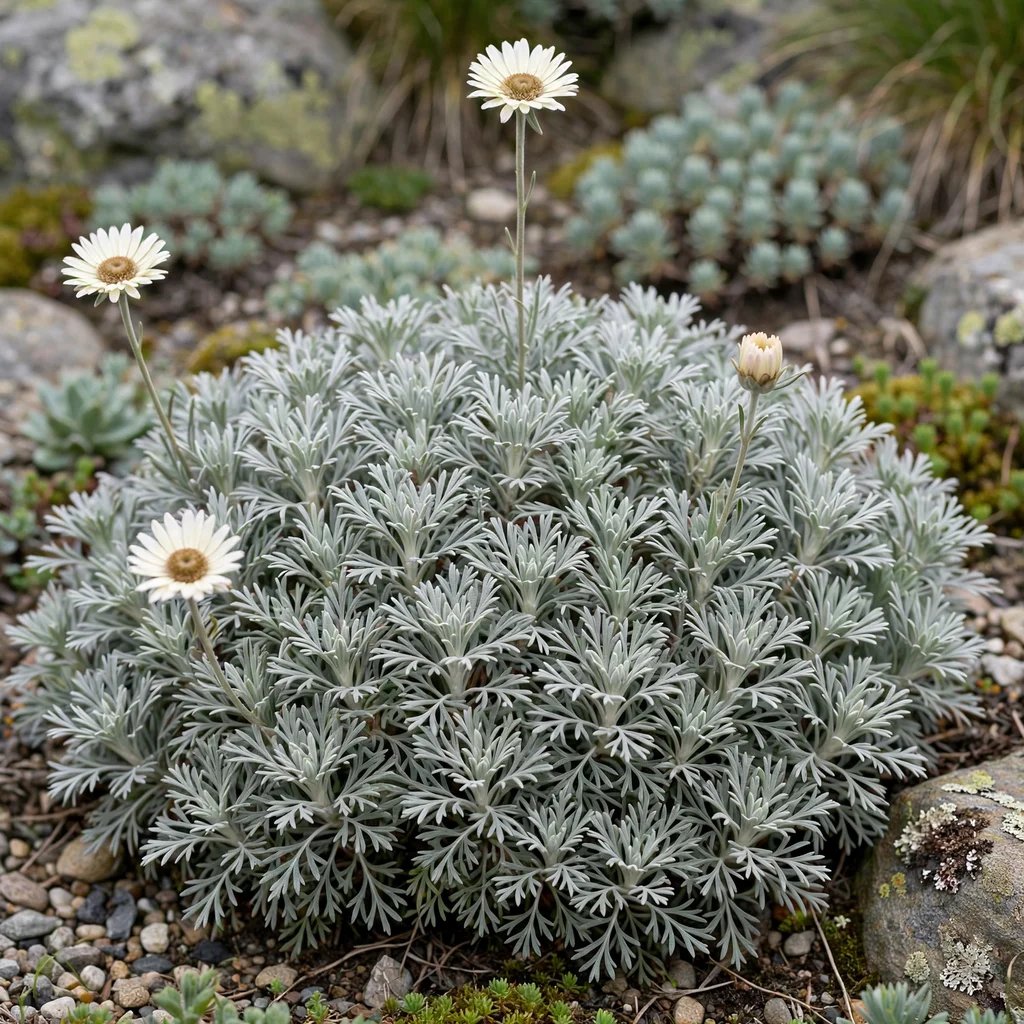
Rhodanthemum hosmariense is a low mounding subshrub from the Atlas Mountains of Morocco, forming a woody-based mat 8 to 12 inches high with soft, finely divided silvery gray-blue leaves. The solitary daisy heads sit just above the foliage, about 2 inches wide, with white rays around a large golden-yellow disk.
Unlike garden chrysanthemums it keeps its silver mound year-round and blooms from spring to fall without need for short days. The leaves are cut into narrow segments that dry quickly after rain, which suits it to lean rockeries with sharp drainage where winter wet kills the crown.
Uses & Benefits:
Essentials
At a Glance
Plant Type
Perennial
Height
10"
Width
24"
Light
Full Sun, Partial Sun
Zones
8, 9, 10
Water
Low
Humidity
Low
Lifespan
Perennial subshrub
Native To
Morocco - Atlas Mountains
Toxicity
Not known to be toxic
Bloom period
Early spring – Fall
In flower about 9 months of the year
Planting
How to Grow
- Plant in full sun in loamy, sharply drained soil, spacing plants about 20 inches apart.
- Water deeply at planting, then sparingly; established plants tolerate drought and rot in constant wet.
- Deadhead spent heads regularly to extend bloom from spring to fall.
- Tip-prune lightly after the main summer flush to keep the mound dense; do not cut into old leafless wood.
- Keep winter mulch pulled back from the crown to prevent wet rot.
Pro Tip
Plant high in full sun in lean, sharply drained soil; winter wet kills it faster than cold, and it fails below about 10F.
Keep It Thriving
Care Guide
Do
- Give full sun and sharp drainage in a rockery, edge or raised bed
- Deadhead spent heads to prolong bloom
- Space for air flow on lean soil
Don't
- Do not plant in heavy clay or low wet spots
- Do not overwater or push soft growth with rich fertilizer
- Do not cut back into old bare wood
Seasonal Care Calendar
| Task | Jan | Feb | Mar | Apr | May | Jun | Jul | Aug | Sep | Oct | Nov | Dec |
|---|---|---|---|---|---|---|---|---|---|---|---|---|
| Deadhead | ||||||||||||
| Pest Check | ||||||||||||
| Plant | ||||||||||||
| Prune | ||||||||||||
| Winter Prep |
Watch Out For
Pests & Diseases
Common Pests
Common Diseases
In the Garden
Landscape Uses & Companions
Landscape Uses
Companion Plants
Multiply
Propagation Methods
Good to Know
Common Questions
Moroccan Daisy questions
What zones can Moroccan Daisy grow in?
Moroccan Daisy is hardy in USDA Zones 8–10: in that range it survives winter in the ground. Colder than Zone 8, grow it in a container you can move to shelter for the winter, or as an annual.
Is Moroccan Daisy deer resistant?
Yes — Moroccan Daisy is rated deer-resistant. Deer typically pass it over, though extreme hunger can override any plant's defenses.
When does Moroccan Daisy bloom?
Moroccan Daisy typically blooms from spring to fall. Exact timing shifts a week or two with your zone — Sow's bloom calendar maps it to your garden.
Does Moroccan Daisy need full sun?
Moroccan Daisy does best in full sun to part shade. In hot climates, afternoon shade keeps blooms fresher longer.
Is Moroccan Daisy drought tolerant?
Yes — once established (usually after the first full season), Moroccan Daisy handles dry spells with minimal watering. Water deeply its first year to build the root system that makes that possible.
Keep exploring
Explore the genus
Hardy in your zone?
Grow Moroccan Daisy with confidence
See it in a design of your actual yard, get zone-matched care reminders, and track it season by season in your garden journal.