The Story
Plant Bio
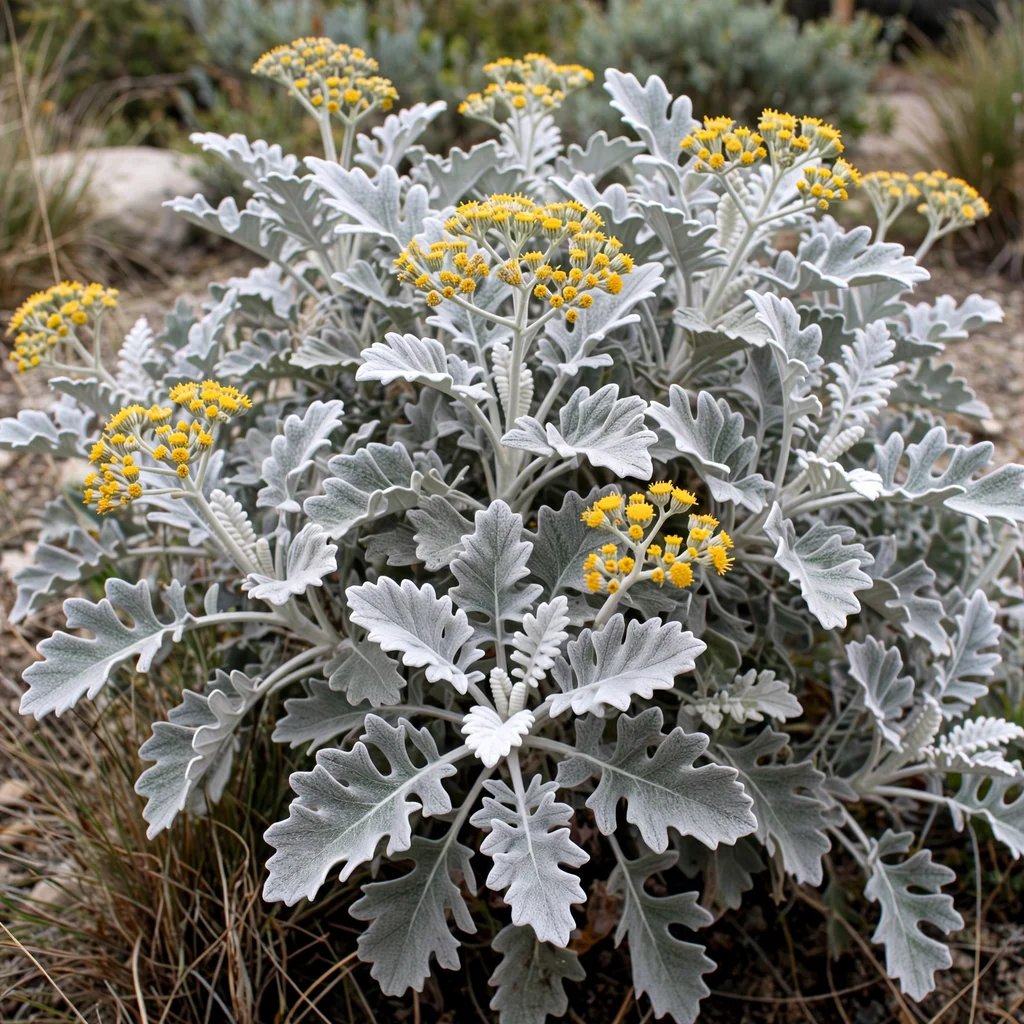
Perityle incana is an evergreen subshrub forming a dense irregular mound 2 to 3 feet tall and 3 to 5 feet wide, with silvery green deeply dissected leaves like dusty miller. The flowers are very small rayless golden yellow disc heads borne in umbrella-like clusters above the foliage, opening mainly in spring and summer with repeat bloom into fall.
The foliage is nearly white and feathery, finer and more divided than Catalina silverlace, with which it is often confused in nurseries. It is endemic to Guadalupe Island off Baja California and is frost tender, holding color best in full coastal sun with sharp drainage and little summer water.
Uses & Benefits:
Essentials
At a Glance
Plant Type
Shrub
Height
30"
Width
48"
Light
Full Sun, Partial Sun
Zones
10
Water
Low
Humidity
Tolerates coastal humidity
Lifespan
Perennial subshrub
Native To
Guadalupe Island, Mexico
Toxicity
Unknown
Bloom period
Spring – Fall
In flower about 9 months of the year
Planting
How to Grow
- Plant in fall or spring in sandy or rocky well-drained soil, in full sun near the coast with afternoon shade inland.
- Dig the hole twice the pot width, set the crown level with the soil, backfill and water deeply once.
- Mulch lightly with gravel, keeping mulch away from the stems.
- Water regularly the first season, then reduce to a deep soak every 4 to 6 weeks in summer and none near the coast.
- Leave early seed heads for songbirds, then shape lightly after flowering.
Pro Tip
Cut back by one-third after flowering and leave frost-damaged stems until spring growth resumes; hard shearing into old wood and frequent summer water shorten its life.
Keep It Thriving
Care Guide
Do
- Give at least 6 hours of morning sun, with afternoon shade in hot inland gardens.
- Provide sharp drainage and allow soil to dry between waterings.
- Grow large plants in pots in cold areas so they can be moved indoors before frost.
Don't
- Do not plant in soggy soil or water frequently in summer.
- Do not shear hard into old bare wood or cut back more than one-third at once.
- Do not cut frost-damaged stems until new growth starts in spring.
Seasonal Care Calendar
| Task | Jan | Feb | Mar | Apr | May | Jun | Jul | Aug | Sep | Oct | Nov | Dec |
|---|---|---|---|---|---|---|---|---|---|---|---|---|
| Deadhead | ||||||||||||
| Plant | ||||||||||||
| Propagate | ||||||||||||
| Prune | ||||||||||||
| Winter Prep |
Watch Out For
Pests & Diseases
Common Pests
Common Diseases
In the Garden
Landscape Uses & Companions
Landscape Uses
Multiply
Propagation Methods
Good to Know
Common Questions
Guadalupe Island Rock Daisy questions
What zones can Guadalupe Island Rock Daisy grow in?
Guadalupe Island Rock Daisy is hardy in USDA Zone 10: in that range it survives winter in the ground. Colder than Zone 10, grow it in a container you can move to shelter for the winter.
When does Guadalupe Island Rock Daisy bloom?
Guadalupe Island Rock Daisy typically blooms from spring to fall. Exact timing shifts a week or two with your zone — Sow's bloom calendar maps it to your garden.
Does Guadalupe Island Rock Daisy need full sun?
Guadalupe Island Rock Daisy does best in full sun to part shade. In hot climates, afternoon shade keeps blooms fresher longer.
Is Guadalupe Island Rock Daisy drought tolerant?
Yes — once established (usually after the first full season), Guadalupe Island Rock Daisy handles dry spells with minimal watering. Water deeply its first year to build the root system that makes that possible.
Keep exploring
Explore the genus
Hardy in your zone?
Grow Guadalupe Island Rock Daisy with confidence
See it in a design of your actual yard, get zone-matched care reminders, and track it season by season in your garden journal.