The Story
Plant Bio
Anchomanes difformis is a deciduous tuberous member of the arum family that grows from a large horizontal tuber. Each season it sends up a single giant divided leaf on a fleshy spiny stalk reaching six to ten feet tall, then dies back to the tuber for a dry rest.
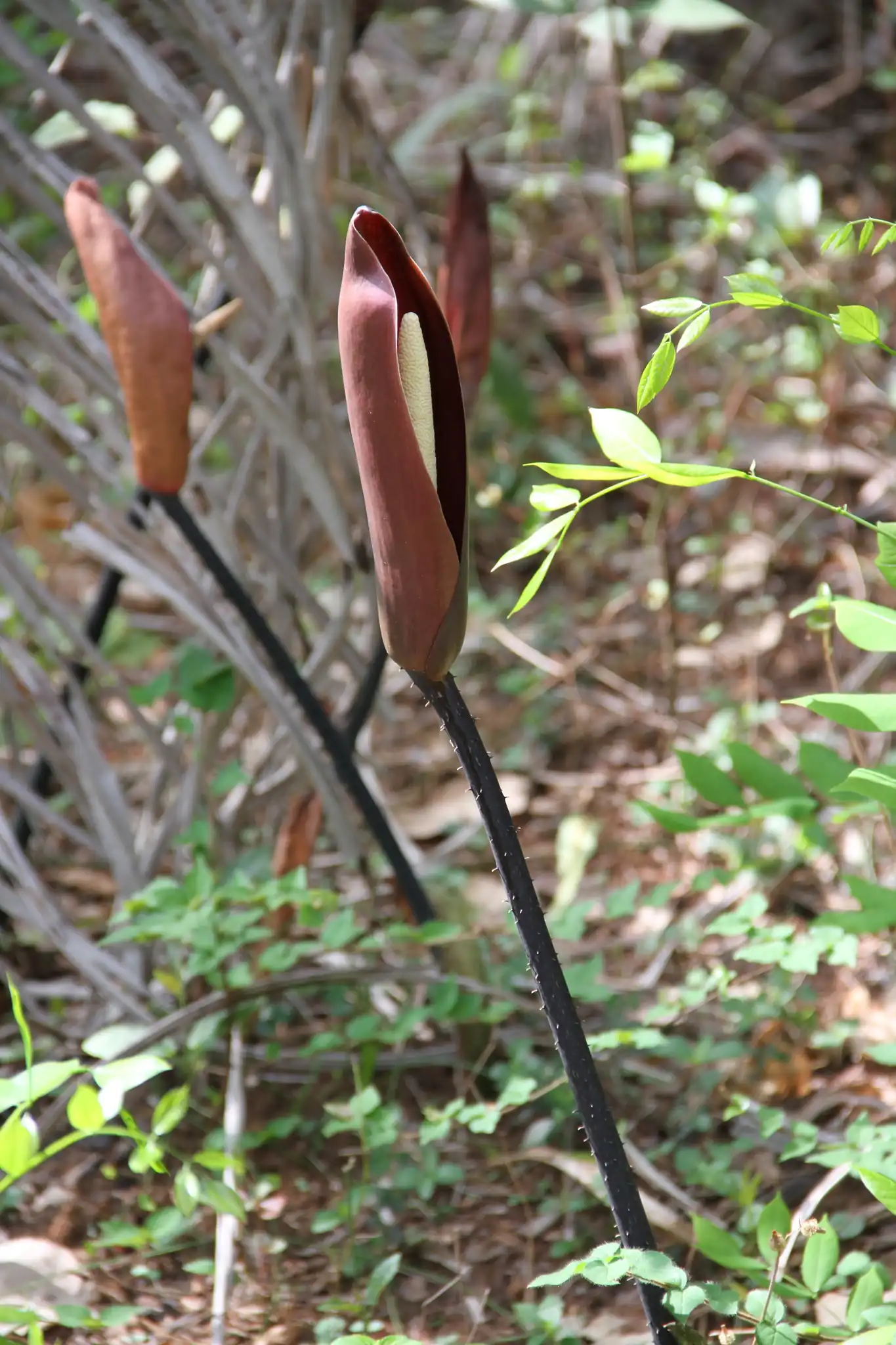
The leaf is tripartite and repeatedly forked into glossy intense-green leaflets, carried on a purple-green petiole dotted white and armed with short whitish spines. The inflorescence rises separately on a spiny stalk, with a pink to purple spathe around a two-toned spadix that produces heat and a strong carrion odor to attract beetle pollinators.
Uses & Benefits:
Essentials
At a Glance
Plant Type
Bulb Corm Tuber
Height
79"
Width
39"
Light
Partial Sun, Shade
Zones
9, 10
Water
High
Humidity
High
Lifespan
Perennial
Native To
Tropical Africa
Toxicity
Toxic
Bloom period
Summer
In flower about 3 months of the year
Planting
How to Grow
- Plant the dormant tuber shallowly in humus-rich, moisture-retentive but draining loam once nights stay warm, eyes up.
- Grow in bright indirect light or semi-shade to full shade with 6 to 8 hours of filtered light.
- Keep the mix constantly humid during leaf growth and never let it dry out completely.
- Withhold water as the leaf yellows in fall, then store the tuber dry and frost-free until growth resumes.
Pro Tip
Do not cut the growing leaf — let it yellow and collapse on its own, and expect a leafless dormancy; bare soil is rest, not death.
Keep It Thriving
Care Guide
Do
- Keep humidity high and soil evenly moist while the leaf is up
- Provide sheltered warmth with no frost exposure
- Allow the spent leaf to die back naturally before removing it
Don't
- Do not cut the single growing leaf to control size
- Do not let the mix dry out during active growth
- Do not eat any part raw; the tuber is caustic without prolonged processing
Seasonal Care Calendar
| Task | Jan | Feb | Mar | Apr | May | Jun | Jul | Aug | Sep | Oct | Nov | Dec |
|---|---|---|---|---|---|---|---|---|---|---|---|---|
| Fertilize | ||||||||||||
| Pest Check | ||||||||||||
| Plant | ||||||||||||
| Winter Prep |
Watch Out For
Pests & Diseases
Common Pests
Common Diseases
In the Garden
Landscape Uses & Companions
Landscape Uses
Companion Plants
Multiply
Propagation Methods
Good to Know
Common Questions
Children's Umbrella questions
What zones can Children's Umbrella grow in?
Children's Umbrella is hardy in USDA Zones 9–10: in that range it survives winter in the ground. Colder than Zone 9, grow it in a container you can move to shelter for the winter, or as an annual.
When does Children's Umbrella bloom?
Children's Umbrella typically blooms in summer. Exact timing shifts a week or two with your zone — Sow's bloom calendar maps it to your garden.
Does Children's Umbrella need full sun?
Children's Umbrella does best in part shade.
Keep exploring
Explore the genus
Hardy in your zone?
Grow Children's Umbrella with confidence
See it in a design of your actual yard, get zone-matched care reminders, and track it season by season in your garden journal.