The Story
Plant Bio
Funastrum clausum, sold as Sarcostemma clausum, is an evergreen twining vine from southern Florida and Texas south to Argentina, climbing 20 to 30 feet by wrapping pale, hairless stems around any support. The leaves are opposite, lush green and evergreen where frost-free, and the stems bleed a sticky white latex when cut.
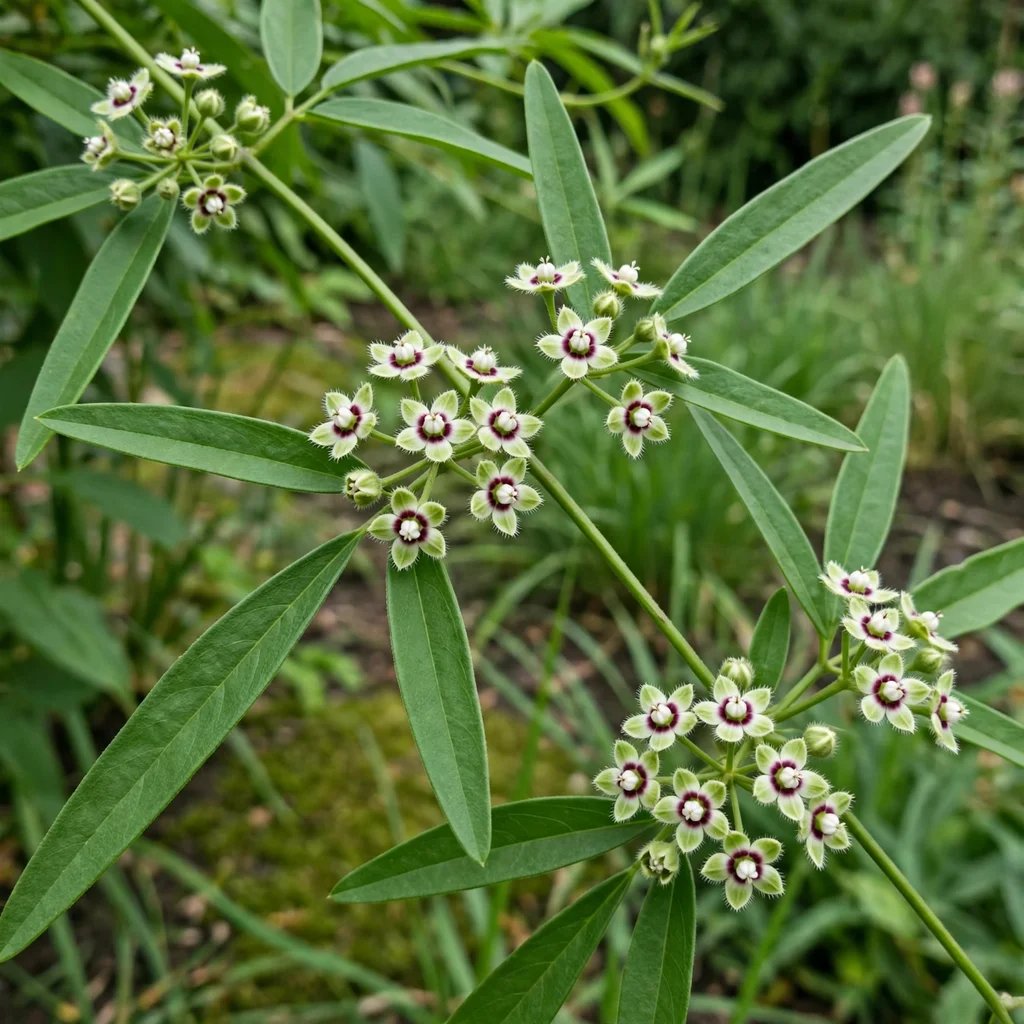
The flowers are borne in umbel-like clusters of 10 to 20, each about 3/8 inch across with five white to greenish-cream hairy lobes and a purple-maroon ring at the base around a glossy white corona, sweetly fragrant. It is a larval host for monarch, queen and soldier butterflies, and in frost-free ground it blooms from summer into fall and often through winter, forming dense tangles if left uncut.
Uses & Benefits:
Essentials
At a Glance
Plant Type
Vine
Height
360"
Width
120"
Light
Full Sun, Partial Sun
Zones
8, 9, 10
Water
Average to moist
Humidity
High
Lifespan
Perennial vine
Native To
S. Florida, S. Texas to Argentina
Toxicity
Toxic if ingested
Bloom period
Summer – Fall
In flower about 6 months of the year
Planting
How to Grow
- Plant in full sun to partial shade in sandy or limestone soil enriched with humus, moist but well-drained.
- Set the root ball at grade next to an arbor, fence or large trellis and tie the lead stems to the support.
- Water deeply at planting and keep soil evenly moist through the first season; mulch 2 inches to hold moisture.
- Feed with liquid fertilizer from spring through early fall and prune wandering stems back to contain the tangle.
Pro Tip
Tie young shoots to the trellis early and cut wandering stems back to a leaf joint after bloom; established plants resprout readily and need steady trimming to stay on their support.
Keep It Thriving
Care Guide
Do
- Grow on a sturdy arbor, fence or trellis or in a large container with support
- Keep soil moist but not soggy and mulch to hold even moisture
- Wear gloves when pruning to avoid the sticky milky sap
Don't
- Do not let it scramble untrimmed into shrubs or citrus where it tangles
- Do not plant where hard freezes occur without winter protection
- Do not ingest any part and keep sap away from eyes and mouth
Seasonal Care Calendar
| Task | Jan | Feb | Mar | Apr | May | Jun | Jul | Aug | Sep | Oct | Nov | Dec |
|---|---|---|---|---|---|---|---|---|---|---|---|---|
| Fertilize | ||||||||||||
| Pest Check | ||||||||||||
| Prune | ||||||||||||
| Stake | ||||||||||||
| Winter Prep |
Watch Out For
Pests & Diseases
Common Pests
Common Diseases
In the Garden
Landscape Uses & Companions
Landscape Uses
Multiply
Propagation Methods
Good to Know
Common Questions
White Twinevine questions
What zones can White Twinevine grow in?
White Twinevine is hardy in USDA Zones 8–10: in that range it survives winter in the ground. Colder than Zone 8, grow it in a container you can move to shelter for the winter, or as an annual.
When does White Twinevine bloom?
White Twinevine typically blooms from summer to fall. Exact timing shifts a week or two with your zone — Sow's bloom calendar maps it to your garden.
Does White Twinevine need full sun?
White Twinevine does best in full sun to part shade. In hot climates, afternoon shade keeps blooms fresher longer.
Keep exploring
Explore the genus
Hardy in your zone?
Grow White Twinevine with confidence
See it in a design of your actual yard, get zone-matched care reminders, and track it season by season in your garden journal.