The Story
Plant Bio
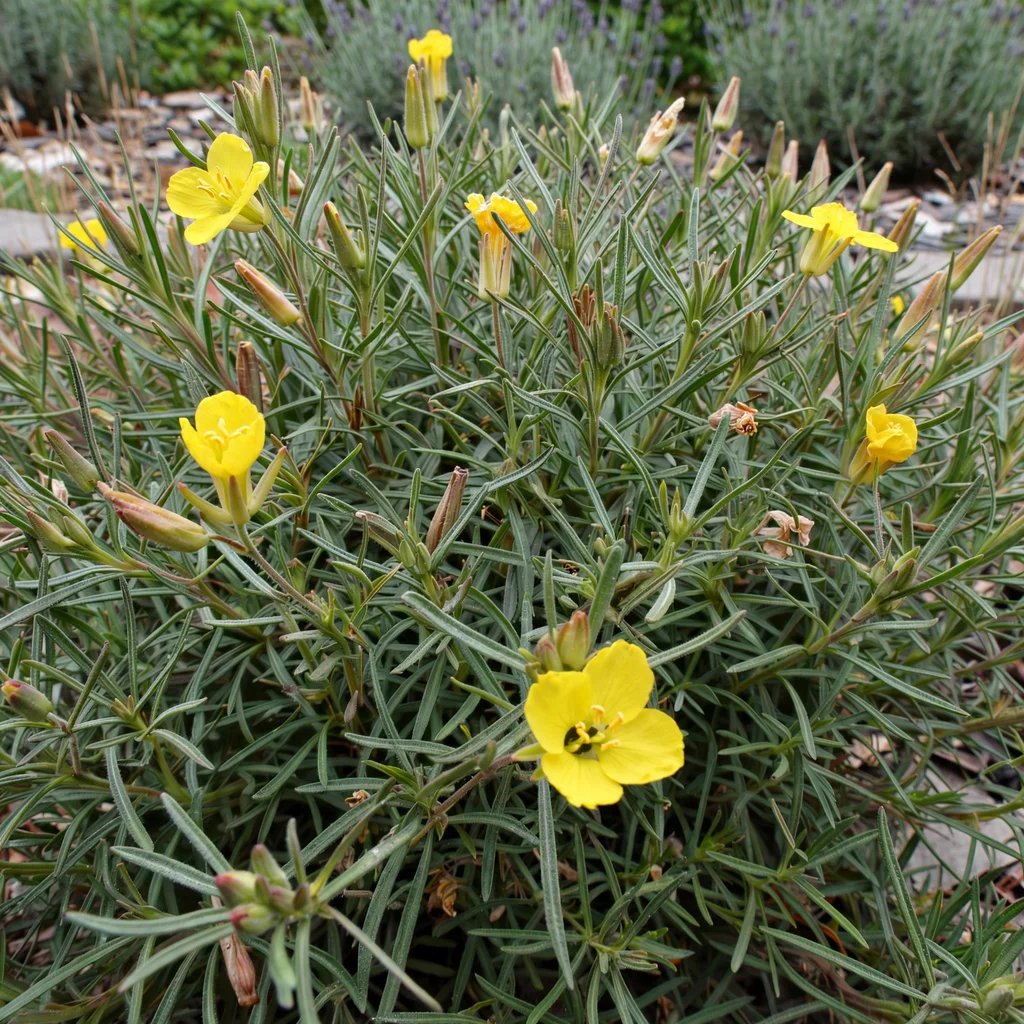
Calylophus hartwegii, now accepted as Oenothera hartwegii, is a mounding deciduous perennial with stems woody at the base and ascending to suberect, reaching 12 to 18 inches high and 24 to 36 inches wide. It carries narrow leaves and solitary clear yellow cup flowers that open in the evening and close by the next afternoon, followed by dry capsules.
It flowers from spring to fall, with deadheading and summer water extending the display from March into November. It requires fast-draining sandy, rocky or limestone ground with pH 6.0 to 8.5, withstands drought and reflected heat, and is hardy to minus 20 degrees Fahrenheit.
Uses & Benefits:
Essentials
At a Glance
Plant Type
Perennial
Height
18"
Width
36"
Light
Full Sun, Partial Sun
Zones
5, 6, 7, 8, 9
Water
Low
Humidity
Unknown
Lifespan
Perennial
Native To
South-Central U.S. to Mexico
Toxicity
Unknown
Bloom period
Spring – Fall
In flower about 9 months of the year
Planting
How to Grow
- Plant in full sun to part shade, with afternoon shade in low desert heat, in fast-draining sandy or rocky soil.
- Space plants 24 to 36 inches apart to allow the wide mounding habit to fill.
- Water sparingly after establishment and let soil dry between waterings; do not overwater.
- Deadhead spent blooms through summer and cut back to 6 to 8 inches in fall to reshape.
Pro Tip
Set the crown slightly high in fast-draining gritty soil and withhold water once established; judge bloom in the morning because evening-opened flowers close by the next afternoon.
Keep It Thriving
Care Guide
Do
- Plant in fast-draining sandy, sandy-loam or rocky limestone soil
- Give 6 or more hours of sun, with part shade in low desert
- Deadhead and add summer water to prolong flowering
Don't
- Do not overwater or leave the crown in soggy ground
- Do not judge flowering in the afternoon when blooms have closed
- Do not plant in heavy wet soil without drainage
Seasonal Care Calendar
| Task | Jan | Feb | Mar | Apr | May | Jun | Jul | Aug | Sep | Oct | Nov | Dec |
|---|---|---|---|---|---|---|---|---|---|---|---|---|
| Deadhead | ||||||||||||
| Pest Check | ||||||||||||
| Plant | ||||||||||||
| Prune |
Watch Out For
Pests & Diseases
Common Pests
Common Diseases
In the Garden
Landscape Uses & Companions
Landscape Uses
Multiply
Propagation Methods
Good to Know
Common Questions
Hartweg's Sundrops questions
What zones can Hartweg's Sundrops grow in?
Hartweg's Sundrops is hardy in USDA Zones 5–9: in that range it survives winter in the ground. Colder than Zone 5, grow it in a container you can move to shelter for the winter, or as an annual. Warmer than Zone 9, winter isn't the problem: it prefers colder winters, and summer heat can shorten its life.
When does Hartweg's Sundrops bloom?
Hartweg's Sundrops typically blooms from spring to fall. Exact timing shifts a week or two with your zone — Sow's bloom calendar maps it to your garden.
Does Hartweg's Sundrops need full sun?
Hartweg's Sundrops does best in full sun to part shade. In hot climates, afternoon shade keeps blooms fresher longer.
Is Hartweg's Sundrops drought tolerant?
Yes — once established (usually after the first full season), Hartweg's Sundrops handles dry spells with minimal watering. Water deeply its first year to build the root system that makes that possible.
More Calylophus to compare
Keep exploring
Explore the genus
Hardy in your zone?
Grow Hartweg's Sundrops with confidence
See it in a design of your actual yard, get zone-matched care reminders, and track it season by season in your garden journal.