The Story
Plant Bio
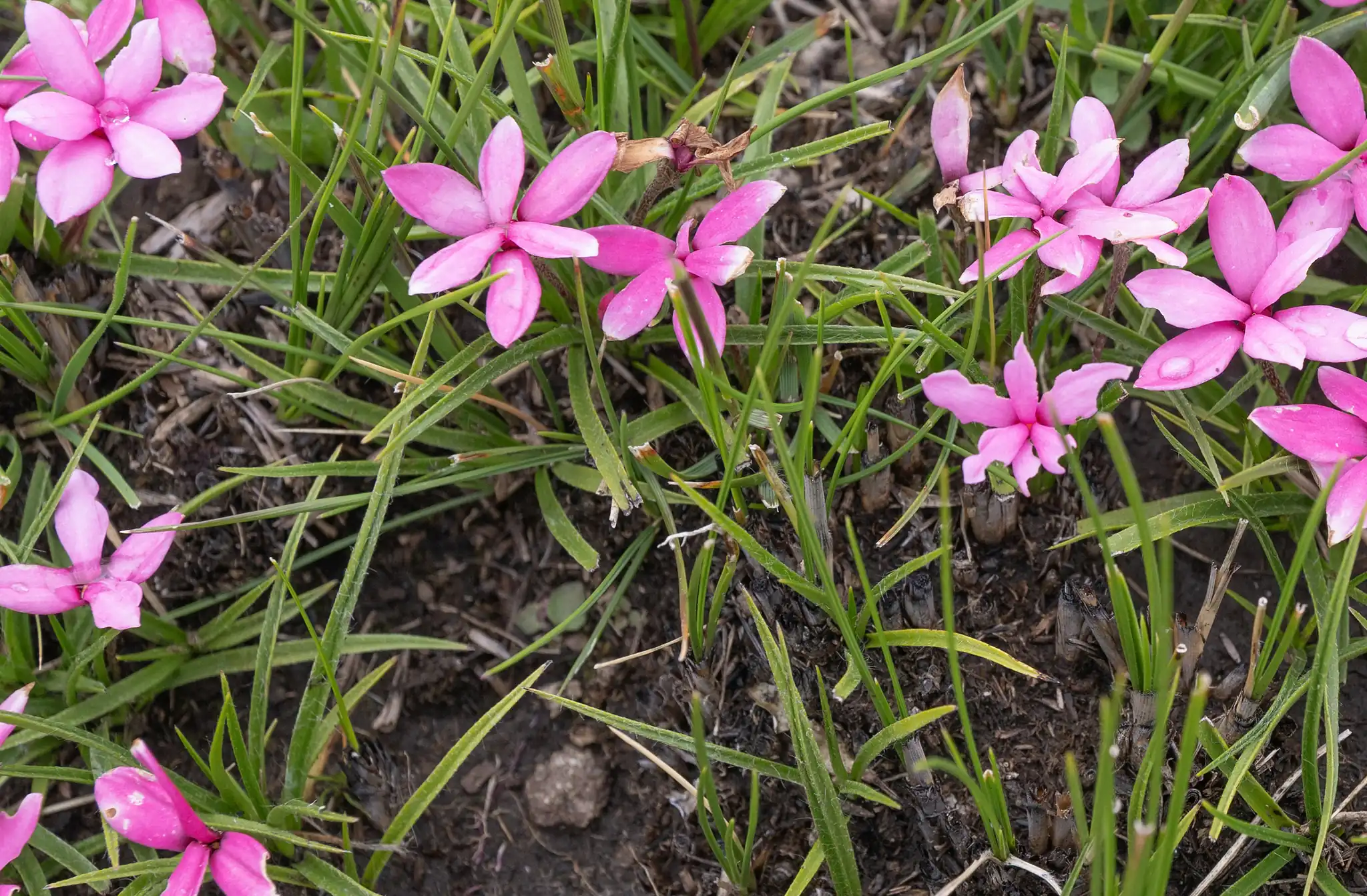
Rhodohypoxis baurii is a low stoloniferous perennial from damp high-elevation meadows, forming a tight carpet 9 to 12 inches wide from small tubers linked by creeping stolons. The foliage is narrow, grass-like and gray-green, folded along the midrib and covered in soft white hairs.
Flowers are solitary six-pointed stars about an inch across, held on 2- to 4-inch stalks just above the leaves in white through pale pink to deep magenta-red. Bloom opens in succession from late spring into early fall, at peak almost hiding the foliage.
Uses & Benefits:
Essentials
At a Glance
Plant Type
Bulb Corm Tuber
Height
4"
Width
10"
Light
Full Sun, Partial Sun
Zones
7, 8, 9
Water
Medium in summer, dry in winter
Humidity
Low
Lifespan
Perennial
Native To
South Africa, Lesotho, Eswatini
Toxicity
Non-toxic
Bloom period
Late spring – Early fall
In flower about 5 months of the year
Planting
How to Grow
- Plant in full sun in humus-rich yet sharply draining sandy loam that stays moist in summer and dries in winter.
- Set tubers shallowly with the crown at soil level, spacing to allow stolons to knit into a mat.
- Water freely from spring leaf-out through late summer while in flower, then taper off as foliage yellows.
- Move containers to a cool, dry frost-free spot for winter dormancy and resume watering only at spring regrowth.
Pro Tip
Keep dormant tubers almost dry under cover in winter; cold alone to about 14 degrees is tolerated, cold combined with wet rots the crown.
Keep It Thriving
Care Guide
Do
- Give full sun and free air movement for compact growth and heaviest bloom.
- Feed monthly with balanced liquid fertilizer only while actively growing.
- Stop watering after foliage yellows and keep dormant pots almost dry.
Don't
- Do not leave dormant tubers cold and wet outdoors through winter.
- Do not cut into tubers or shear the grassy foliage.
- Do not fertilize during winter dormancy.
Seasonal Care Calendar
| Task | Jan | Feb | Mar | Apr | May | Jun | Jul | Aug | Sep | Oct | Nov | Dec |
|---|---|---|---|---|---|---|---|---|---|---|---|---|
| Divide | ||||||||||||
| Fertilize | ||||||||||||
| Pest Check | ||||||||||||
| Plant | ||||||||||||
| Winter Prep |
Watch Out For
Pests & Diseases
Common Pests
Common Diseases
In the Garden
Landscape Uses & Companions
Landscape Uses
Multiply
Propagation Methods
Good to Know
Common Questions
Pink Star questions
What zones can Pink Star grow in?
Pink Star is hardy in USDA Zones 7–9: in that range it survives winter in the ground. Colder than Zone 7, grow it in a container you can move to shelter for the winter, or as an annual. Warmer than Zone 9, winter isn't the problem: it prefers colder winters, and summer heat can shorten its life.
When does Pink Star bloom?
Pink Star typically blooms from late spring to early fall. Exact timing shifts a week or two with your zone — Sow's bloom calendar maps it to your garden.
Does Pink Star need full sun?
Pink Star does best in full sun to part shade. In hot climates, afternoon shade keeps blooms fresher longer.
Keep exploring
Explore the genus
Hardy in your zone?
Grow Pink Star with confidence
See it in a design of your actual yard, get zone-matched care reminders, and track it season by season in your garden journal.