The Story
Plant Bio
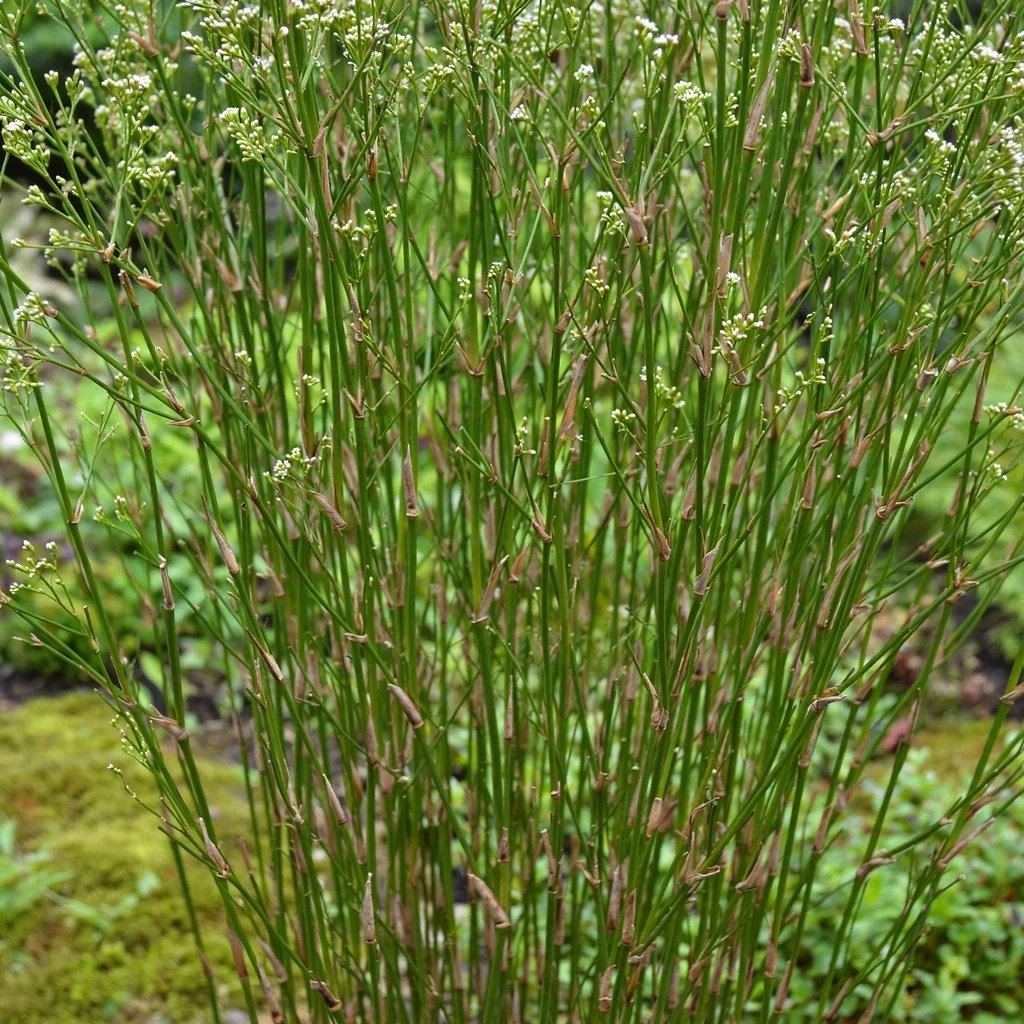
Restio paniculatus, the paniculate restio, is an evergreen rhizomatous perennial from South African riverbanks that forms a bushy clump of erect round green culms to about six to eight feet in gardens. True leaves are reduced to persistent sheaths on the stems and photosynthesis is carried out by the bright green to olive-green branched culms themselves.
Plants are dioecious with terminal branched panicles that differ by sex with females bearing snowy-white clusters that age brown and set brown capsules while males bear less showy pale yellow-green clusters. Lower stems are bamboo-like and sometimes purple-spotted, and mature clumps reach six to eight feet tall and three to five feet wide on moist acid sand or loam.
Uses & Benefits:
Essentials
At a Glance
Plant Type
Perennial
Height
79"
Width
63"
Light
Full Sun
Zones
10
Water
Moderate to moist
Humidity
Moderate
Lifespan
Perennial
Native To
South Africa
Toxicity
Unknown - no toxicity reported
Bloom period
Summer
In flower about 3 months of the year
Planting
How to Grow
- Plant in full sun in a sheltered spot in moist but well-drained acid loam or sand, with room for a 3 to 5 foot clump.
- Set the potted rootball intact at the same depth it grew in the pot and water in deeply; do not bare-root, divide at planting, or let roots dry.
- Water moderately through spring, summer and early fall to keep the root zone evenly moist; it tolerates wet soil with roots near water.
- Use a low-nutrient acid mix in containers and give full light under glass; move pots to a cool dry frost-free cover where winters drop below about 18F.
Pro Tip
Keep the rootball constantly moist and set it intact without teasing or drying; plants whose roots are disturbed or dried at planting rarely re-establish.
Keep It Thriving
Care Guide
Do
- Keep soil evenly moist in the growing season and shelter plants from hard frost.
- Remove only dead or broken culms at the base in spring.
- Grow in acid, peat-free loam or sandy mix in containers.
Don't
- Do not let the rootball dry out or tease roots apart at transplant.
- Do not cut the clump back hard or shear annually.
- Do not plant in alkaline or dry soil or leave containers waterlogged and airless in winter.
Seasonal Care Calendar
| Task | Jan | Feb | Mar | Apr | May | Jun | Jul | Aug | Sep | Oct | Nov | Dec |
|---|---|---|---|---|---|---|---|---|---|---|---|---|
| Pest Check | ||||||||||||
| Plant | ||||||||||||
| Propagate | ||||||||||||
| Prune | ||||||||||||
| Winter Prep |
Watch Out For
Pests & Diseases
Common Pests
Common Diseases
In the Garden
Landscape Uses & Companions
Landscape Uses
Companion Plants
Multiply
Propagation Methods
Good to Know
Common Questions
Paniculate Restio questions
What zones can Paniculate Restio grow in?
Paniculate Restio is hardy in USDA Zone 10: in that range it survives winter in the ground. Colder than Zone 10, grow it in a container you can move to shelter for the winter, or as an annual.
When does Paniculate Restio bloom?
Paniculate Restio typically blooms in summer. Exact timing shifts a week or two with your zone — Sow's bloom calendar maps it to your garden.
Does Paniculate Restio need full sun?
Paniculate Restio does best in full sun (6+ hours).
Keep exploring
Explore the genus
Hardy in your zone?
Grow Paniculate Restio with confidence
See it in a design of your actual yard, get zone-matched care reminders, and track it season by season in your garden journal.