The Story
Plant Bio
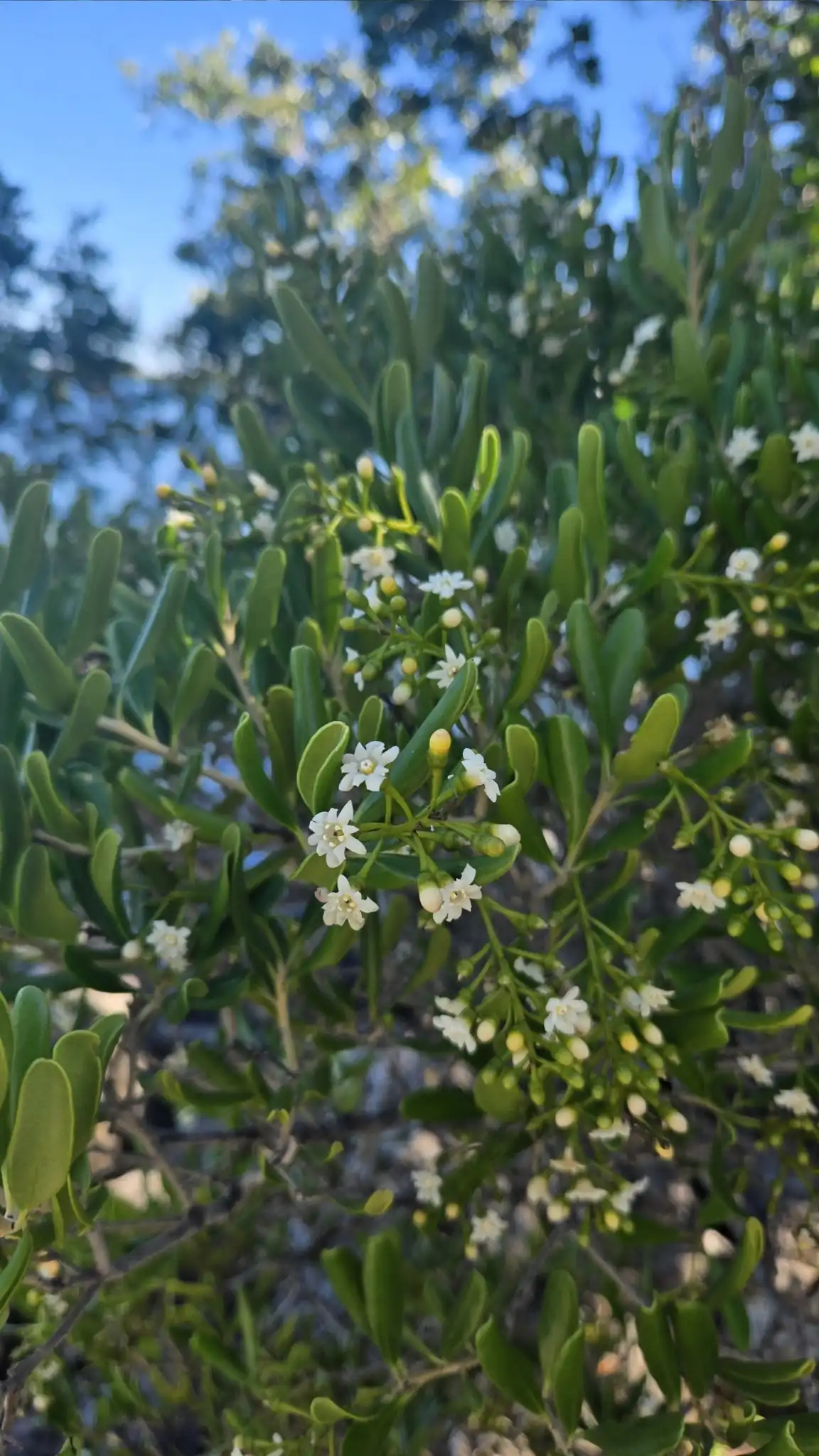
Jacquinia keyensis, known as joewood, is a very slow-growing evergreen shrub to small tree reaching 8 feet tall and 12 feet wide in gardens, with stiff glossy recurved leaves spiraled on short rigid branches. Bloom comes in terminal unbranched racemes to 3 inches long of white to ivory jasmine-scented flowers with five petals backed by five petal-like staminodes, opening sporadically year-round and heaviest from spring to fall.
It is separated from its naturalized relative braceletwood by small 1.5 to 2 inch obovate leaves with entire revolute margins and rounded retuse tips, held weakly whorled rather than strongly whorled. Berries ripen from ivory to orange-red rather than consistently red, on a compact rounded crown wider than tall in full sun that adds only about 6 inches a year.
Uses & Benefits:
Essentials
At a Glance
Plant Type
Shrub
Height
96"
Width
144"
Light
Full Sun, Partial Sun
Zones
10
Water
Low once established
Humidity
Average
Lifespan
Long-lived
Native To
South Florida and Caribbean
Toxicity
Toxic if ingested
Bloom period
Spring – Fall
In flower about 9 months of the year
Planting
How to Grow
- Plant container stock in full sun to light shade in well-drained sand, loam, or clay with acidic to alkaline pH.
- Dig the hole the same depth as the rootball and twice as wide; set level, backfill firmly and mulch thinly.
- Water frequently for several weeks to establish, then irrigate only in dry spells to speed growth.
- Feed lightly in spring; prune only dead wood and never shear the crown annually.
Pro Tip
Plant it in full sun and then leave it alone; annual shearing and heavy feeding spoil its naturally compact rounded crown.
Keep It Thriving
Care Guide
Do
- Plant in full sun for a dense rounded crown wider than tall.
- Water regularly until established, then during the dry season.
- Mulch thinly to conserve moisture on sand or coral soils.
Don't
- Do not shear annually or cut back into old bare wood.
- Do not overfertilize or plant where soil stays flooded.
- Do not eat the berries; all parts are poisonous to humans.
Seasonal Care Calendar
| Task | Jan | Feb | Mar | Apr | May | Jun | Jul | Aug | Sep | Oct | Nov | Dec |
|---|---|---|---|---|---|---|---|---|---|---|---|---|
| Fertilize | ||||||||||||
| Mulch | ||||||||||||
| Plant | ||||||||||||
| Prune |
Watch Out For
Pests & Diseases
Common Pests
Common Diseases
In the Garden
Landscape Uses & Companions
Landscape Uses
Multiply
Propagation Methods
Good to Know
Common Questions
Joewood questions
What zones can Joewood grow in?
Joewood is hardy in USDA Zone 10: in that range it survives winter in the ground. Colder than Zone 10, grow it in a container you can move to shelter for the winter.
When does Joewood bloom?
Joewood typically blooms from spring to fall. Exact timing shifts a week or two with your zone — Sow's bloom calendar maps it to your garden.
Does Joewood need full sun?
Joewood does best in full sun to part shade. In hot climates, afternoon shade keeps blooms fresher longer.
Is Joewood drought tolerant?
Yes — once established (usually after the first full season), Joewood handles dry spells with minimal watering. Water deeply its first year to build the root system that makes that possible.
Keep exploring
Explore the genus
Hardy in your zone?
Grow Joewood with confidence
See it in a design of your actual yard, get zone-matched care reminders, and track it season by season in your garden journal.