The Story
Plant Bio
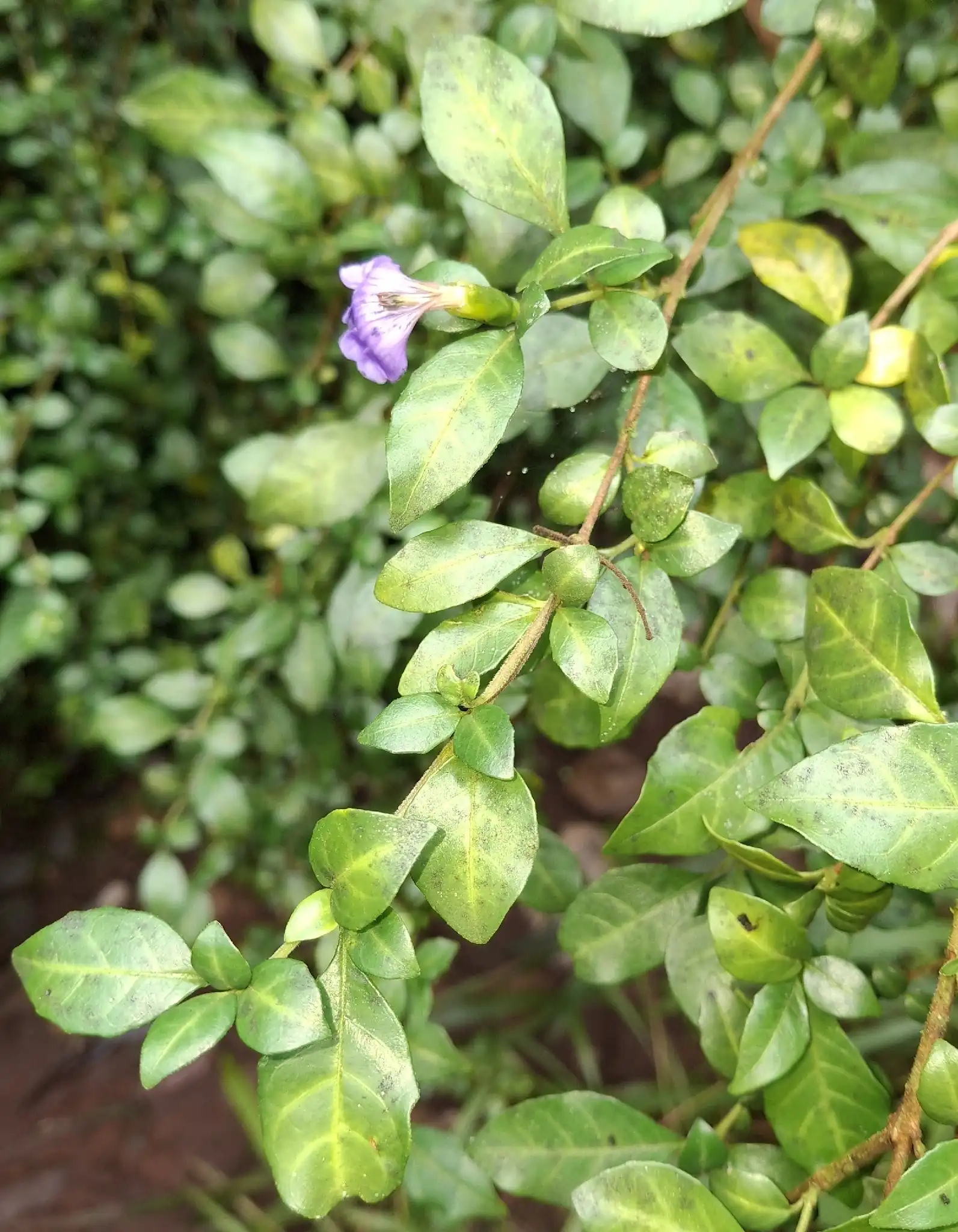
Sclerochiton harveyanus is a multi-stemmed evergreen shrub from the margins and understory of southeastern African forest, reaching six to eight feet tall and wide in cultivation with thin, lax, soft-wooded stems. The leaves are opposite, oval-elliptic and glossy deep green above, about two inches long on short petioles with entire to bluntly toothed margins.
The flowers are solitary in the leaf axils, mauve-blue to purple with a ribbed lower lip, each with a short tube and five equal fringed lobes forming a flat face about half to three-quarters of an inch across. After flowering it forms a green tapering capsule about half an inch long that splits explosively in two valves to release seed.
Uses & Benefits:
Essentials
At a Glance
Plant Type
Shrub
Height
96"
Width
96"
Light
Partial Sun, Shade
Zones
9, 10
Water
Moderate
Humidity
Unknown
Lifespan
Evergreen shrub
Native To
Zimbabwe to South Africa
Toxicity
Unknown - no toxicity record found
Bloom period
Summer – Fall
In flower about 6 months of the year
Planting
How to Grow
- Plant in part to full shade under trees or on a shaded porch, protected from freezing.
- Dig into well-drained, fertile loam enriched with leaf mold and compost, neutral to acid.
- Water consistently to keep soil evenly moist and mulch with compost; do not let it dry out.
- Feed each season with balanced organic or inorganic fertilizer; give seedlings liquid feed to prevent yellowing.
- Tip-prune lightly to keep a compact rounded shape for hedge or container use.
Pro Tip
Plant it grouped under trees in mulched, leafy soil and keep it out of full sun; in a pot on a shaded porch the small axillary flowers sit at eye level where they are actually seen.
Keep It Thriving
Care Guide
Do
- Grow in shade to semi-shade
- Keep soil evenly moist and mulched with compost
- Feed each season
- Tip-prune to keep compact
Don't
- Do not plant in full sun or poor dry soil
- Do not allow to freeze
- Do not keep waterlogged
Seasonal Care Calendar
| Task | Jan | Feb | Mar | Apr | May | Jun | Jul | Aug | Sep | Oct | Nov | Dec |
|---|---|---|---|---|---|---|---|---|---|---|---|---|
| Fertilize | ||||||||||||
| Mulch | ||||||||||||
| Pest Check | ||||||||||||
| Propagate | ||||||||||||
| Prune |
Watch Out For
Pests & Diseases
Common Pests
Common Diseases
In the Garden
Landscape Uses & Companions
Landscape Uses
Companion Plants
Multiply
Propagation Methods
Good to Know
Common Questions
Blue Lips questions
What zones can Blue Lips grow in?
Blue Lips is hardy in USDA Zones 9–10: in that range it survives winter in the ground. Colder than Zone 9, grow it in a container you can move to shelter for the winter.
When does Blue Lips bloom?
Blue Lips typically blooms from summer to fall. Exact timing shifts a week or two with your zone — Sow's bloom calendar maps it to your garden.
Does Blue Lips need full sun?
Blue Lips does best in part shade.
Keep exploring
Explore the genus
Hardy in your zone?
Grow Blue Lips with confidence
See it in a design of your actual yard, get zone-matched care reminders, and track it season by season in your garden journal.