The Story
Plant Bio
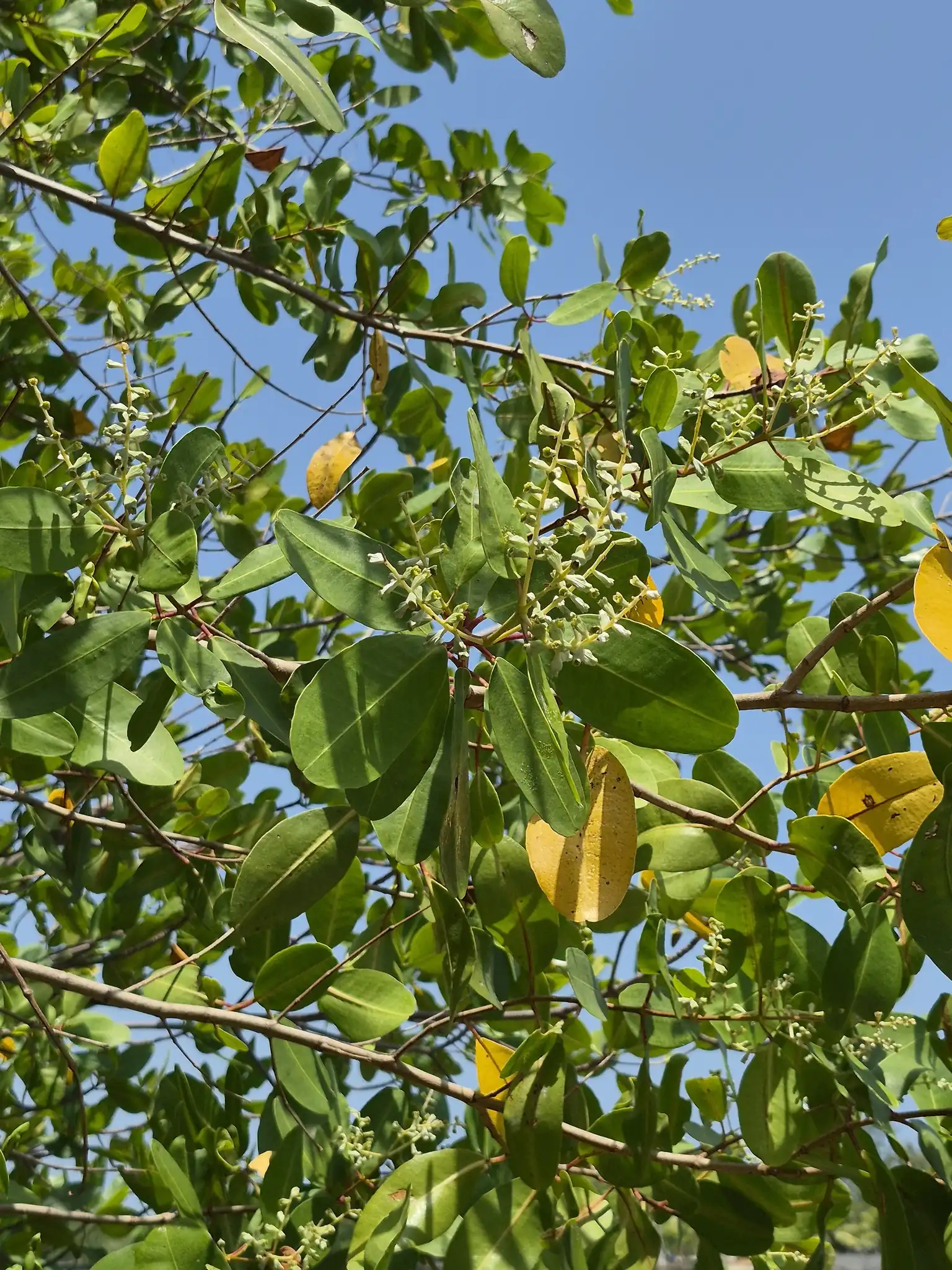
Laguncularia racemosa, the white mangrove, is an evergreen tree reaching 30 to 40 feet in cultivation, with rounded leathery leaves that excrete salt through glands at the leaf base. The small bell-shaped white to greenish-white flowers bear ten stamens and are held in spikes in the leaf axils and at the branch tips, blooming almost year-round.
Unlike red mangrove it forms no prop roots and unlike black mangrove it sends up no pneumatophores, growing more erect on higher ground landward of the tidal front. Leaves often carry a white crust of excreted salt, which is normal function rather than disease, and the species is legally protected in Florida where trimming and removal require a permit.
Uses & Benefits:
Essentials
At a Glance
Plant Type
Tree
Height
420"
Width
360"
Light
Full Sun
Zones
9, 10
Water
High
Humidity
High
Lifespan
Long-lived tree
Native To
Florida, South Texas and tropical Atlantic coasts
Toxicity
Unknown
Bloom period
Year round
In flower about 12 months of the year
Planting
How to Grow
- Plant in full sun on a frost-free tidal or brackish shoreline in zones 9a-11b, where roots stay wet with brackish water.
- Set propagules or small pots into moist mud or sandy mud at or just above mean high water, not in a dry garden bed.
- Do not amend with rich fertilizer or fresh mulch; tidal exchange supplies nutrients.
- Keep roots tidal-wet; do not try to grow it as a freshwater inland tree.
- Leave trimming and removal to permitted work; check state and local rules before cutting any stem.
Pro Tip
Leave the canopy alone unless trimming is permitted; remove no more than a quarter of the canopy at one time and never cut below six feet.
Keep It Thriving
Care Guide
Do
- Plant only where legal and suited to tidal flooding.
- Keep roots wet with brackish water in full sun.
- Leave salt crust on leaves undisturbed.
Don't
- Do not cut or remove trees without required permits.
- Do not plant in dry inland beds or freshwater gardens.
- Do not cut back into old bare wood beyond what is permitted.
Seasonal Care Calendar
| Task | Jan | Feb | Mar | Apr | May | Jun | Jul | Aug | Sep | Oct | Nov | Dec |
|---|---|---|---|---|---|---|---|---|---|---|---|---|
| Pest Check | ||||||||||||
| Plant | ||||||||||||
| Propagate | ||||||||||||
| Prune |
Watch Out For
Pests & Diseases
Common Pests
Common Diseases
In the Garden
Landscape Uses & Companions
Landscape Uses
Multiply
Propagation Methods
Good to Know
Common Questions
White Mangrove questions
What zones can White Mangrove grow in?
White Mangrove is hardy in USDA Zones 9–10: in that range it survives winter in the ground. Colder than Zone 9, winters are too cold for it to survive outdoors.
When does White Mangrove bloom?
White Mangrove typically blooms year-round. Exact timing shifts a week or two with your zone — Sow's bloom calendar maps it to your garden.
Does White Mangrove need full sun?
White Mangrove does best in full sun (6+ hours).
Keep exploring
Explore the genus
Hardy in your zone?
Grow White Mangrove with confidence
See it in a design of your actual yard, get zone-matched care reminders, and track it season by season in your garden journal.