The Story
Plant Bio
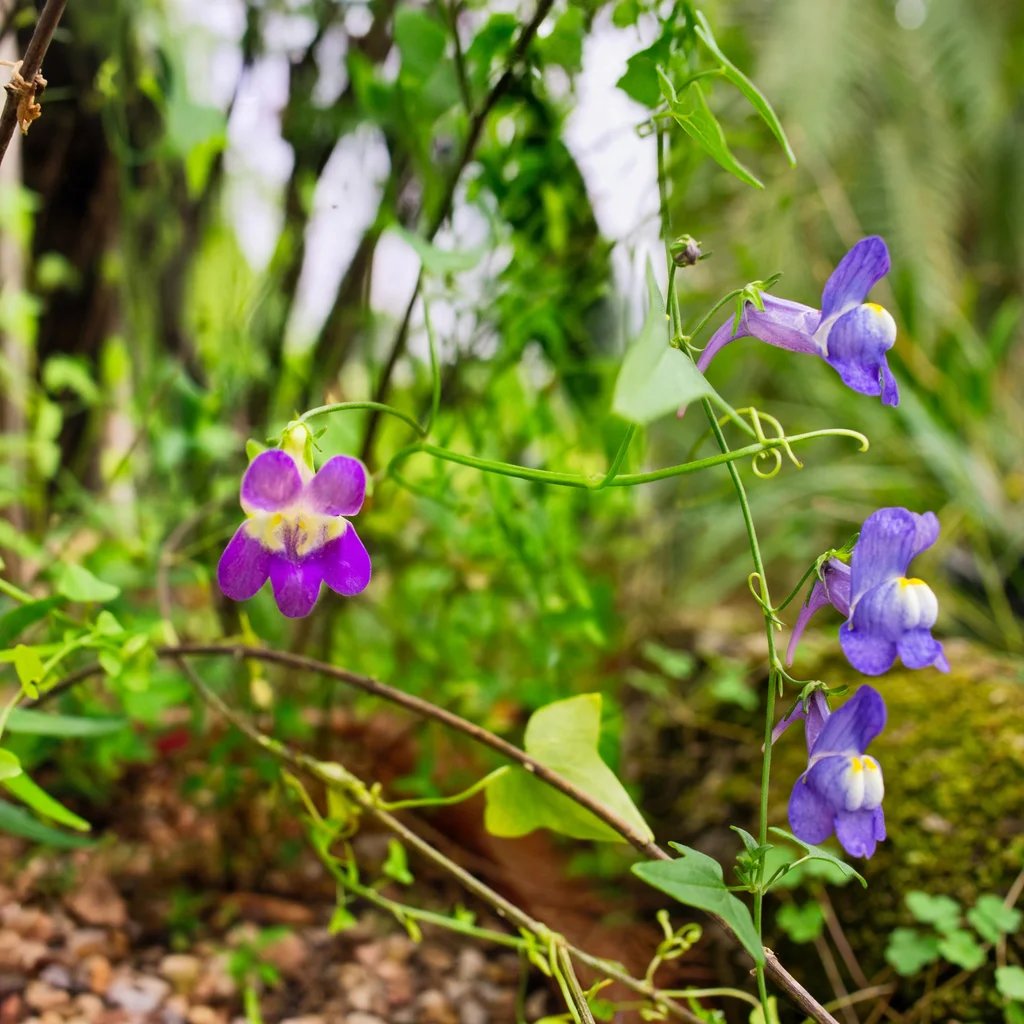
Maurandella antirrhiniflora, still sold as Maurandya antirrhiniflora, is a herbaceous perennial vine from the southwestern United States to Mexico that climbs by twisting its leaf stalks and flower stalks around support. From a crown that dies back in winter it sends out scrambling stems 5 to 10 feet long, lined with small triangular arrow-shaped green leaves.
The flowers are solitary in the leaf axils on slender stalks, each a two-lipped snapdragon-type bloom in rose-purple to blue-violet, with some populations pink to red, marked with white to yellow on the palate. Foliage is smooth and hastate to 1 inch long, and established plants resprout from the base each spring rather than holding woody growth through winter.
Uses & Benefits:
Essentials
At a Glance
Plant Type
Vine
Height
120"
Width
36"
Light
Partial Sun
Zones
7, 8, 9, 10
Water
Low to medium
Humidity
Low
Lifespan
Perennial vine, winter-dormant
Native To
Southwestern USA to Mexico
Toxicity
Unknown - no data
Bloom period
Spring – Fall
In flower about 9 months of the year
Planting
How to Grow
- Sow seed on the surface of well-drained potting mix after last frost and press in lightly without deep covering.
- Keep evenly moist until germination, then grow on in full light with part afternoon shade.
- Set out 12 to 18 inches apart at the base of a small trellis, fence wire, or hanging basket.
- Water to establish, then water only when soil dries; cut back spent top growth in late fall and mulch the crown.
Pro Tip
Offer thin twigs, wire, or a small trellis for the leaf stalks to wind around, and leave the winter-dormant crown undisturbed to resprout in spring.
Keep It Thriving
Care Guide
Do
- Do give it a small trellis, wire, or neighboring shrub to twine through.
- Do grow in well-drained sand, loam, or limestone soil.
- Do leave the crown in place over winter to resprout.
Don't
- Do not grow in heavy clay or soil that stays wet.
- Do not pull plants as dead in winter; top growth dies back naturally.
- Do not overfertilize or overwater once established.
Seasonal Care Calendar
| Task | Jan | Feb | Mar | Apr | May | Jun | Jul | Aug | Sep | Oct | Nov | Dec |
|---|---|---|---|---|---|---|---|---|---|---|---|---|
| Deadhead | ||||||||||||
| Plant | ||||||||||||
| Spring Cleanup | ||||||||||||
| Stake | ||||||||||||
| Winter Prep |
Watch Out For
Pests & Diseases
Common Pests
Common Diseases
In the Garden
Landscape Uses & Companions
Landscape Uses
Multiply
Propagation Methods
Good to Know
Common Questions
Snapdragon Vine questions
What zones can Snapdragon Vine grow in?
Snapdragon Vine is hardy in USDA Zones 7–10: in that range it survives winter in the ground. Colder than Zone 7, grow it in a container you can move to shelter for the winter, or as an annual.
Is Snapdragon Vine deer resistant?
Yes — Snapdragon Vine is rated deer-resistant. Deer typically pass it over, though extreme hunger can override any plant's defenses.
When does Snapdragon Vine bloom?
Snapdragon Vine typically blooms from spring to fall. Exact timing shifts a week or two with your zone — Sow's bloom calendar maps it to your garden.
Does Snapdragon Vine need full sun?
Snapdragon Vine does best in part shade.
Is Snapdragon Vine drought tolerant?
Yes — once established (usually after the first full season), Snapdragon Vine handles dry spells with minimal watering. Water deeply its first year to build the root system that makes that possible.
Keep exploring
Explore the genus
Hardy in your zone?
Grow Snapdragon Vine with confidence
See it in a design of your actual yard, get zone-matched care reminders, and track it season by season in your garden journal.