The Story
Plant Bio
Herbertia lahue is a small bulbous perennial from a 15 to 20 mm corm, forming a miniature clump of narrow basal leaves with stems simple or branched one to three times from the base. Leaves are linear and green, four to six to the clump and 4 to 6 mm wide, with stem leaves reduced to sheathing bracts.
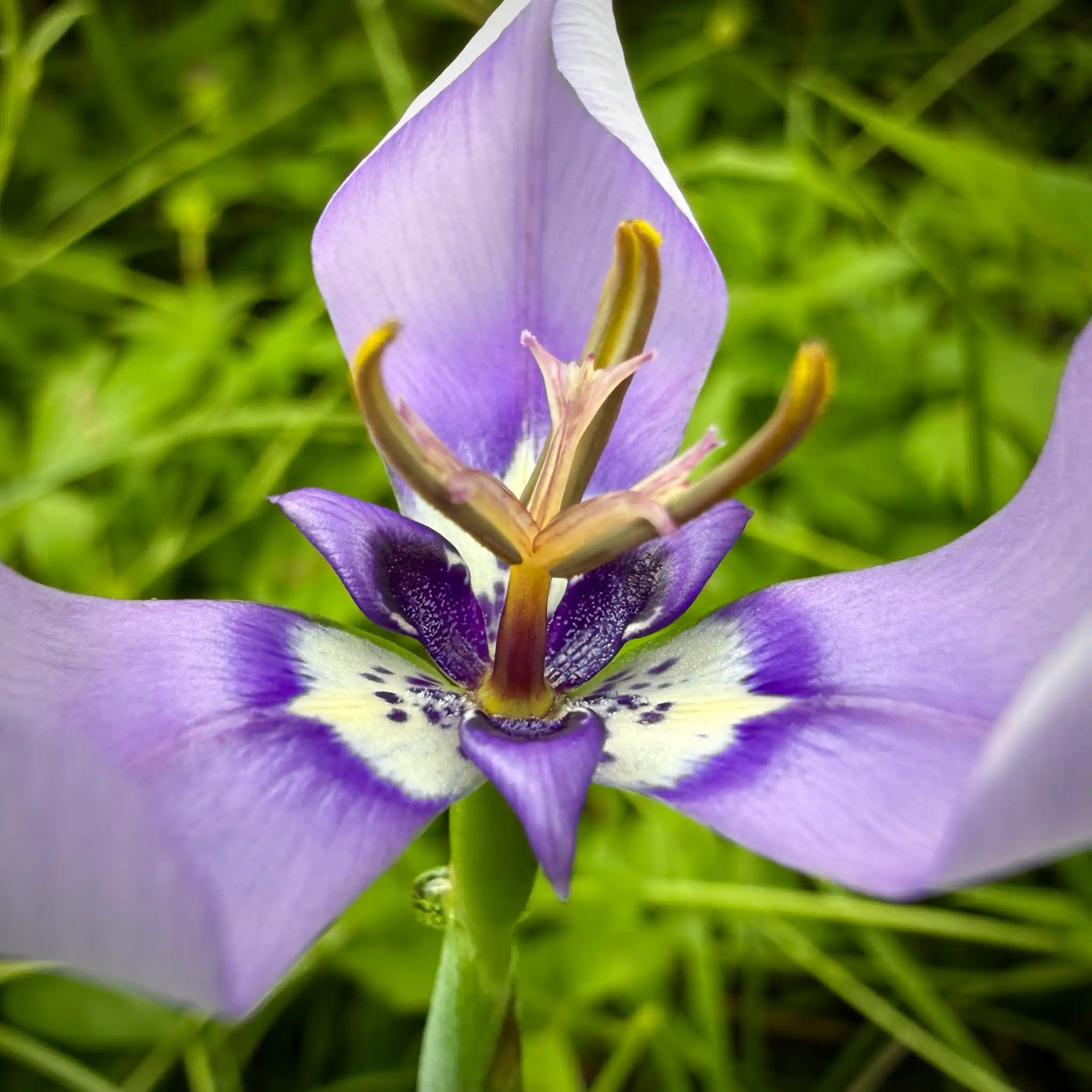
Flowers open for one day from spring to early summer, each with three large spreading violet-blue outer tepals 23 to 28 mm long around a white eye speckled violet and three much smaller inner tepals 8 to 12 mm long. Plants set copious seed without hand pollination and go fully dormant after seed set, disappearing until the next spring.
Uses & Benefits:
Essentials
At a Glance
Plant Type
Bulb Corm Tuber
Height
12"
Width
6"
Light
Full Sun, Partial Sun
Zones
7, 8, 9, 10
Water
Medium, dry when dormant
Humidity
Tolerates high humidity
Lifespan
Perennial corm, summer-dormant
Native To
South America and south-central USA, TX, LA, MS
Toxicity
Unknown - no warning found
Bloom period
Spring – Early summer
In flower about 4 months of the year
Planting
How to Grow
- Set corms 2 inches deep in fall in well-drained sandy loam to clay loam in full sun to part shade.
- Water in at planting and water through spring growth, then withhold water once foliage yellows.
- Leave foliage intact until it pulls away dry to recharge the corm.
- Mark the clump and do not dig; disturb only to divide an established colony.
- Allow seed to drop where a colony is wanted.
Pro Tip
Leave foliage to ripen after bloom and keep dormant corms dry; summer disappearance is dormancy, not death.
Keep It Thriving
Care Guide
Do
- Plant in well-drained soil and keep moist only during spring growth.
- Feed seedlings lightly with dilute fertilizer during active growth.
- Leave to self-sow to build a colony.
Don't
- Do not overwater dormant corms in summer.
- Do not lift corms every year.
- Do not cut back green foliage after bloom.
Seasonal Care Calendar
| Task | Jan | Feb | Mar | Apr | May | Jun | Jul | Aug | Sep | Oct | Nov | Dec |
|---|---|---|---|---|---|---|---|---|---|---|---|---|
| Fertilize | ||||||||||||
| Pest Check | ||||||||||||
| Plant | ||||||||||||
| Propagate | ||||||||||||
| Winter Prep |
Watch Out For
Pests & Diseases
Common Pests
Common Diseases
In the Garden
Landscape Uses & Companions
Landscape Uses
Multiply
Propagation Methods
Good to Know
Common Questions
Prairie Nymph questions
What zones can Prairie Nymph grow in?
Prairie Nymph is hardy in USDA Zones 7–10: in that range it survives winter in the ground. Colder than Zone 7, grow it in a container you can move to shelter for the winter, or as an annual.
When does Prairie Nymph bloom?
Prairie Nymph typically blooms from early spring to early summer. Exact timing shifts a week or two with your zone — Sow's bloom calendar maps it to your garden.
Does Prairie Nymph need full sun?
Prairie Nymph does best in full sun to part shade. In hot climates, afternoon shade keeps blooms fresher longer.
Is Prairie Nymph drought tolerant?
Yes — once established (usually after the first full season), Prairie Nymph handles dry spells with minimal watering. Water deeply its first year to build the root system that makes that possible.
Keep exploring
Explore the genus
Hardy in your zone?
Grow Prairie Nymph with confidence
See it in a design of your actual yard, get zone-matched care reminders, and track it season by season in your garden journal.