The Story
Plant Bio
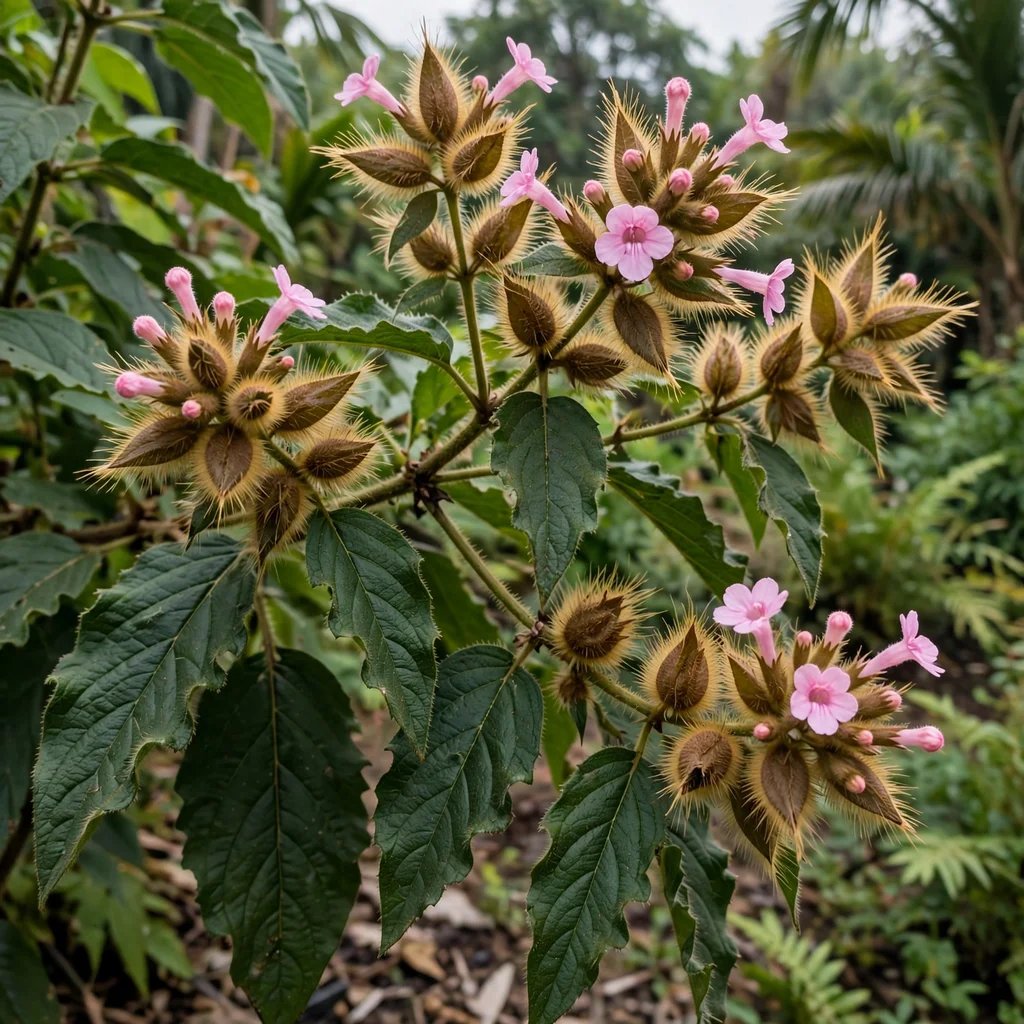
Suessenguthia multisetosa is an evergreen shrub from Bolivia's wet forests and streambanks, with stout erect basal stems and long flexible stems that arch outward and root where they touch moist ground. The foliage is opposite, dark green and large at 5 to 10 inches long, elliptical-ovate with wavy toothed margins, a pointed tip and short stiff hairs.
It carries terminal branched thyrse clusters with ovate bracts, the bracts and calyces covered in long golden bristles. The flowers are 2-inch-wide by 3-inch-long funnels of bright purplish-pink with lavender veining, borne spring into summer on shrubs held at 4 to 5 feet or allowed to scramble to 10 to 15 feet with support.
Uses & Benefits:
Essentials
At a Glance
Plant Type
Shrub
Height
60"
Width
60"
Light
Full Sun, Partial Sun
Zones
9, 10
Water
Regular
Humidity
High
Lifespan
Evergreen shrub
Native To
Bolivia
Toxicity
Unknown
Bloom period
Spring – Summer
In flower about 6 months of the year
Planting
How to Grow
- Plant in full coastal sun to bright part shade in well-drained soil after frost danger has passed.
- Water deeply and regularly to keep soil evenly moist; foliage wilts quickly if dry.
- Prune to 4 to 5 feet after the spring bloom to maintain a shrub form, or stake and allow to scramble.
- Move containers indoors or under cover before hard frost; brief exposure to 27 to 28F kills top growth but crowns resprout.
Pro Tip
Keep the root zone evenly moist and never let it dry to flagging; prune back to 4 to 5 feet after bloom to keep it shrubby rather than sprawling.
Keep It Thriving
Care Guide
Do
- Irrigate regularly in warm weather to mimic streambank moisture
- Grow in containers outside zone 9b to move under cover in winter
- Provide support if you want a taller scrambling form
Don't
- Do not let soil dry completely — wilt is rapid and severe
- Do not plant in unirrigated xeric soil
- Do not expose to prolonged freezes below 27F
Seasonal Care Calendar
| Task | Jan | Feb | Mar | Apr | May | Jun | Jul | Aug | Sep | Oct | Nov | Dec |
|---|---|---|---|---|---|---|---|---|---|---|---|---|
| Mulch | ||||||||||||
| Plant | ||||||||||||
| Propagate | ||||||||||||
| Prune | ||||||||||||
| Winter Prep |
Watch Out For
Pests & Diseases
Common Pests
Common Diseases
In the Garden
Landscape Uses & Companions
Landscape Uses
Multiply
Propagation Methods
Good to Know
Common Questions
Bolivian Violet questions
What zones can Bolivian Violet grow in?
Bolivian Violet is hardy in USDA Zones 9–10: in that range it survives winter in the ground. Colder than Zone 9, grow it in a container you can move to shelter for the winter.
When does Bolivian Violet bloom?
Bolivian Violet typically blooms from spring to summer. Exact timing shifts a week or two with your zone — Sow's bloom calendar maps it to your garden.
Does Bolivian Violet need full sun?
Bolivian Violet does best in full sun to part shade. In hot climates, afternoon shade keeps blooms fresher longer.
Keep exploring
Explore the genus
Hardy in your zone?
Grow Bolivian Violet with confidence
See it in a design of your actual yard, get zone-matched care reminders, and track it season by season in your garden journal.