The Story
Plant Bio
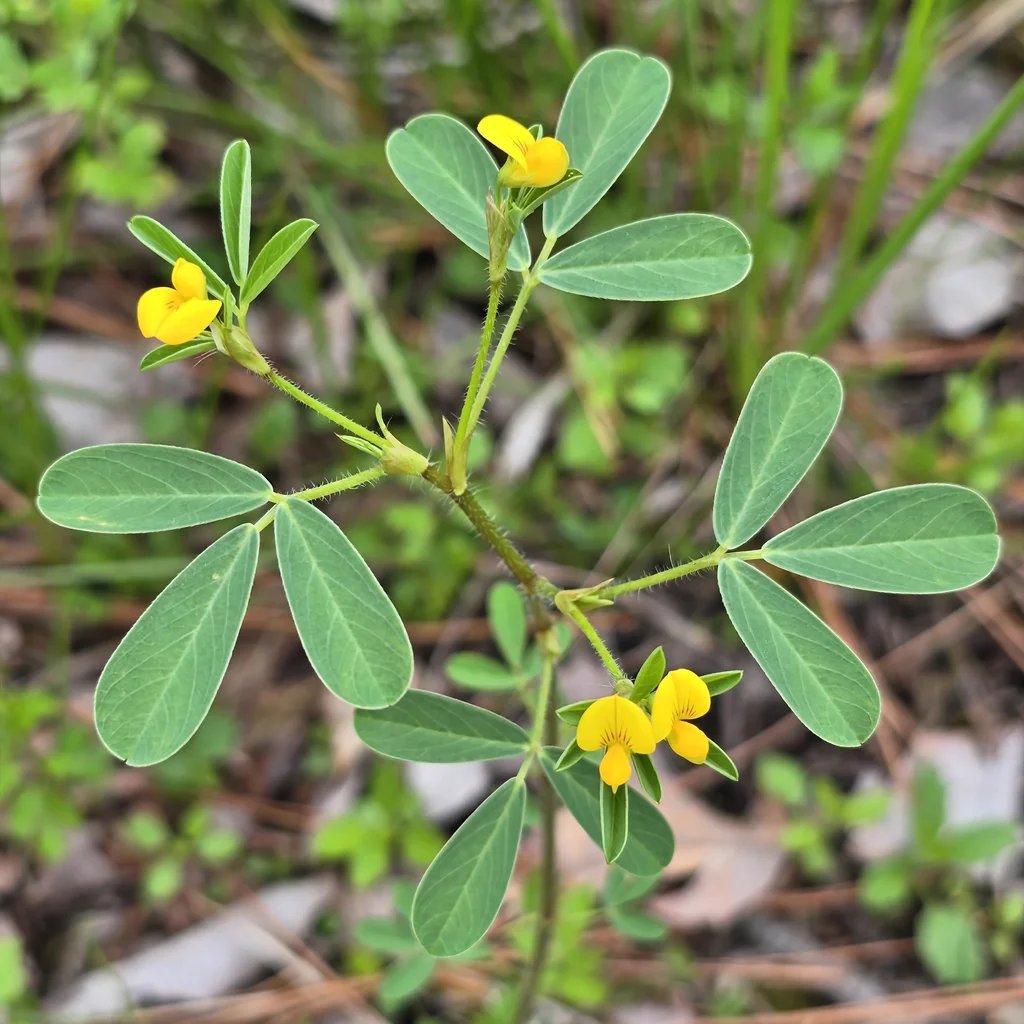
Stylosanthes biflora is a branching perennial legume with one to several erect wiry hairy stems reaching 6 to 18 inches. Its few trifoliate leaves carry very narrowly elliptic leaflets about 1.5 inches long, and its yellow pea flowers are borne singly or in small clusters at the branch ends.
The calyx forms a stalk-like tube around the pistil, giving each yellow-orange flower its pencilflower structure. Leaf undersides show veins paler than the blade, which separates it from similar Desmodium and Lespedeza, and bloom stays sparse from late spring into fall even on healthy plants.
Uses & Benefits:
Essentials
At a Glance
Plant Type
Perennial
Height
18"
Width
12"
Light
Full Sun, Partial Sun
Zones
5
Water
Low
Humidity
Unknown
Lifespan
Perennial
Native To
Central, Eastern and Southeastern USA
Toxicity
Unknown
Bloom period
Late spring – Early fall
In flower about 5 months of the year
Planting
How to Grow
- Set plants in full sun to partial shade in well-drained acidic sand or rocky loam.
- Space 10 to 12 inches apart in low-competition ground with sandstone or gravel near the surface.
- Water to establish, then leave dry; do not enrich the soil or apply nitrogen fertilizer.
- Leave stems to ripen seed and self-sow to maintain the patch.
Pro Tip
Plant in poor acidic sand or rocky loam with low competition and withhold fertilizer; rich soil and added nitrogen favor competitors and weaken it.
Keep It Thriving
Care Guide
Do
- Grow in dry upland spots with poor acidic soil
- Give full sun with room free of aggressive competitors
- Leave seed to self-sow
Don't
- Do not fertilize richly or add nitrogen
- Do not overwater or plant in wet fertile loam
- Do not cut back hard expecting denser rebloom
Seasonal Care Calendar
| Task | Jan | Feb | Mar | Apr | May | Jun | Jul | Aug | Sep | Oct | Nov | Dec |
|---|---|---|---|---|---|---|---|---|---|---|---|---|
| Pest Check | ||||||||||||
| Plant | ||||||||||||
| Propagate | ||||||||||||
| Spring Cleanup |
Watch Out For
Pests & Diseases
Common Pests
Common Diseases
In the Garden
Landscape Uses & Companions
Landscape Uses
Multiply
Propagation Methods
Good to Know
Common Questions
Sidebeak Pencilflower questions
What zones can Sidebeak Pencilflower grow in?
Sidebeak Pencilflower is hardy in USDA Zone 5: in that range it survives winter in the ground. Colder than Zone 5, grow it in a container you can move to shelter for the winter, or as an annual. Warmer than Zone 5, winter isn't the problem: it prefers colder winters, and summer heat can shorten its life.
Is Sidebeak Pencilflower deer resistant?
Not reliably. Deer may browse Sidebeak Pencilflower, especially tender spring growth — plan on repellents or fencing where pressure is high.
When does Sidebeak Pencilflower bloom?
Sidebeak Pencilflower typically blooms from late spring to early fall. Exact timing shifts a week or two with your zone — Sow's bloom calendar maps it to your garden.
Does Sidebeak Pencilflower need full sun?
Sidebeak Pencilflower does best in full sun to part shade. In hot climates, afternoon shade keeps blooms fresher longer.
Is Sidebeak Pencilflower drought tolerant?
Yes — once established (usually after the first full season), Sidebeak Pencilflower handles dry spells with minimal watering. Water deeply its first year to build the root system that makes that possible.
Keep exploring
Explore the genus
Hardy in your zone?
Grow Sidebeak Pencilflower with confidence
See it in a design of your actual yard, get zone-matched care reminders, and track it season by season in your garden journal.