The Story
Plant Bio
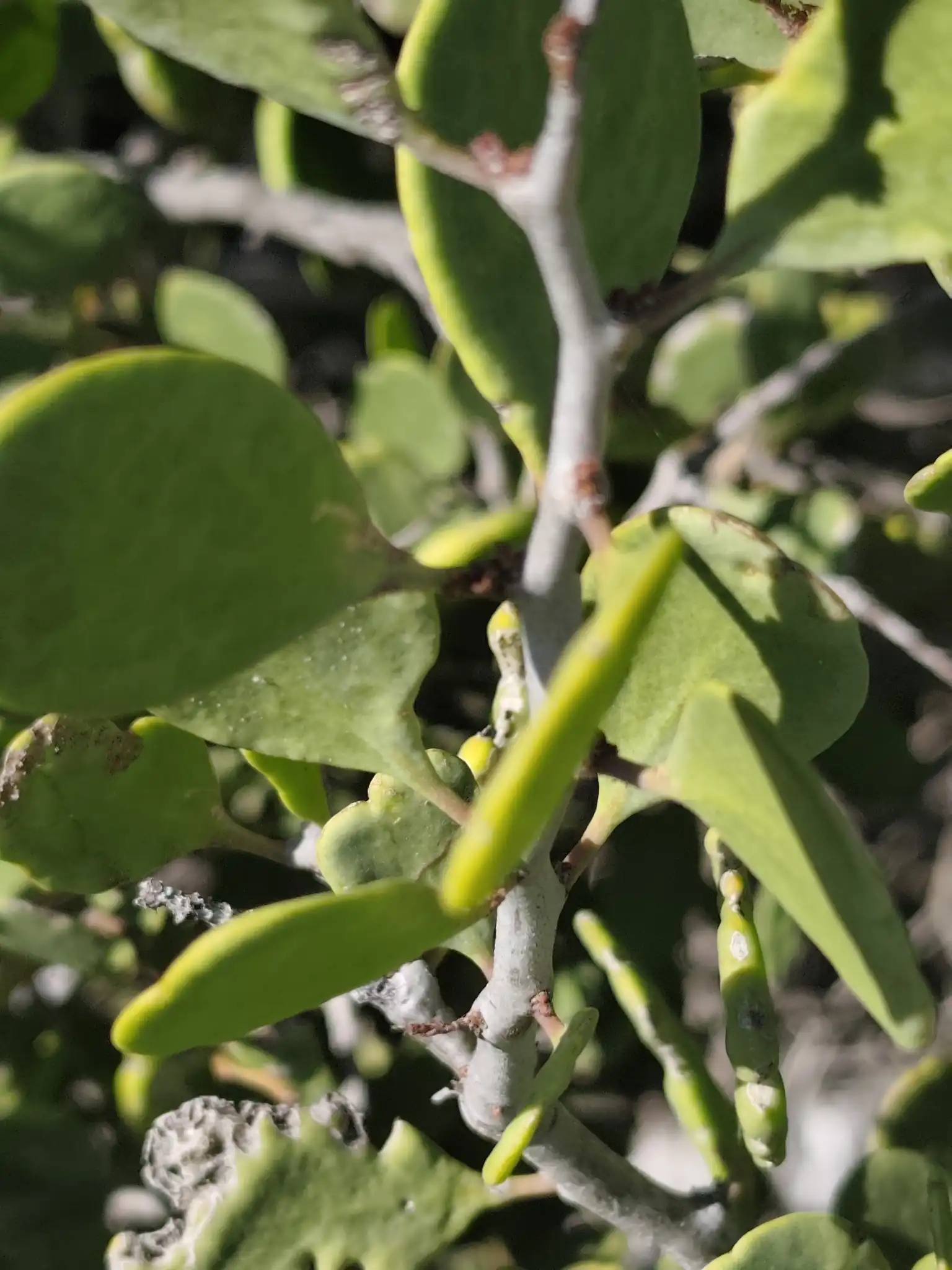
Maytenus phyllanthoides is a long-lived evergreen shrub to small tree reaching 4 to 10 foot in gardens, with dense highly branched stems, light gray bark and reddish young shoots. The leaves are stiff leathery and faintly succulent, elliptic to obovate and 1 to 2 inches long with entire to finely toothed margins on short reddish petioles.
Unlike a true mangrove it grows on dunes, hammocks and clay mounds just above tidal flooding, tolerating salt spray and brackish soil without standing in water and layering where low branches touch soil to form broad thickets. Bloom is small axillary clusters of creamy white-green flowers opening to tan capsules that split to show a red fleshy aril, and nursery plants labeled Tricerma phyllanthoides are the same species.
Uses & Benefits:
Essentials
At a Glance
Plant Type
Shrub
Height
120"
Width
144"
Light
Full Sun, Partial Sun
Zones
8, 9, 10
Water
Low
Humidity
Tolerant of humid coastal air
Lifespan
Long-lived shrub
Native To
Coastal Texas, Florida, Mexico, Bahamas, Cuba
Toxicity
Non-toxic; do not ingest leaves
Bloom period
Spring – Fall
In flower about 9 months of the year
Planting
How to Grow
- Plant in spring after soil warms, in full sun with room for 10 to 12 foot of spread.
- Dig a hole as deep as the container and twice as wide, set the crown level and backfill with native sand, clay or loam.
- Water deeply at planting, then water low through the first year, increasing only in the hottest months.
- Mulch 2 to 3 inches with pine bark or leaf mulch, kept back from the stems.
- Leave unpruned except to remove dead tips after winter cold.
Pro Tip
Give it full sun and its full 10 to 12 foot spread from the start; shade or shearing leaves it open and leggy, and growth is slow at first then faster with age and summer water.
Keep It Thriving
Care Guide
Do
- Plant in full sun on a saline or drought-prone coastal site
- Allow low branches to layer and form a thicket for birds and butterflies
- Water sparingly once established
Don't
- Do not plant in shade or crowd against a walk where its spread will force shearing
- Do not shear annually into a tight hedge; thin selectively if needed
- Do not overwater or keep the crown constantly wet
Seasonal Care Calendar
| Task | Jan | Feb | Mar | Apr | May | Jun | Jul | Aug | Sep | Oct | Nov | Dec |
|---|---|---|---|---|---|---|---|---|---|---|---|---|
| Mulch | ||||||||||||
| Pest Check | ||||||||||||
| Plant | ||||||||||||
| Propagate | ||||||||||||
| Prune |
Watch Out For
Pests & Diseases
Common Pests
Common Diseases
In the Garden
Landscape Uses & Companions
Landscape Uses
Multiply
Propagation Methods
Good to Know
Common Questions
Florida Mayten questions
What zones can Florida Mayten grow in?
Florida Mayten is hardy in USDA Zones 8–10: in that range it survives winter in the ground. Colder than Zone 8, grow it in a container you can move to shelter for the winter.
When does Florida Mayten bloom?
Florida Mayten typically blooms from spring to fall. Exact timing shifts a week or two with your zone — Sow's bloom calendar maps it to your garden.
Does Florida Mayten need full sun?
Florida Mayten does best in full sun to part shade. In hot climates, afternoon shade keeps blooms fresher longer.
Is Florida Mayten drought tolerant?
Yes — once established (usually after the first full season), Florida Mayten handles dry spells with minimal watering. Water deeply its first year to build the root system that makes that possible.
Keep exploring
Explore the genus
Hardy in your zone?
Grow Florida Mayten with confidence
See it in a design of your actual yard, get zone-matched care reminders, and track it season by season in your garden journal.