The Story
Plant Bio
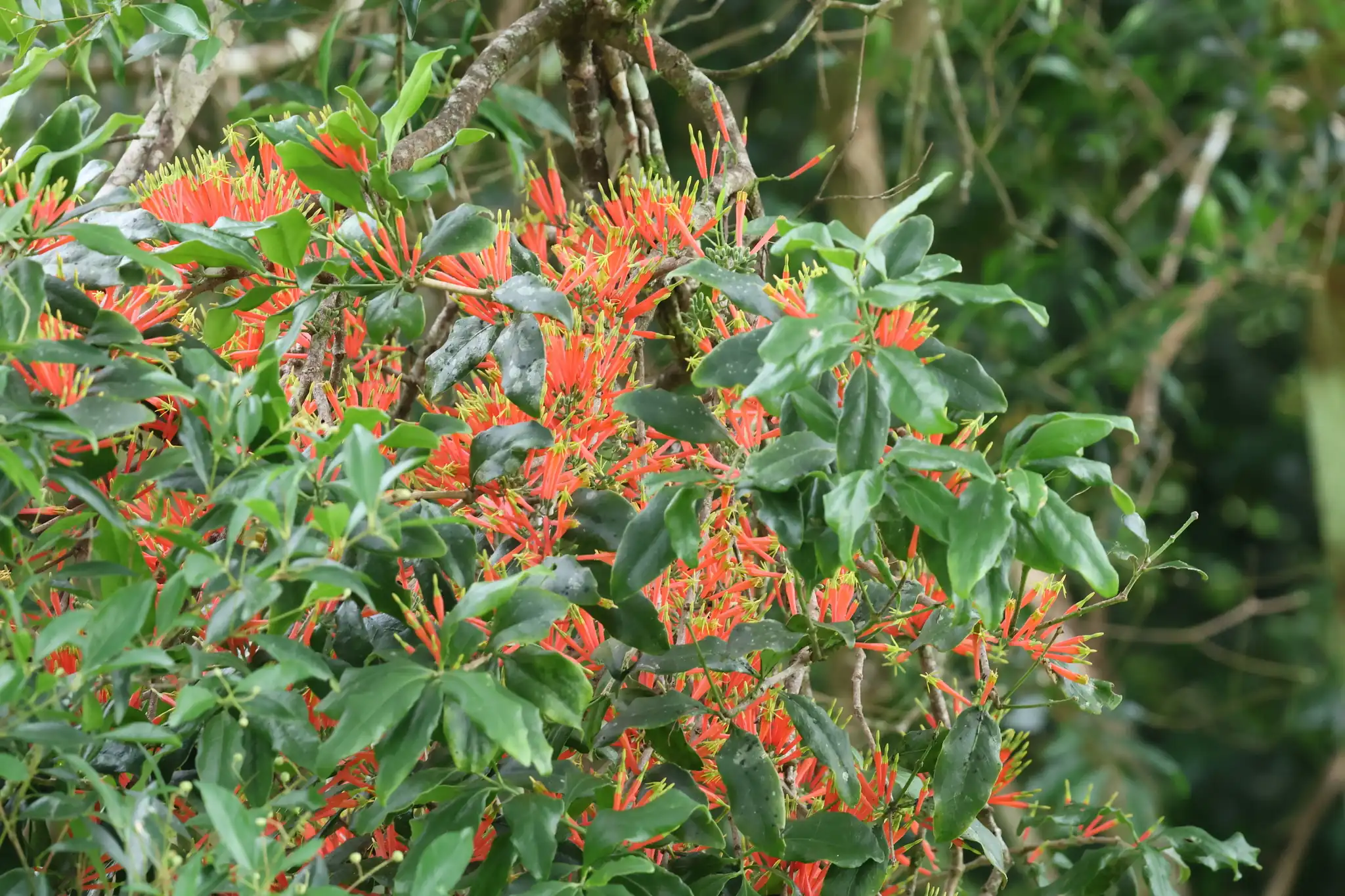
Amylotheca dictyophleba is a weeping, aerial stem-parasitic shrub native to tropical and subtropical rainforest environments. The plant grows suspended from host tree branches, producing glossy lance-shaped leaves with distinct net-like venation and corky bark on mature stems.
The species produces tubular red-to-coral flowers that swell in the middle before opening to reveal green and yellow tips. Specialized root-like structures called haustoria penetrate the host tree bark to extract water and mineral nutrients directly from its sap.
Uses & Benefits:
Essentials
At a Glance
Plant Type
Shrub
Height
79"
Width
79"
Light
Full Sun, Partial Sun
Zones
10
Water
Low (relies on host)
Humidity
High
Lifespan
Perennial
Native To
Australia, Oceania
Toxicity
Non-toxic
Bloom period
Summer
In flower about 3 months of the year
Planting
How to Grow
- Select a mature, healthy rainforest host tree in a warm conservatory or frost-free climate.
- Obtain fresh berries and press the sticky seeds onto the smooth bark of upper host branches.
- Provide high atmospheric humidity to prevent the germinating seed radicle from drying out.
- Maintain optimal water and soil nutrients for the host tree to support both organisms.
Pro Tip
Never prune into the attachment union or cut away the host branch beneath the parasite, as disturbing the haustorial connection will kill the plant.
Keep It Thriving
Care Guide
Do
- Ensure high humidity levels around the canopy.
- Keep host trees well-watered and healthy.
Don't
- Do not plant seeds in soil or potting media.
- Do not prune host branches at the haustorial junction.
Seasonal Care Calendar
| Task | Jan | Feb | Mar | Apr | May | Jun | Jul | Aug | Sep | Oct | Nov | Dec |
|---|---|---|---|---|---|---|---|---|---|---|---|---|
| Pest Check | ||||||||||||
| Propagate | ||||||||||||
| Prune | ||||||||||||
| Winter Prep |
Watch Out For
Pests & Diseases
Common Pests
Common Diseases
In the Garden
Landscape Uses & Companions
Landscape Uses
Companion Plants
Multiply
Propagation Methods
Good to Know
Common Questions
Brush Mistletoe questions
What zones can Brush Mistletoe grow in?
Brush Mistletoe is hardy in USDA Zone 10: in that range it survives winter in the ground. Colder than Zone 10, grow it in a container you can move to shelter for the winter.
When does Brush Mistletoe bloom?
Brush Mistletoe typically blooms in summer. Exact timing shifts a week or two with your zone — Sow's bloom calendar maps it to your garden.
Does Brush Mistletoe need full sun?
Brush Mistletoe does best in full sun to part shade. In hot climates, afternoon shade keeps blooms fresher longer.
Keep exploring
Explore the genus
Hardy in your zone?
Grow Brush Mistletoe with confidence
See it in a design of your actual yard, get zone-matched care reminders, and track it season by season in your garden journal.