The Story
Plant Bio
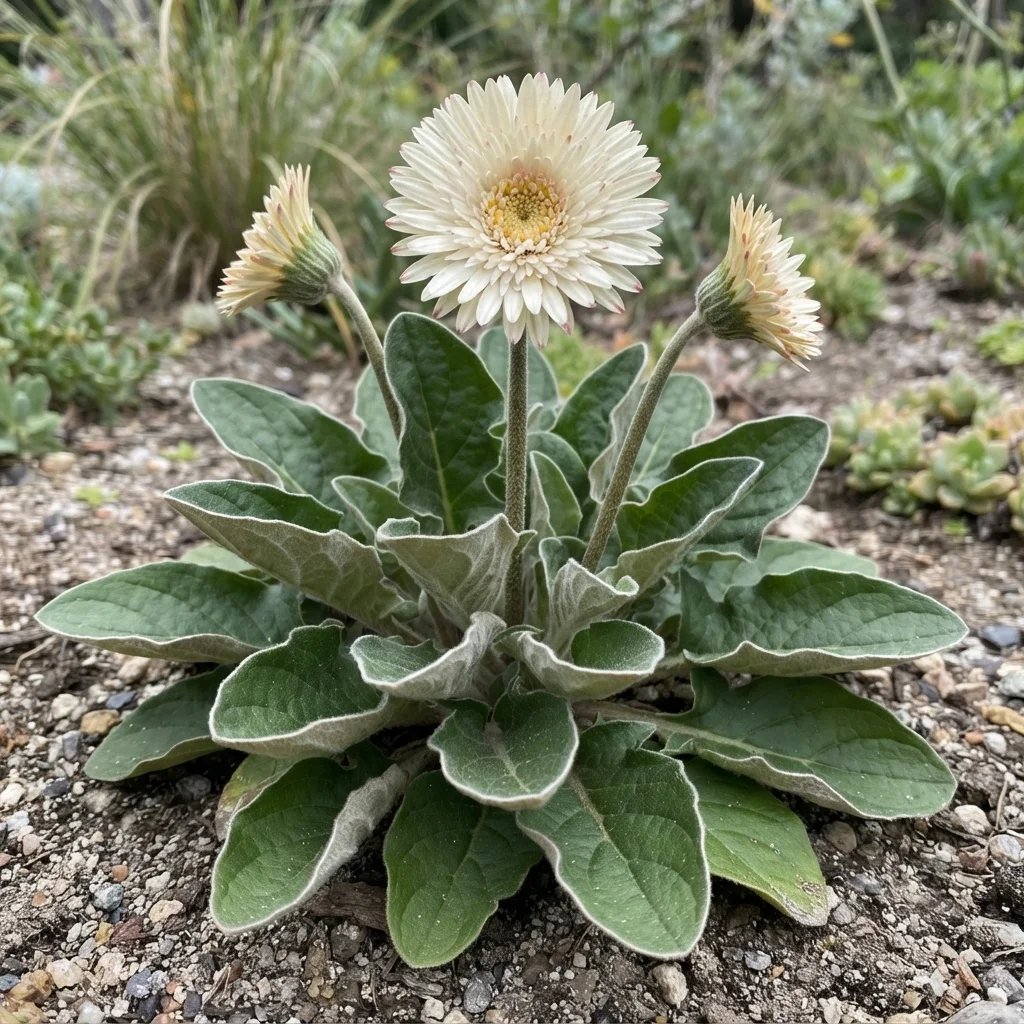
Gerbera leandrii is a tender perennial rosette plant endemic to Madagascar, forming compact clumps of elongated, deeply lobed basal leaves with pubescent undersides. The daisy-like flowers feature variable red, orange, or yellow ray florets surrounding contrasting central disks, borne singly on leafless, upright stems above the foliage.
This species is distinguished by its bright green emerging foliage and highly textured, hairy leaf petioles. Unlike common hybrid cultivars, it retains a wild, species-typical growth habit while offering a long blooming period from spring through fall.
Uses & Benefits:
Essentials
At a Glance
Plant Type
Perennial
Height
18"
Width
16"
Light
Full Sun, Partial Sun
Zones
9, 10
Water
Moderate
Humidity
Moderate
Lifespan
Perennial
Native To
Madagascar
Toxicity
Non-toxic
Bloom period
Spring – Fall
In flower about 9 months of the year
Planting
How to Grow
- Select a planting site with rich, sandy loam that drains rapidly, or use a raised bed to ensure high drainage.
- Position the plant so the crown sits one-quarter inch above the surrounding soil level to prevent water accumulation.
- Water consistently to keep the soil evenly moist but never saturated during the active spring and summer growing seasons.
- Overwinter container specimens in a cool, dry indoor location, reducing water significantly to prevent cold-season rot.
Pro Tip
Plant the crown slightly above the soil line; burying the crown traps moisture at the base and rapidly induces fatal Phytophthora or Pythium rot.
Keep It Thriving
Care Guide
Do
- Deadhead spent flower stalks weekly by cutting them cleanly at the base of the plant.
- Ensure excellent air circulation around the basal rosette to minimize powdery mildew.
- Apply a balanced, water-soluble fertilizer lightly every four to six weeks during active growth.
Don't
- Do not bury the central crown below the soil level when planting or mulching.
- Do not overwater or allow the roots to sit in standing, waterlogged soil.
- Do not shear the foliage or cut into the central crown during routine cleanup.
Seasonal Care Calendar
| Task | Jan | Feb | Mar | Apr | May | Jun | Jul | Aug | Sep | Oct | Nov | Dec |
|---|---|---|---|---|---|---|---|---|---|---|---|---|
| Deadhead | ||||||||||||
| Divide | ||||||||||||
| Fertilize | ||||||||||||
| Pest Check | ||||||||||||
| Winter Prep |
Watch Out For
Pests & Diseases
Common Pests
Common Diseases
In the Garden
Landscape Uses & Companions
Landscape Uses
Multiply
Propagation Methods
Good to Know
Common Questions
Madagascar Gerbera Daisy questions
What zones can Madagascar Gerbera Daisy grow in?
Madagascar Gerbera Daisy is hardy in USDA Zones 9–10: in that range it survives winter in the ground. Colder than Zone 9, grow it in a container you can move to shelter for the winter, or as an annual.
Is Madagascar Gerbera Daisy deer resistant?
Not reliably. Deer may browse Madagascar Gerbera Daisy, especially tender spring growth — plan on repellents or fencing where pressure is high.
When does Madagascar Gerbera Daisy bloom?
Madagascar Gerbera Daisy typically blooms from spring to fall. Exact timing shifts a week or two with your zone — Sow's bloom calendar maps it to your garden.
Does Madagascar Gerbera Daisy need full sun?
Madagascar Gerbera Daisy does best in full sun to part shade. In hot climates, afternoon shade keeps blooms fresher longer.
More Gerbera to compare
Keep exploring
Explore the genus
Hardy in your zone?
Grow Madagascar Gerbera Daisy with confidence
See it in a design of your actual yard, get zone-matched care reminders, and track it season by season in your garden journal.