The Story
Plant Bio
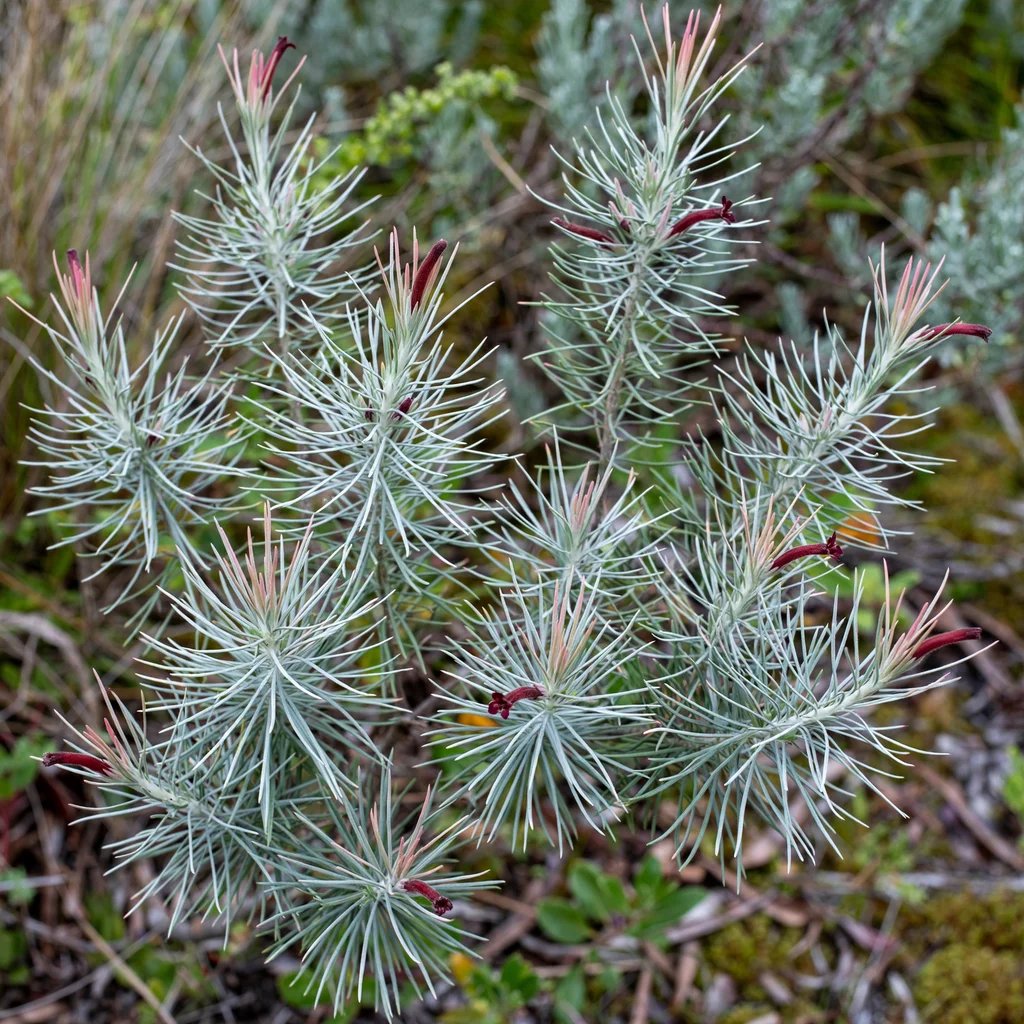
Adenanthos x cunninghamii is an evergreen shrub from southwestern Western Australia, forming a densely branched mound of soft, finely divided foliage. The leaves are split into six to eight hair-like segments that read silvery blue-green with silver undersides, flushed pink to red on the new tips.
It is a natural hybrid grown for foliage rather than flower, the small dull crimson tubes sitting singly at the branch tips and largely hidden among the leaves. In cultivation it holds a bushy sprawling-mounding habit to about five feet tall by seven feet wide in California gardens.
Uses & Benefits:
Essentials
At a Glance
Plant Type
Shrub
Height
60"
Width
83"
Light
Full Sun
Zones
8, 9
Water
Low
Humidity
Low
Lifespan
Long-lived shrub
Native To
Southwest Western Australia
Toxicity
Unknown
Bloom period
Fall – Spring
In flower about 9 months of the year
Planting
How to Grow
- Plant in full sun in very well-drained light sandy soil with the crown level with the soil surface.
- Water deeply at planting, then water sparingly once established; it does not tolerate wet feet.
- Feed rarely or not at all, and only with a low-phosphorus native fertilizer.
- Tip-trim lightly after flowering to keep the mound dense, without cutting hard into old leafless wood.
- Give it open air and space; it dislikes high humidity and crowded, damp planting.
Pro Tip
Plant it for the silver foliage and give it sun, sand and drainage; wet soil and standard high-phosphorus fertilizer kill it faster than cold.
Keep It Thriving
Care Guide
Do
- Plant in full sun with sharp drainage and sandy soil.
- Water to establish, then keep on the dry side.
- Use only low-phosphorus fertilizer or none.
- Trim lightly after flowering to maintain a dense mound.
Don't
- Do not plant in clay, low spots, or soil that stays wet.
- Do not use standard high-phosphorus fertilizers.
- Do not cut hard back into old leafless wood.
- Do not crowd into humid, poorly ventilated spots.
Seasonal Care Calendar
| Task | Jan | Feb | Mar | Apr | May | Jun | Jul | Aug | Sep | Oct | Nov | Dec |
|---|---|---|---|---|---|---|---|---|---|---|---|---|
| Fertilize | ||||||||||||
| Mulch | ||||||||||||
| Pest Check | ||||||||||||
| Plant | ||||||||||||
| Prune |
Watch Out For
Pests & Diseases
Common Pests
Common Diseases
In the Garden
Landscape Uses & Companions
Landscape Uses
Multiply
Propagation Methods
Good to Know
Common Questions
Albany Woollybush questions
What zones can Albany Woollybush grow in?
Albany Woollybush is hardy in USDA Zones 8–9: in that range it survives winter in the ground. Colder than Zone 8, grow it in a container you can move to shelter for the winter. Warmer than Zone 9, winter isn't the problem: it prefers colder winters, and summer heat can shorten its life.
When does Albany Woollybush bloom?
Albany Woollybush typically blooms from fall to spring. Exact timing shifts a week or two with your zone — Sow's bloom calendar maps it to your garden.
Does Albany Woollybush need full sun?
Albany Woollybush does best in full sun (6+ hours).
Is Albany Woollybush drought tolerant?
Yes — once established (usually after the first full season), Albany Woollybush handles dry spells with minimal watering. Water deeply its first year to build the root system that makes that possible.
More Adenanthos to compare
Keep exploring
Explore the genus
Hardy in your zone?
Grow Albany Woollybush with confidence
See it in a design of your actual yard, get zone-matched care reminders, and track it season by season in your garden journal.