The Story
Plant Bio
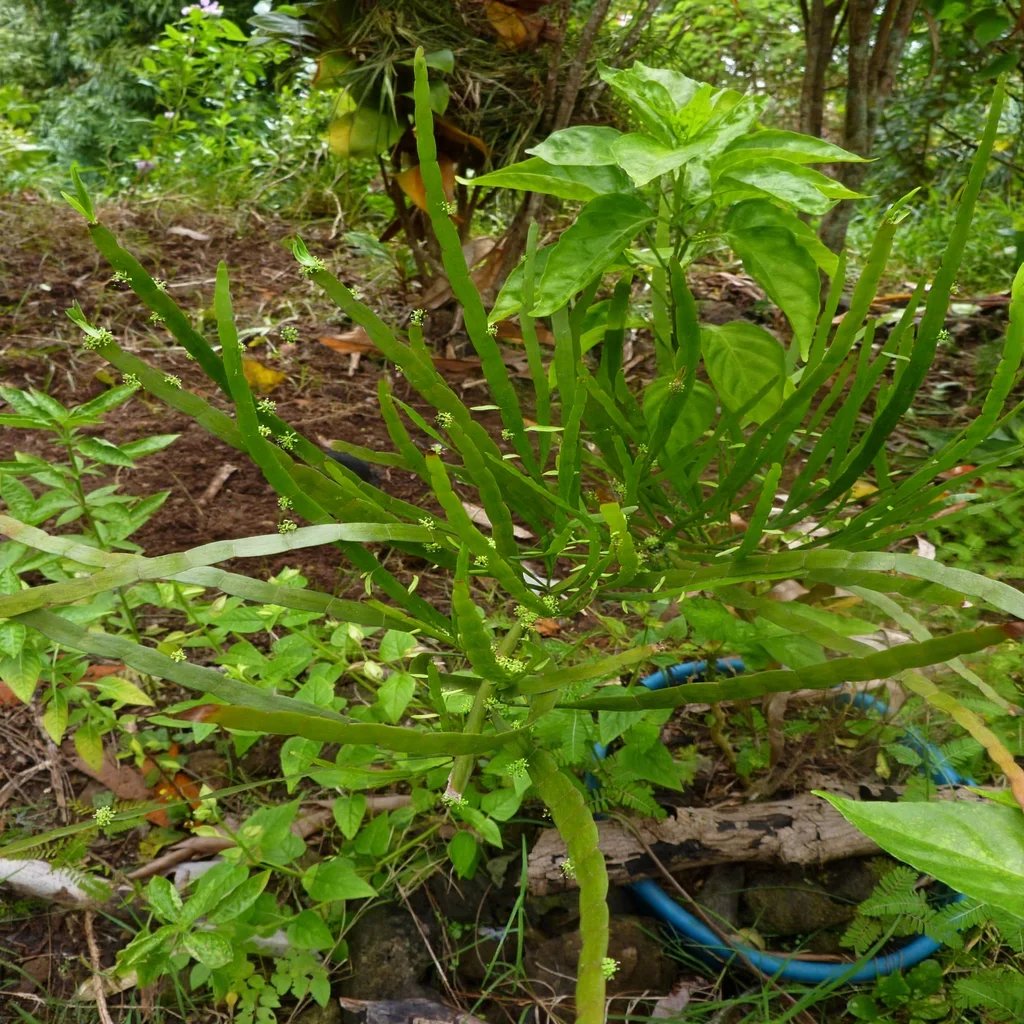
Homalocladium platycladum is an evergreen scrambling shrub from New Guinea and the Solomon Islands, reaching four to eight feet in the garden and far higher with support from rounded brown older stems that produce flat jointed green wands. The wands are photosynthetic platyclades one-half to three-quarters of an inch wide, mostly leafless except for small leaves on new growth.
What reads as foliage is stem tissue; tiny greenish-white flowers nest directly in the joints of the ribbons in late fall through winter, followed by small red berries. Midday sun yellows the ribbons while shade keeps them dark green, and the plant climbs with support but cascades or scrambles without it.
Uses & Benefits:
Essentials
At a Glance
Plant Type
Shrub
Height
72"
Width
36"
Light
Full Sun, Partial Sun, Shade
Zones
9, 10
Water
Medium
Humidity
High
Lifespan
Long-lived shrub
Native To
New Guinea, Solomon Islands
Toxicity
Mildly toxic
Bloom period
Late fall – Winter
In flower about 4 months of the year
Planting
How to Grow
- Plant outdoors in Zones 9-12 after last frost, or grow as a houseplant elsewhere in a bright room.
- Set in full sun to shade with protection from hot midday sun to keep ribbons dark green.
- Plant in ordinary to enriched, well-drained soil that is mildly acidic to mildly alkaline; water to keep evenly moist, allowing the top to dry between waterings.
- Provide a trellis or stake for climbing growth, or leave unsupported to cascade and scramble to about 3 feet wide.
- Move containers indoors before frost and hold above freezing through winter.
Pro Tip
Give afternoon shade to hold deep green color and tie wands to a stake or trellis if upright growth is wanted; unsupported stems arch and scramble.
Keep It Thriving
Care Guide
Do
- Do provide afternoon shade in hot climates to prevent yellowing.
- Do water regularly while allowing drainage; established plants in shade tolerate dry spells.
- Do prune to control scramble; plants resprout rapidly, including from the base after cold damage.
Don't
- Do not leave outdoors below 25F without protection; foliage is frost sensitive.
- Do not overwater or leave pots waterlogged.
- Do not expect true leaves; yellow flat stems signal too much midday sun, not nutrient failure.
Seasonal Care Calendar
| Task | Jan | Feb | Mar | Apr | May | Jun | Jul | Aug | Sep | Oct | Nov | Dec |
|---|---|---|---|---|---|---|---|---|---|---|---|---|
| Fertilize | ||||||||||||
| Pest Check | ||||||||||||
| Plant | ||||||||||||
| Prune | ||||||||||||
| Winter Prep |
Watch Out For
Pests & Diseases
Common Pests
Common Diseases
In the Garden
Landscape Uses & Companions
Landscape Uses
Companion Plants
Multiply
Propagation Methods
Good to Know
Common Questions
Ribbon Bush questions
What zones can Ribbon Bush grow in?
Ribbon Bush is hardy in USDA Zones 9–10: in that range it survives winter in the ground. Colder than Zone 9, grow it in a container you can move to shelter for the winter.
When does Ribbon Bush bloom?
Ribbon Bush typically blooms from late fall to late winter. Exact timing shifts a week or two with your zone — Sow's bloom calendar maps it to your garden.
Does Ribbon Bush need full sun?
Ribbon Bush does best in full sun to part shade. In hot climates, afternoon shade keeps blooms fresher longer.
Is Ribbon Bush drought tolerant?
Yes — once established (usually after the first full season), Ribbon Bush handles dry spells with minimal watering. Water deeply its first year to build the root system that makes that possible.
Keep exploring
Explore the genus
Hardy in your zone?
Grow Ribbon Bush with confidence
See it in a design of your actual yard, get zone-matched care reminders, and track it season by season in your garden journal.