The Story
Plant Bio
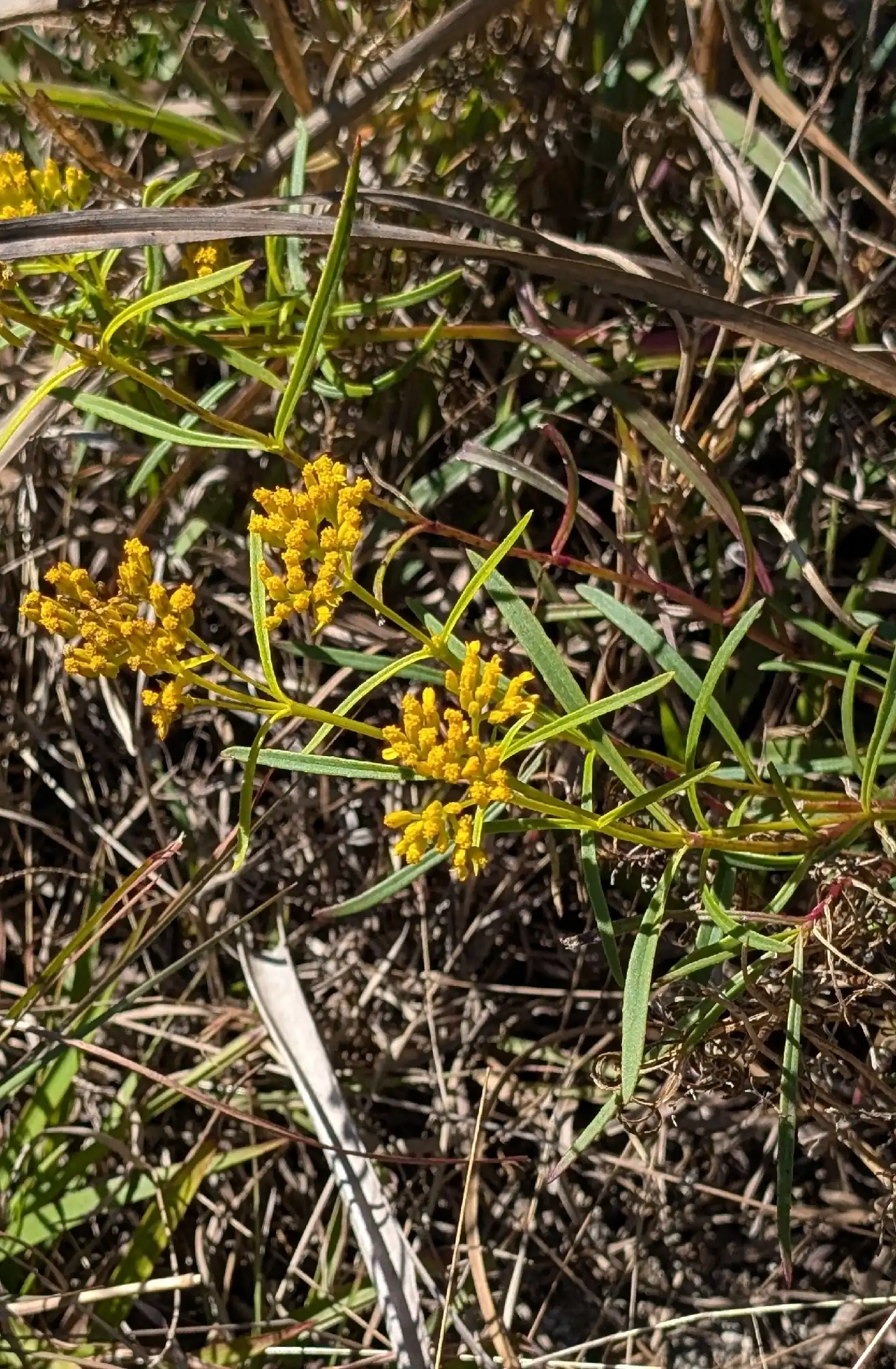
Flaveria linearis is an evergreen perennial forming a low sprawling mound of long narrow leaves with tall erect stalks to about three feet. The display is a showy flat-topped corymb of many tiny bright yellow flowers without rays, carried well above the foliage.
Leaves are linear, entire and glabrous with a single prominent vein, which separates it from the weedy Flaveria bidentis with toothed hairy leaves with three veins. Mature clumps run wider than tall to about four feet across and live on in sandy or limestone ground.
Uses & Benefits:
Essentials
At a Glance
Plant Type
Perennial
Height
36"
Width
48"
Light
Full Sun, Partial Sun
Zones
8, 9, 10
Water
Low
Humidity
Tolerant of Florida humidity
Lifespan
Short- to long-lived perennial
Native To
Peninsular Florida, Bahamas, Cuba, Yucatan Peninsula
Toxicity
Unknown - no toxicity data
Bloom period
Year round
In flower about 12 months of the year
Planting
How to Grow
- Plant in full sun to light partial shade in sandy or limestone soil that drains freely.
- Space to allow four feet of spread, as clumps grow wider than tall.
- Water to establish, then cut back; plants tolerate heat, humidity and drought once rooted.
- Leave room for tall flower stalks above the low leaf mound where year-round bloom feeds pollinators.
Pro Tip
Check the leaf before you buy: one smooth vein and entire edge means narrowleaf yellowtops, three veins with teeth and hairs means the weedy Flaveria bidentis.
Keep It Thriving
Care Guide
Do
- Give full sun and open air in coastal or low inland sites.
- Grow in sand or limestone that drains after rain.
- Leave spent heads for seed where spread is wanted.
Don't
- Do not plant in heavy clay that holds water around the crown.
- Do not let toothed three-veined seedlings establish; pull them as weeds.
- Do not overwater once established.
Seasonal Care Calendar
| Task | Jan | Feb | Mar | Apr | May | Jun | Jul | Aug | Sep | Oct | Nov | Dec |
|---|---|---|---|---|---|---|---|---|---|---|---|---|
| Deadhead | ||||||||||||
| Mulch | ||||||||||||
| Pest Check | ||||||||||||
| Plant | ||||||||||||
| Propagate |
Watch Out For
Pests & Diseases
Common Pests
Common Diseases
In the Garden
Landscape Uses & Companions
Landscape Uses
Multiply
Propagation Methods
Good to Know
Common Questions
Narrowleaf Yellowtops questions
What zones can Narrowleaf Yellowtops grow in?
Narrowleaf Yellowtops is hardy in USDA Zones 8–10: in that range it survives winter in the ground. Colder than Zone 8, grow it in a container you can move to shelter for the winter, or as an annual.
When does Narrowleaf Yellowtops bloom?
Narrowleaf Yellowtops typically blooms year-round. Exact timing shifts a week or two with your zone — Sow's bloom calendar maps it to your garden.
Does Narrowleaf Yellowtops need full sun?
Narrowleaf Yellowtops does best in full sun to part shade. In hot climates, afternoon shade keeps blooms fresher longer.
Is Narrowleaf Yellowtops drought tolerant?
Yes — once established (usually after the first full season), Narrowleaf Yellowtops handles dry spells with minimal watering. Water deeply its first year to build the root system that makes that possible.
Keep exploring
Explore the genus
Hardy in your zone?
Grow Narrowleaf Yellowtops with confidence
See it in a design of your actual yard, get zone-matched care reminders, and track it season by season in your garden journal.