The Story
Plant Bio
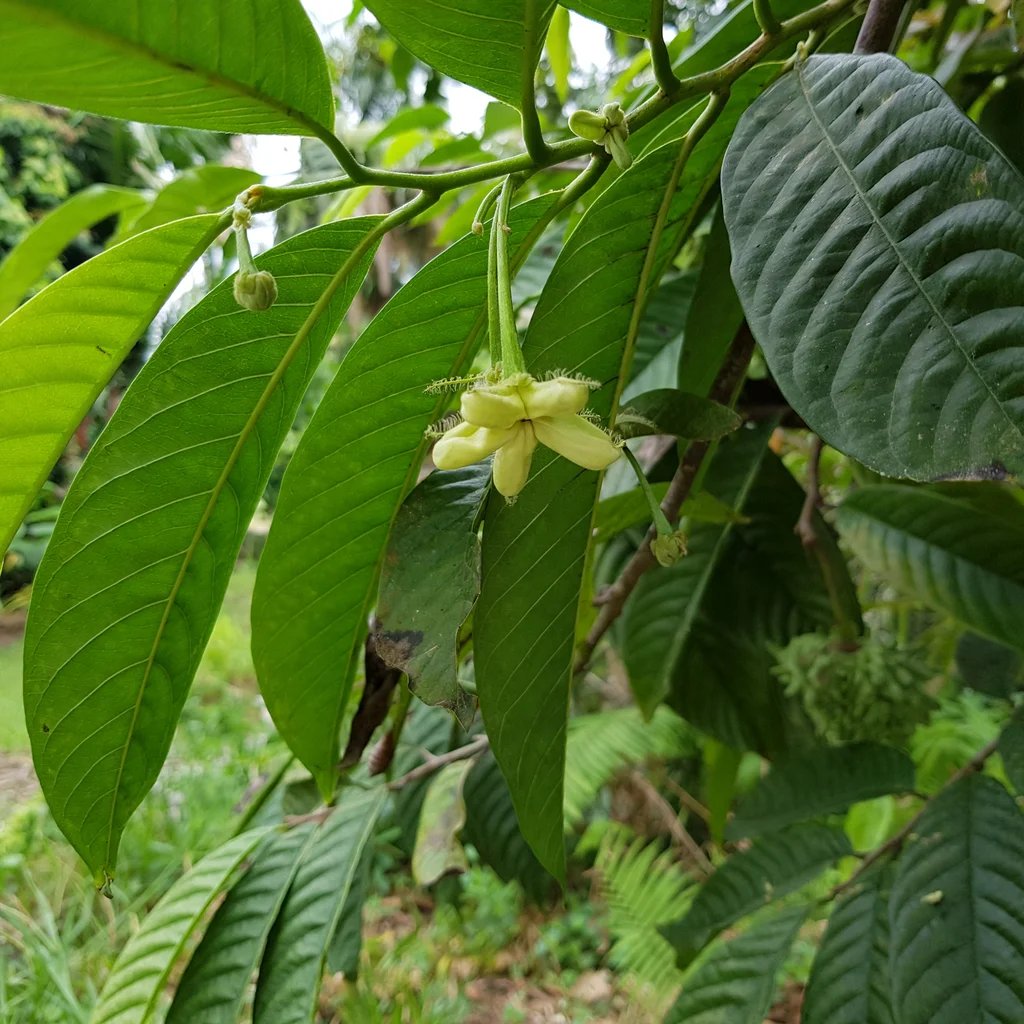
Annona mucosa, sold as Rollinia deliciosa, is a fast-growing evergreen tree reaching 10 to 20 feet in South Florida gardens with an open spreading crown and dark green oblong leaves to 14 inches long. The green to yellowish-white flowers have three hairy sepals and three fleshy outer petals borne singly in the leaf axils and are scented for night-active beetles.
It differs from cherimoya and sugar-apple in requiring constant heat above 41 degrees and high humidity for pollination, with only about one-third of flowers setting fruit even when beetles are present. Seedlings flower in 18 months to two years and fruit in three to four years, but need steady water during flowering and fruit set to prevent premature ripening.
Uses & Benefits:
Essentials
At a Glance
Plant Type
Tree
Height
240"
Width
156"
Light
Full Sun, Partial Sun, Shade
Zones
10
Water
High
Humidity
High
Lifespan
Long-lived tree
Native To
Western Amazon Basin, South America
Toxicity
Seeds toxic if ingested
Bloom period
Spring – Summer
In flower about 6 months of the year
Planting
How to Grow
- Plant in full sun to partial shade in a warm sheltered frost-free spot with rich well-drained soil.
- Water regularly through spring flowering and summer fruit development and do not let the soil dry out.
- Prune annually to maintain 13 to 26 feet and an open canopy for airflow and picking.
- Cover with frost cloth the day before a freeze; young trees are killed near 37 degrees.
Pro Tip
Water deeply and steadily through flowering and fruit set and keep air humid; dry soil and dry air cause poor set and early ripening, and hand-pollination lifts set where beetles are scarce.
Keep It Thriving
Care Guide
Do
- Water deeply during flowering and fruit set to avoid premature ripening.
- Mulch to hold soil moisture and keep humidity high around the canopy.
- Hand-pollinate flowers in the evening where beetles are scarce to improve set.
Don't
- Do not eat the seeds; they contain cytotoxic compounds and only the pulp is eaten.
- Do not plant where winter drops below 41 degrees or frost settles.
- Do not let soil dry out while fruit is sizing.
Seasonal Care Calendar
| Task | Jan | Feb | Mar | Apr | May | Jun | Jul | Aug | Sep | Oct | Nov | Dec |
|---|---|---|---|---|---|---|---|---|---|---|---|---|
| Harvest | ||||||||||||
| Pest Check | ||||||||||||
| Plant | ||||||||||||
| Prune | ||||||||||||
| Winter Prep |
Watch Out For
Pests & Diseases
Common Pests
Common Diseases
In the Garden
Landscape Uses & Companions
Landscape Uses
Multiply
Propagation Methods
Good to Know
Common Questions
Biriba questions
What zones can Biriba grow in?
Biriba is hardy in USDA Zone 10: in that range it survives winter in the ground. Colder than Zone 10, winters are too cold for it to survive outdoors.
When does Biriba bloom?
Biriba typically blooms from spring to summer. Exact timing shifts a week or two with your zone — Sow's bloom calendar maps it to your garden.
Does Biriba need full sun?
Biriba does best in full sun to part shade. In hot climates, afternoon shade keeps blooms fresher longer.
Keep exploring
Explore the genus
Hardy in your zone?
Grow Biriba with confidence
See it in a design of your actual yard, get zone-matched care reminders, and track it season by season in your garden journal.