The Story
Plant Bio
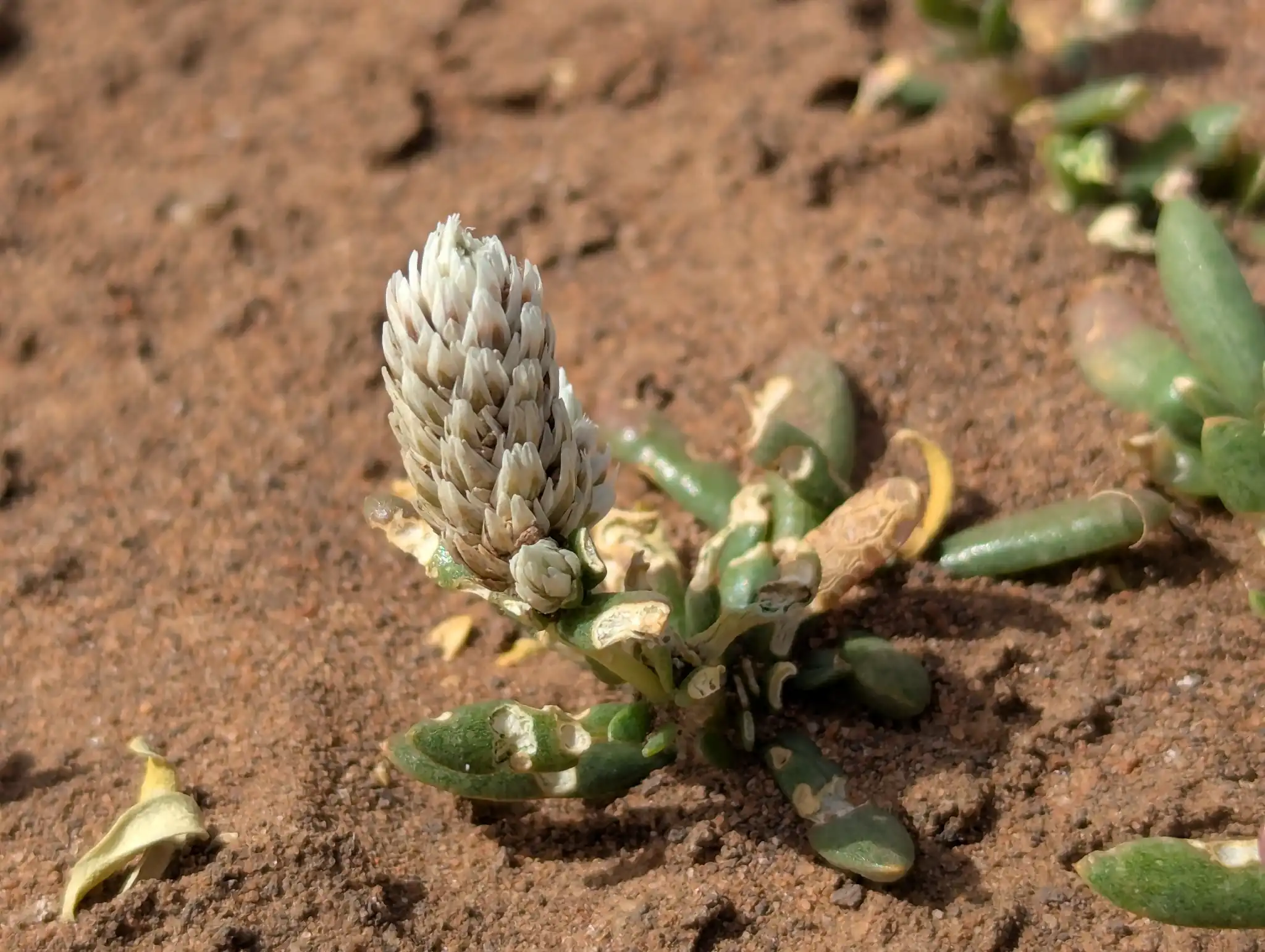
Blutaparon vermiculare is a prostrate perennial of tropical beaches and dunes, rooting at the nodes to form low mats of fleshy opposite leaves. The pinkish jointed stems carry dense globose to cylindric heads of small white flowers that dry silvery white.
It creeps to about six feet across, with narrow linear to club-shaped succulent leaves one-half to two inches long. The white heads bloom year round in frost-free sites in saline sand just above sea level, where the plant holds sand rather than performing as a bedding flower.
Uses & Benefits:
Essentials
At a Glance
Plant Type
Groundcover
Height
12"
Width
72"
Light
Full Sun
Zones
8, 9, 10
Water
Low
Humidity
Unknown
Lifespan
Perennial
Native To
Florida, Louisiana, Texas and tropical coasts of the Americas and West Africa
Toxicity
Unknown
Bloom period
Year round
In flower about 12 months of the year
Planting
How to Grow
- Plant in full sun in loose, well-drained beach sand with room to spread.
- Set rooted stem pieces just at the sand surface and firm gently.
- Water in to settle the sand, then keep drainage sharp and avoid standing water.
- Let stems root at the nodes to knit cover and trim edge stems to contain spread.
Pro Tip
Buy it under either Blutaparon vermiculare or Gomphrena vermicularis — the name is in flux and both refer to the same beach creeper, not an upright bedding Gomphrena.
Keep It Thriving
Care Guide
Do
- Plant in full sun in loose, well-drained saline sand.
- Allow stems to root at nodes to stabilize sand.
- Contain edge stems if growth moves beyond bounds.
Don't
- Do not plant in heavy clay or poorly drained soil.
- Do not expect hard frost tolerance inland.
- Do not treat it as an upright bedding Gomphrena.
Seasonal Care Calendar
| Task | Jan | Feb | Mar | Apr | May | Jun | Jul | Aug | Sep | Oct | Nov | Dec |
|---|---|---|---|---|---|---|---|---|---|---|---|---|
| Pest Check | ||||||||||||
| Plant | ||||||||||||
| Propagate | ||||||||||||
| Prune |
Watch Out For
Pests & Diseases
Common Pests
Common Diseases
In the Garden
Landscape Uses & Companions
Landscape Uses
Companion Plants
Multiply
Propagation Methods
Good to Know
Common Questions
Silverhead questions
What zones can Silverhead grow in?
Silverhead is hardy in USDA Zones 8–10: in that range it survives winter in the ground. Colder than Zone 8, grow it in a container you can move to shelter for the winter, or as an annual.
When does Silverhead bloom?
Silverhead typically blooms year-round. Exact timing shifts a week or two with your zone — Sow's bloom calendar maps it to your garden.
Does Silverhead need full sun?
Silverhead does best in full sun (6+ hours).
Keep exploring
Explore the genus
Hardy in your zone?
Grow Silverhead with confidence
See it in a design of your actual yard, get zone-matched care reminders, and track it season by season in your garden journal.