The Story
Plant Bio
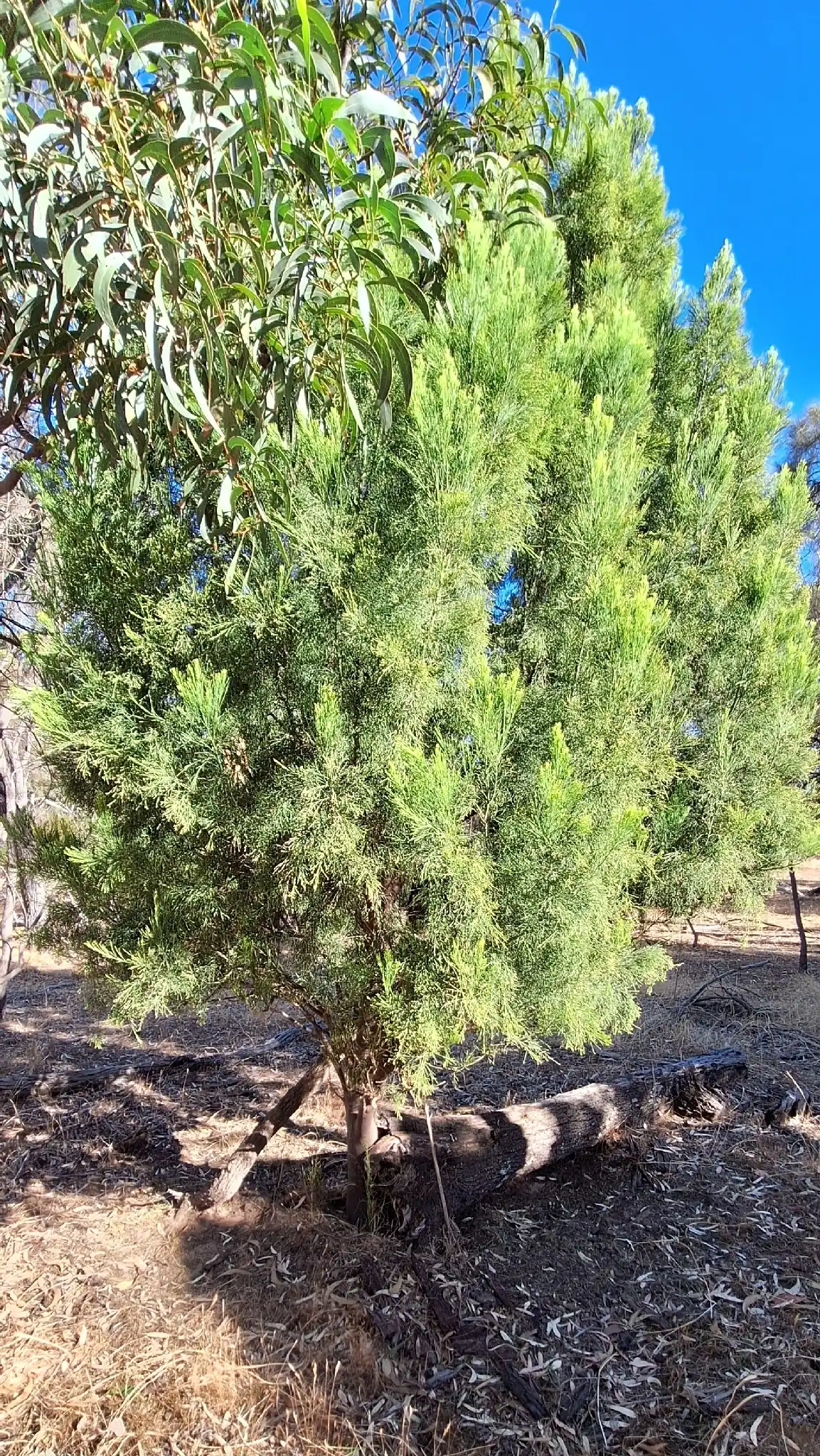
Exocarpos cupressiformis, commonly known as cherry ballart, is an Australian evergreen small tree featuring slender, weeping branchlets that superficially resemble a cypress. The leaves are reduced to minute triangular scales, leaving the ribbed green branchlets to perform the tree's photosynthesis.
It is an obligate root hemiparasite that attaches to host roots during early development to draw water and mineral nutrients. Small greenish-yellow flowers develop into a single hard nut sitting atop a swollen, bright red, edible stem that resembles a external cherry.
Uses & Benefits:
Essentials
At a Glance
Plant Type
Tree
Height
394"
Width
236"
Light
Full Sun, Partial Sun
Zones
9, 10
Water
Low
Humidity
Low to Moderate
Lifespan
Perennial
Native To
Australia
Toxicity
Non-toxic
Bloom period
Spring – Fall
In flower about 9 months of the year
Planting
How to Grow
- Select a site in full sun or light shade adjacent to an established native host tree.
- Ensure the soil provides high drainage, as roots will rot in soggy or waterlogged conditions.
- Plant young plugs directly into the host plant's root zone with minimal root disturbance.
- Water moderately during the first season until the parasitic root connections establish.
- Avoid applying heavy phosphorus or synthetic fertilizers around the root system.
Pro Tip
Plant directly adjacent to an established host tree such as an Acacia or Eucalyptus; standalone specimens inevitably decline and die without root connections.
Keep It Thriving
Care Guide
Do
- Provide well-drained soil with excellent water runoff.
- Plant near appropriate living host trees to support development.
- Tip-prune lightly only on young green branchlets if shaping is required.
Don't
- Do not attempt to cultivate as a standalone specimen without a host plant.
- Do not cut back into old leafless wood, as bare stems will not regenerate.
- Do not overwater or plant in poorly drained clay pockets.
Seasonal Care Calendar
| Task | Jan | Feb | Mar | Apr | May | Jun | Jul | Aug | Sep | Oct | Nov | Dec |
|---|---|---|---|---|---|---|---|---|---|---|---|---|
| Mulch | ||||||||||||
| Pest Check | ||||||||||||
| Plant | ||||||||||||
| Prune |
Watch Out For
Pests & Diseases
Common Pests
Common Diseases
In the Garden
Landscape Uses & Companions
Landscape Uses
Companion Plants
Multiply
Propagation Methods
Good to Know
Common Questions
Cherry Ballart questions
What zones can Cherry Ballart grow in?
Cherry Ballart is hardy in USDA Zones 9–10: in that range it survives winter in the ground. Colder than Zone 9, winters are too cold for it to survive outdoors.
When does Cherry Ballart bloom?
Cherry Ballart typically blooms from spring to fall. Exact timing shifts a week or two with your zone — Sow's bloom calendar maps it to your garden.
Does Cherry Ballart need full sun?
Cherry Ballart does best in full sun to part shade. In hot climates, afternoon shade keeps blooms fresher longer.
Is Cherry Ballart drought tolerant?
Yes — once established (usually after the first full season), Cherry Ballart handles dry spells with minimal watering. Water deeply its first year to build the root system that makes that possible.
Keep exploring
Explore the genus
Hardy in your zone?
Grow Cherry Ballart with confidence
See it in a design of your actual yard, get zone-matched care reminders, and track it season by season in your garden journal.